
The Design of Design Studio. What is service design by the way? Could Better Design Reform The Banking Industry? While Occupy protesters are holding sit-ins in foreclosed homes and pledging to default on their student loans, Madison Avenue, too, is targeting Wall Street’s abusive practices.
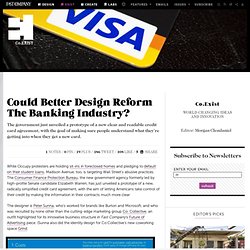
The Consumer Finance Protection Bureau, the new government agency formerly led by high-profile Senate candidate Elizabeth Warren, has just unveiled a prototype of a new, radically simplified credit card agreement, with the aim of letting Americans take control of their credit by making the information in their contracts much more clear The designer is Peter Sunna, who’s worked for brands like Burton and Microsoft, and who was recruited by none other than the cutting-edge marketing group Co: Collective, an outfit highlighted for its innovative business structure in Fast Company's Future of Advertising piece.
Innovation Is Everyone's Job - Ron Ashkenas. By Ron Ashkenas | 1:20 PM December 6, 2011.
Fluid Networks: The Next Agency Model? Social Innovation Needs Design, and Design Needs Social Innovation (November 28, 2011) Social innovation needs people who know how to create lives filled with both success and purpose. It needs designers. Social innovation is all around us. From Paul Hawkins observation in Blessed Unrest that grassroots organizations make up “the largest movement on earth,” to c-suite executives who have expressed renewed interest in intra-preneurship, to the millions of startup social entrepreneurs being supported by forward-looking foundations, and the venture capitalists who are prefacing the word investing with impact—some days it seems that there is no one left in the world who does not want to change it. This is Service Design Thinking.
Service Design: an Interaction Design Perspective. Evolutive experience design. User centric. Whatidiscover’s Presentations on SlideShare. Design Thinking for Startups - Are You Design Driven? Design Thinking Dallas by Chris Bernard. The Professional Site of Stephen P. Anderson. User Experience Diagrams. A collection of diagrams about user experience fundamentals.
Last updated June 2011. The Elements of User Experience (PDF) Conceptual model of the considerations involved in designing successful user experiences for Web sites. Design thinking. Design thinking stands for design-specific cognitive activities that designers apply during the process of designing.[1] Overview[edit] Design thinking has come to be defined as combining empathy for the context of a problem, creativity in the generation of insights and solutions, and rationality in analyzing and fitting various solutions to the problem context.[2] According to Tim Brown, CEO and president of IDEO, the goal of Design Thinking is "matching people’s needs with what is technologically feasible and viable as a business strategy" [3] The premise of teaching Design Thinking is that by knowing about how designers approach problems and the methods which they use to ideate, select and execute solutions, individuals and businesses will be better able to improve their own problem solving processes and take innovation to a higher level.
Origins of the term[edit] (For a detailed evolution, see History, below.) Solution-based thinking[edit] User-centered design. The chief difference from other product design philosophies is that user-centered design tries to optimize the product around how users can, want, or need to use the product, rather than forcing the users to change their behavior to accommodate the product.
Ingomar. IMP³rove » Publications. Startup Advice & Strategy: As first time entrepreneurs, what part of the process are people often completely blind to.
Company reference. Sturmunddrang.de. Nowadays it is practically impossible to successfully position and communicate brands, products and services that are not based on strong insights.
To research these insights, we stay on the pulse of the consumer and analyze his or her behavior in a situational context. We use research methods from psychology, anthropology and semiotics and our proprietary, smart software. Driver and Barrier AnalysisNeedstate AnalysisDesign ResearchInsight CommunitiesInsight Management Markets are made where today none yet exist.
About. Spatial Agency is a project that presents a new way of looking at how buildings and space can be produced.
Moving away from architecture's traditional focus on the look and making of buildings, Spatial Agency proposes a much more expansive field of opportunities in which architects and non-architects can operate. It suggests other ways of doing architecture. In the spirit of Cedric Price the project started with the belief that a building is not necessarily the best solution to a spatial problem. The project attempts to uncover a second history of architecture, one that moves sharply away from the figure of the architect as individual hero, and replaces it with a much more collaborative approach in which agents act with, and on behalf of, others. Design Meets Research. Article by Debbie Millman & Mike BainbridgeFebruary 22, 2008 True story.
At Sterling Brands in New York, we have a wonderful cleaning woman named Marta who comes to the office every night around seven o'clock to clean the place up. One evening not so long ago, we had a client review that ran rather late into the night. We were all gathered around the table in one of our conference rooms, where we had narrowed a wide range of package design options down to what we all considered the top three. We sat there with furrowed brows as we pondered the three finalists and attempted to make a democratic decision on the favorite. The professional association for design. Blog. Visualizing the Creative Process.
As I coach new developers, I've taken to scribbling out the same useful diagram for visualizing the creative process again and again on coffee-ringed napkins.
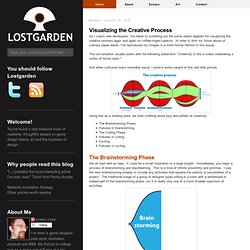
In order to limit my future abuse of culinary paper wares, I've reproduced my images in a more formal fashion in this essay. The conversation usually starts with the following statement: "Creativity is like a snake swallowing a series of tennis balls. " And when confused looks inevitably result, I sketch some variant of this odd little picture: Our Work. Health outcomes have massively improved in the west.
However, we face new challenges around increased ageing, rising health inequality and concern about trends in relation to particular public health issues including mental health, substance and obesity. Public resources are limited and that many of these issues require much wider responses from prevention to changes in individual and market behaviour. Thinkertoys’ 10 Tips to Become an Idea Person. In an age where new ideas quickly becomes commodity, creativity is a must. It is creativity that continuously give us new ideas to keep us ahead in the competition. Regarding this, I recently found an interesting book: Thinkertoys by Michael Michalko. This book contains a lot of actionable ideas on how to become an idea person and get our creative juice flow. In chapter 2 of the book, Michalko gives us 10 tips to become an idea person which I find very useful and thought-provoking.
Innovation Services. Communication Design Honours @ RMIT — Communication Design for Social Change.