
Logy Magazine. For years researchers have been debating whether Enceladus, a tiny moon floating just outside Saturn’s rings, is home to a vast underground ocean.
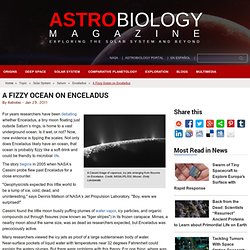
Is it wet, or not? Now, new evidence is tipping the scales. Not only does Enceladus likely have an ocean, that ocean is probably fizzy like a soft drink and could be friendly to microbial life. Diamond Planet Discovered By Astronomers. The nursery song "twinkle twinkle, little star" might have a whole new meaning now that astronomers have found a planet they believe to be made almost entirely of diamonds.
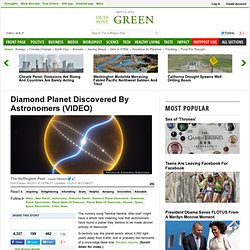
Scientists say the planet exists about 4,000 light years away from Earth, and is probably the remnants of a once-large dead star, Reuters reports. (Scroll down for video.) "The evolutionary history and amazing density of the planet all suggest it is comprised of carbon," Matthew Bailes of the University of Technology in Melbourne told Reuters. He calls it "a massive diamond orbiting a neutron star every two hours in an orbit so tight it would fit inside our own Sun. " The Daily Mail reported that, even though the planet is small in size, it has slightly more mass than the planet Jupiter.
- Out of the ordinary...out of this world. New Horizons: Mission to Pluto and the Kuiper Belt. Jupiter. MESSENGER - Unlocking the Secrets of Mercury. Astronomy Picture of the Day. Discover the cosmos!
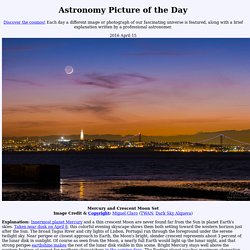
Each day a different image or photograph of our fascinating universe is featured, along with a brief explanation written by a professional astronomer. 2016 April 15 Mercury and Crescent Moon Set Image Credit & Copyright: Miguel Claro (TWAN, Dark Sky Alqueva) Saturn. .bodycard 1456.