
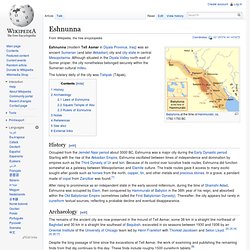
Eshnunna. Coordinates: 33°29′3″N 44°43′42″E / 33.48417°N 44.72833°E / 33.48417; 44.72833 Eshnunna (modern Tell Asmar in Diyala Province, Iraq) was an ancient Sumerian (and later Akkadian) city and city-state in central Mesopotamia.
Forbidden History - Nightly. Sumerians. Forbidden History - Nightly. The Epic of gilgamesh. Forbidden History - Nightly. Jul09wallpaper-8_1280.jpg (1280×960) Giant Crystal Pyramid Discovered In Bermuda Triangle - Nightly. Atlantis Found: Giant Sphinxes, Pyramids In Bermuda Triangle. (Before It's News) (Editor’s Note: It is with great sorrow that we announce the passing of the author of this story, Terrence Aym.

Please visit his obituary here.) Join my Twitter feed | Like my Facebook page. Pyramids of Glass Found in the Bermuda Triangle - New Earth Daily - Nightly. Cuban underwater city - Wikipedia, the free encyclopedia - Nightly. Cuban underwater city refers to a site thought by some to be a submerged granite complex structures off the coast of the Guanahacabibes peninsula in the Pinar del Río Province of Cuba.[1][2][3] Sonar images interpreted as being symmetrical and geometric stone structures resembling an urban complex were first recorded in early 2001 covering an area of 2 square kilometres (200 ha) at depths of between 600 metres (2,000 ft) and 750 metres (2,460 ft).[1] The discovery was reported by Pauline Zalitzki, a marine engineer, and her husband Paul Weinzweig, owners of a Canadian company called Advanced Digital Communications,[4] working on an exploration and survey mission in conjunction with the Cuban government.

The team returned to the site a second time with an underwater video robot that filmed sonar images interpreted as various pyramids and circular structures made out of massive, smooth blocks of stone that resembled hewn granite. Underwater Pyramid Structures Found Near Western Cuba - Nightly. September 29, 2012 - Pyramids under the waters of Cuba were discovered by two scientists Paul Weinzweig and Pauline Zalitzki.
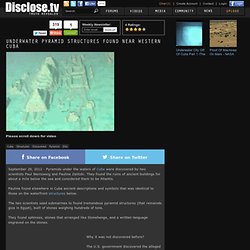
They found the ruins of ancient buildings for about a mile below the sea and considered them to be Atlantis. Paulina found elsewhere in Cuba ancient descriptions and symbols that was identical to those on the waterfront structures below. Giant Underwater Pyramid Found Near Azores Island Associated With Atlantis, Portuguese Navy Investigating. (Before It's News) Researchers have discovered an underwater pyramid 60 meters high and 8000 meters square base near the Bank De João de Castro, between the islands of Terceira and São Miguel.
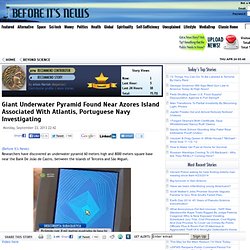
Video here The structure was identified by the sailor Diocleciano Smith based on bathymetry readings. Cucuteni-Trypillian culture - Wikipedia, the free encyclopedia - Nightly. The Cucuteni-Trypillian culture (known as Cucuteni in Romanian and Trypilska Трипільська, Tripolskaya Трипольская in Ukrainian and Russian after the respective type sites), is a Neolithic–Eneolithic archaeological culture (ca. 4800 to 3000 BC) in Eastern Europe.

It extends from the Carpathian Mountains to the Dniester and Dnieper regions, centered on modern-day Moldova and covering substantial parts of western Ukraine and northeastern Romania, encompassing an area of some 350,000 km2 (140,000 sq mi), with a diameter of some 500 km (300 mi; roughly from Kiev in the northeast to Brasov in the southwest).[2][3] Nomenclature[edit] The culture was initially named after the village of Cucuteni in Iaşi County, Romania. In 1884 Teodor T. Burada visited the tell (a hill or mound formed by long-term human occupation) there and found fragments of pottery and terracotta figurines.
Forbidden History - Nightly. DROWNED CITIES - Nightly. A HIGH-SPIRITED FILLY, WAS THE PRINCESS.
She could down alcohol with the best of them. The binge had gone on all afternoon. I don’t know what triggered the idea. It may have been a dare. Or just plain and simple curiosity. Gradually rising seas. Harsidhhi - Wikipedia, the free encyclopedia - Nightly. Harsidhhi, a contracted form or, at its very least, a form of "Harshad Amba" - The Happy Mother, is considered one of the aspect of Amba and Kalika, the Hindu Devi.
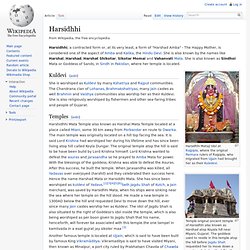
She is also known by the names like Harshal, Harshad, Harshat Shikotar, Sikotar Momai and Vahanvati Mata. She is also known as Sindhoi Mata or Goddess of Sands, in Sindh in Pakistan, where her temple is located. Kuldevi[edit] She is worshiped as Kuldevi by many Kshatriya and Rajput communities. The Chandrana clan of Lohanas, Brahmakshatriyas, many Jain castes as well Brahmin and Vaishya communities also worship her as their Kuldevi. Temples[edit] Temple original ancient temple of Harsidhhi also known as Harshad atop Koyala hill near Miyani, Gujarat. Dolní Věstonice (archaeology) - Wikipedia, the free encyclopedia - Nightly.
Dolní Věstonice (often without diacritics as Dolni Vestonice) refers to an Upper Paleolithic archaeological site near the village of Dolní Věstonice, Moravia in the Czech Republic, dating to approximately 26,000 BP, as supported by radiocarbon dating.
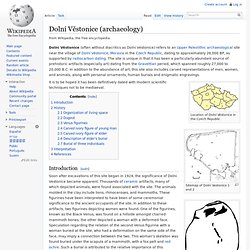
The site is unique in that it has been a particularly abundant source of prehistoric artifacts (especially art) dating from the Gravettian period, which spanned roughly 27,000 to 20,000 B.C. Minoan civilization - Wikipedia, the free encyclopedia - Nightly. 10 Strange Animal Freaks Of Nature - Listverse - Nightly. Animals On occasion, you may encounter an animal, either in literature or the wild, that will cause you to stop and wonder how such a weird creature came to exist.

The purpose of freakish adaptations can sometimes perplex even the most skilled biologists, but there often exists a ready explanation. Still, that doesn’t make these animals any less bizarre (or disturbing). 10Blood From A Stone Tunichates are just plain weird. 9Long-Horned Orb Weaver Most orb weavers epitomize the stereotypical, ordinary garden spider. 8Three-Wattled Bellbird. Amazon rainforest was giant garden city - Telegraph - Nightly. Scientists find evidence discrediting theory Amazon was virtually unlivable - Nightly. SAN MARTIN DE SAMIRIA, PERU - To the untrained eye, all evidence here in the heart of the Amazon signals virgin forest, untouched by man for time immemorial - from the ubiquitous fruit palms to the cry of howler monkeys, from the air thick with mosquitoes to the unruly tangle of jungle vines.
Archaeologists, many of them Americans, say the opposite is true: This patch of forest, and many others across the Amazon, was instead home to an advanced, even spectacular civilization that managed the forest and enriched infertile soil to feed thousands. The findings are discrediting a once-bedrock theory of archaeology that long held that the Amazon, unlike much of the Americas, was a historical black hole, its environment too hostile and its earth too poor to have ever sustained big, sedentary societies. Only small and primitive hunter-gatherer tribes, the assumption went, could ever have eked out a living in an unforgiving environment. 10 Incredible Architectural Wonders of The Ancient World. The science and art of designing and constructing buildings and other physical structures has been of man’s interest since his very beginning.
Architectural works have cultural rooting and symbolize the thinking of the society. When we look at the constructions of old days, we see wonders built by men with no technology. These wonders built after dedicated efforts of decades stand as a symbol of admiration and amazement. I have listed out a few of them. 10. 31 Architectural Wonders of the Ancient World. Have you ever wondered what unknown stories might lie behind the relics of ancient civilizations? Here are 31 of the most impressive—and yet often still mysterious—architectural wonders from the distant past.
They include the Seven Wonders of the Ancient World, the Egyptian Labyrinth, Easter Island, and more. I've also posted the fascinating tales behind a few of these monuments. It all comes from the Amazeing Art: Wonders of the Ancient World book, which contains 31 mazes and essays. Ancient City Found In India Irradiated By Nuclear Blast 8,000 Years Ago... Lost Egyptian City Revealed After 1,200 Years Under Sea Seriously, For Real?
It is a city shrouded in myth, swallowed by the Mediterranean Sea and buried in sand and mud for more than 1,200 years. But now archeologists are unearthing the mysteries of Heracleion, uncovering amazingly well-preserved artifacts that tell the story of a vibrant classical-era port. Known as Heracleion to the ancient Greeks and Thonis to the ancient Eygptians, the city was rediscovered in 2000 by French underwater archaeologist Dr. Franck Goddio and a team from the European Institute for Underwater Acheology (IEASM) after a four-year geophysical survey. Carnac stones. Anunnaki. Black Mountain (Kalkajaka) National Park. Black Mountain (Kalkajaka) National Park is a 781 hectare [1]protected area in the Queensland, (Australia), 25 km south west of Cooktown.
It is managed and protected as a national park under the Nature Conservation Act 1992. Ancient History. Black Mountain, Australia. Undefined Excerpt from branton's CAVERNS, DUNGEONS & LABYRINTHS The 'I.N.F.O. JOURNAL' (box 367., Arlington, VA, 22210), a publication devoted to 'Fortean' research, Vol. Popol Vuh (The Mayan Bible) With its’ first inhabitants was destroyed by a great disaster. Tahtzibichen Labyrinth Ancient Temple. Originally submitted by coldrum. A slightly different article --- Cueva de los Tayos. Cueva de los Tayos.
Derinkuyu Underground City. Awning at the Colosseum. Petra. Ashurbanipal Library Phase 1. Lascaux. Cave painting of a dun horse (equine) at Lascaux Modern entrance to the Lascaux cave Lascaux (Lascaux Caves) (English /læsˈkoʊ/,[1] French: [lasko][2]) is the setting of a complex of caves in southwestern France famous for its Paleolithic cave paintings. Olduvai Gorge (archaeological site, Tanzania.
Olduvai Gorge. The Behistun Inscription. Göbekli Tepe.
Top 10 Civilizations That Mysteriously Disappeared. Tiwanaku. Perihelion. List of colossal sculpture in situ. Lake Titicaca. Lake Titicaca Underwater Ruins. Tiahuanaco: Gatway to the Gods. Underwater Temple of Lake Titicaca. History of Lake Titicaca - Lonely Planet Travel Information. Huascar, Inca Emperor 1527-1532. Wari culture. The Floating Islands of Lake Titicaca. Uru people. Turkey and India: Fathers of Civilization. Atlantis - The Lost Continent Finally Found. Atlantis or Someone Else? Lost Civilizations: Atlantis: Vital Statistics. Lost Civilizations: Atlantis: Timaeus and Critias. Sigiriya. A Science Odyssey: People and Discoveries: Leakey family discovers human ancestors. Sumerianlegacy.
Shinar. Mada'in Saleh. Hattusa. Ziggurat of Ur. List of largest monoliths in the world. Category:Sumer. Mahabalipuram. Category:Ancient cities. Portal:Ancient Near East. Buddhas of Bamiyan. Babylon. Church of Saint George, Lalibela.
Untitled. Etemenanki. Gobekli Tepe: The World’s First Temple? Sodom and Gomorrah. List of Mesoamerican pyramids. Iron pillar of Delhi. Acre, Israel. Chachapoya culture. Cappadocia. Statue of Decebalus. Mesopotamia. Ancient Civilizations. Ancient Aliens. Ancient Alien Theory and Gobekli Tepe. Nuremberg Germany UFO Battle (1561)