
1Lykkes-bekth-mazar - Σενάριο διδασκαλίας. Magic.piktochart. Enzo Silva blog » ADDIE – “The” Instructional Design Process – Explainer Videos. Doing it Differently: Tips for Teaching Vocabulary. Every Monday my seventh grade English teacher would have us copy a list of 25 words she'd written on the board.

We'd then look up the dictionary definitions and copy those down. For homework, we'd re-write each word seven times. Good, now you know it. Test on Friday and never for those 25 words to be seen again. Poof. Copying definitions from the dictionary we would probably all agree is not an effective way to learn vocabulary. The truth is, and the research shows, students need multiple and various exposures to a word before they fully understand that word and can apply it. Selecting Words Ah, so many words, so little time. My first year teaching, before my tenth graders began reading Lord of the Flies, I went through every chapter and made lists of all the vocabulary words I thought they'd have trouble with, so that I could pre-teach them.
When I looked at those long lists, I began to freak out. Then, here's what to do after the students pick their own words: Ranking Words Teaching Words. Course: Minnesota Studies. Microsoft Account. Topic:Instructional Design. Instructional Design (also called Instructional Systems Design (ISD)) is the practice of creating instructional experiences which make the acquisition of knowledge and skill more efficient, effective, and appealing.[1] The goal of this learning experience is to develop the skills needed to design instructional material.
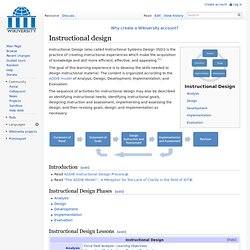
The content is organized according to the ADDIE model of Analysis, Design, Development, Implementation, and Evaluation. The sequence of activities for instructional design may also be described as identifying instructional needs, identifying instructional goals, designing instruction and assessment, implementing and assessing the design, and then revising goals, design, and implementation as necessary: Introduction[edit] Instructional Design Phases[edit] Instructional Design Lessons[edit] See Also[edit] References[edit] Making Meaning in Literature: A Workshop for Teachers, Grades 6-8. Bloom's Digital Taxonomy. The Jigsaw Classroom: Overview of the Technique. Overview of the Technique The jigsaw classroom is a cooperative learning technique with a three-decade track record of successfully reducing racial conflict and increasing positive educational outcomes.
Just as in a jigsaw puzzle, each piece--each student's part--is essential for the completion and full understanding of the final product. If each student's part is essential, then each student is essential; and that is precisely what makes this strategy so effective. Here is how it works: The students in a history class, for example, are divided into small groups of five or six students each. Suppose their task is to learn about World War II. Eventually each student will come back to her or his jigsaw group and will try to present a well-organized report to the group.
To increase the chances that each report will be accurate, the students doing the research do not immediately take it back to their jigsaw group. Instructional System Design (ISD) Handbook (ADDIE) Mind Map Branch: Bloom's Taxonomy. OHCHR Knowledge Sharing Online Toolkit.
The Standards. Ohio PTA Common Core State Standards Initiative (CCSSI) Committee National PTA (NPTA) announced in December 2009 a three year campaign to mobilize parents to advance the Common Core State Standards Initiative (CCSSI) along with other key education reforms.
NPTA will build on PTA’s rich history advocating for education, health and child welfare reforms while complementing PTA’s current Public Policy Agenda. In 2009, Florida, Georgia, New Jersey, and North Carolina were the first states to receive funding and support to develop state-level CCSSI campaigns. NPTA selected the Ohio PTA along with Minnesota, Mississippi, and Washington to participate in the second wave of the Common Core State Standards Campaign in May 2010.
Over the summer of 2010, Ohio PTA (OPTA) formed a CCSSI committee to meaningfully participate in the campaign to implement the newly adopted Common Core Standards. Ohio PTA CCSSI Committee Debbie Tidwell (Chair - District 11) Anna Chapman (District 12) Take the Pledge: Stand Up For Bullied Students.