
MetaHistory - Gaia and Gnosis, Deeper Ecology, Planetary Tantra, Telestics. Ideas, issues, knowledge, data - visualized! The Advantages of Many Gods. Oliver Sacks: What hallucination reveals about our minds. Me, Myself and My Stranger: Understanding the Neuroscience of Selfhood.
Where are you right now?
Maybe you are at home, the office or a coffee shop—but such responses provide only a partial answer to the question at hand. Asked another way, what is the location of your "self" as you read this sentence? Like most people, you probably have a strong sense that your conscious self is housed within your physical body, regardless of your surroundings. But sometimes this spatial self-location goes awry. During a so-called out-of-body experience, for example, one's self seems to be transported outside the physical body into a surreal perspective—some people even believe they are viewing their bodies from above, as though their true selves were floating.
A new paper offers examples of rare bodily illusions that are not confined to a single limb, nor are they complete out-of-body experiences—they are somewhere in between. Patient 1 was a 55-year-old man who had suffered from epilepsy since he was 14 years old. 10 Brilliant Social Psychology Studies ? PsyBlog. Ten of the most influential social psychology experiments.
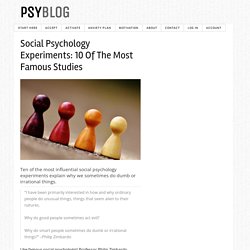
“I have been primarily interested in how and why ordinary people do unusual things, things that seem alien to their natures.Why do good people sometimes act evil? Why do smart people sometimes do dumb or irrational things?” –Philip Zimbardo Like eminent social psychologist Professor Philip Zimbardo (author of The Lucifer Effect: Understanding How Good People Turn Evil), I’m also obsessed with why we do dumb or irrational things. The answer quite often is because of other people – something social psychologists have comprehensively shown. Over the past few months I’ve been describing 10 of the most influential social psychology experiments. Each one tells a unique, insightful story relevant to all our lives, every day. 1. The ‘halo effect’ is a classic social psychology experiment. » Read on about the halo effect -» 2. » Read on about cognitive dissonance -» 3. » Read on about Sherif’s Robbers Cave experiment -» 4. 5. 6.
Quantum Astrology by Kim Falconer. A Low Impact Woodland Home. The Occidental Arts and Ecology Center (OAEC) Path to Freedom Urban Homestead. 4 - Enneagram Type Four: The Individualist. Type Four in Brief Fours are self-aware, sensitive, and reserved.
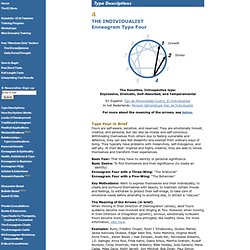
They are emotionally honest, creative, and personal, but can also be moody and self-conscious. Withholding themselves from others due to feeling vulnerable and defective, they can also feel disdainful and exempt from ordinary ways of living. They typically have problems with melancholy, self-indulgence, and self-pity. At their Best: inspired and highly creative, they are able to renew themselves and transform their experiences. Basic Fear: That they have no identity or personal significance Basic Desire: To find themselves and their significance (to create an identity) Enneagram Four with a Three-Wing: "The Aristocrat" Enneagram Four with a Five-Wing: "The Bohemian" The Meaning of the Arrows (in brief) When moving in their Direction of Disintegration (stress), aloof Fours suddenly become over-involved and clinging at Two.
Type Four Overview “I collapse when I am out in the world. Fours are in the same predicament. Divinities, Mythologies, Theologies. The Alchemy Web Site.