
Hedgehog's dilemma. Both Arthur Schopenhauer and Sigmund Freud have used this situation to describe what they feel is the state of individual in relation to others in society.
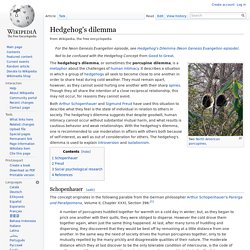
The hedgehog's dilemma suggests that despite goodwill, human intimacy cannot occur without substantial mutual harm, and what results is cautious behavior and weak relationships. With the hedgehog's dilemma, one is recommended to use moderation in affairs with others both because of self-interest, as well as out of consideration for others. The hedgehog's dilemma is used to explain introversion and isolationism. Schopenhauer[edit] The concept originates in the following parable from the German philosopher Arthur Schopenhauer's Parerga und Paralipomena, Volume II, Chapter XXXI, Section 396:[1] Solipsism. Solipsism ( i/ˈsɒlɨpsɪzəm/; from Latin solus, meaning "alone", and ipse, meaning "self")[1] is the philosophical idea that only one's own mind is sure to exist.

As an epistemological position, solipsism holds that knowledge of anything outside one's own mind is unsure; the external world and other minds cannot be known and might not exist outside the mind. As a metaphysical position, solipsism goes further to the conclusion that the world and other minds do not exist. Varieties[edit] There are varying degrees of solipsism that parallel the varying degrees of serious skepticism. The Myth of Sisyphus. The Myth of Sisyphus is a philosophical essay by Albert Camus.
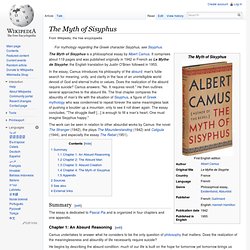
It comprises about 119 pages and was published originally in 1942 in French as Le Mythe de Sisyphe; the English translation by Justin O'Brien followed in 1955. In the essay, Camus introduces his philosophy of the absurd: man's futile search for meaning, unity, and clarity in the face of an unintelligible world devoid of God and eternal truths or values. Does the realization of the absurd require suicide? Camus answers: "No. It requires revolt. "