
Graph Drawing Algorithms. Blog Archive » Operations on a Graph Database (Part 1 – Nodes) Graph databases are still quite unfamiliar to many developers.

This is the first post in a series discussing the operations a graph database makes available to the developer. Just like there are only so many different things you can do on a relational database (like CREATE TABLE or INSERT), there are only so many things you can do on a graph database. It is worth looking at them one at a time, and that’s the goal of this series. This first post is on creating and deleting nodes. To recap, a graph database contains nodes and edges, or MeshObjects and Relationships (as we call them in InfoGrid), or Instances and Links (as the UML would call them), or Resources and Triples (as the semantic web folks would call them), or boxes and arrows (as we draw them on a white board). Combinatorial optimization. In applied mathematics and theoretical computer science, combinatorial optimization is a topic that consists of finding an optimal object from a finite set of objects.[1] In many such problems, exhaustive search is not feasible.

It operates on the domain of those optimization problems, in which the set of feasible solutions is discrete or can be reduced to discrete, and in which the goal is to find the best solution. Some common problems involving combinatorial optimization are the traveling salesman problem ("TSP") and the minimum spanning tree problem ("MST"). Combinatorial optimization is a subset of mathematical optimization that is related to operations research, algorithm theory, and computational complexity theory. It has important applications in several fields, including artificial intelligence, machine learning, mathematics, auction theory, and software engineering. Applications[edit] Applications for combinatorial optimization include, but are not limited to: PageRank.
Mathematical PageRanks for a simple network, expressed as percentages.
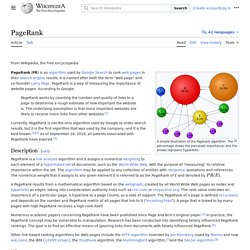
(Google uses a logarithmic scale.) Page C has a higher PageRank than Page E, even though there are fewer links to C; the one link to C comes from an important page and hence is of high value. Minimum spanning tree. The only minimum spanning tree of a planar graph.

Each edge is labeled with its weight, which here is roughly proportional to its length. One example would be a telecommunications company laying cable to a new neighborhood. If it is constrained to bury the cable only along certain paths, then there would be a graph representing which points are connected by those paths. Some of those paths might be more expensive, because they are longer, or require the cable to be buried deeper; these paths would be represented by edges with larger weights. A spanning tree for that graph would be a subset of those paths that has no cycles but still connects to every house. Art gallery problem. Of points is said to guard a polygon if, for every point in the polygon, there is some such that the line segment between and does not leave the polygon.

Two dimensions[edit] Four cameras cover this gallery. There are numerous variations of the original problem that are also referred to as the art gallery problem. Four color theorem. List of graphical methods. List of graphical methods From Wikipedia, the free encyclopedia Jump to: navigation, search There is also a list of computer graphics and descriptive geometry topics.
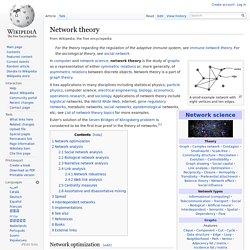
Contents [hide] Simple displays[edit] Network theory. A small example network with eight vertices and ten edges.
It has applications in many disciplines including statistical physics, particle physics, computer science, electrical engineering, biology, economics, operations research, and sociology. Applications of network theory include logistical networks, the World Wide Web, Internet, gene regulatory networks, metabolic networks, social networks, epistemological networks, etc; see List of network theory topics for more examples. Euler's solution of the Seven Bridges of Königsberg problem is considered to be the first true proof in the theory of networks.[1] Network optimization[edit] Network analysis[edit] Discrete mathematics. The set of objects studied in discrete mathematics can be finite or infinite.

The term finite mathematics is sometimes applied to parts of the field of discrete mathematics that deals with finite sets, particularly those areas relevant to business. Research in discrete mathematics increased in the latter half of the twentieth century partly due to the development of digital computers which operate in discrete steps and store data in discrete bits. Concepts and notations from discrete mathematics are useful in studying and describing objects and problems in branches of computer science, such as computer algorithms, programming languages, cryptography, automated theorem proving, and software development.
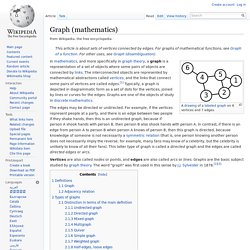
Conversely, computer implementations are significant in applying ideas from discrete mathematics to real-world problems, such as in operations research. Graph (mathematics) The edges may be directed or undirected.
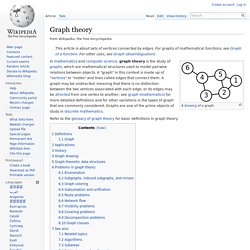
Graph theory. Refer to the glossary of graph theory for basic definitions in graph theory.
Tutorial 1: Introducing Graph Data. Next: Introducing RDF The semantic web can seem unfamiliar and daunting territory at first. If you're eager to understand what the semantic web is and how it works, you must first understand how it stores data. We start from the ground up by outlining the graph database - the data storage model used by the semantic web. After this tutorial, you should be able to: Describe in basic terms what the semantic web is.Experience the paradigm-shift of storing information as a graph database, rather than a hierarchical or relational database.Understand that the semantic web of data is defined using Resource Description Framework (RDF).Understand the basic principles of RDF statements and how they can define data graphs. Estimated time: 5 minutes. Network Graph - Google Fusion Tables Help. Current limitations include: The visualization will only show relationships from the first 100,000 rows in a table. A filter can include rows from 100,001 or beyond in the table, but the graph will still not display them.
Internet Explorer 8 and below are not supported. When using Fusion Tables with an unsupported browser, the Network Graph visualization will not be available. Embedded network graphs are replaced with a static image. Network Graphs. Network Graphs In the 18th century in the town of Königsberg, Germany, a favorite pastime was walking along the Pregel River and strolling over the town's seven bridges (Fig. 1). During this period a natural question arose: Is it possible to take a walk and cross each bridge only once? Before reading further, can you determine the answer? This question was solved by the Swiss mathematician Leonard Euler. His solution was the beginning of network theory.
Figure 1. The Experiment menu - Google Fusion Tables Help. Fusion Tables' Labs offers you a chance to try out the newest visualizations on your data. If you're brave enough to try them, it's important to keep the following things in mind: They may break at any time. Similarly, they may disappear temporarily or permanently. Combinatorics. » actor-network theory. Yesterday, Google introduced a new feature, which represents a substantial extension to how their search engine presents information and marks a significant departure from some of the principles that have underpinned their conceptual and technological approach since 1998. The “knowledge graph” basically adds a layer to the search engine that is based on formal knowledge modelling rather than word statistics (relevance measures) and link analysis (authority measures).
Theory.