
The Economist - Women's Economic Opportunity Index. In hopes of going beyond the traditionally static, and oftentimes boring, PowerPoint presentation, The Economist tapped JESS3 to help bring an important data set to life through a powerful graphic animation.
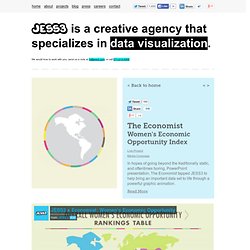
Working closing with the Economist Intelligence Unit, which compiled a 150-page report called the Women’s Economic Opportunity Index, our team explored creative direction through multiple styleframes in order to achieve a look that would illuminate crucial information about women’s opportunity across the world. In combing through data and creating detailed storyboards, this six-minute animation tells the story through data visualization of where women stand in the business world from issues ranging from maternity leave to property rights.
40. Ziam.pdf (application/pdf Object) Knowledge Broker. Search Results.
From Knowledge to Innovation. International Keynote by Ron Young to KM Singapore Conference, Singapore 16th September 2010.
The importance of Knowledge Management. Why Knowledge Management?
Before we start to explore and understand the details of what knowledge management is, and how to implement knowledge management projects and initiatives, we need to first ask ourselves why we want to consider knowledge management in the first place? What are the real benefits that can be gained from effective knowledge management for the individual, the team, the entire organization, the community, the nation, or even the entire planet Earth? Knowledge management is far reaching. Maybe you are considering developing your own personal knowledge management competencies, to become a more effective player in the global knowledge economy, or becoming a more competitive knowledge leader and knowledge driven organization.
Maybe you wish to develop and apply knowledge management strategies to government, military operations, global poverty eradication, international disaster management and even, now, knowledge management for global climate change. Content Rivers and Information Gluttony. As the festive season was drawing to a close, I –like a large portion of the online population– became concerned about ending the cycle of over-eating.
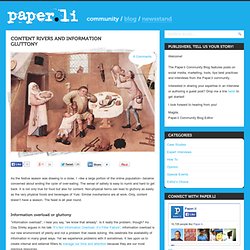
The sense of satiety is easy to numb and hard to get back. It is not only true for food but also for content. Non-physical items can lead to gluttony as easily as the very physical foods and beverages of Yule. Similar mechanisms are at work. Content Curation for Teachers Have you ever felt that there is simply too much interesting, educational content on the web? 100+ Free Online Learning Sites. Note: Free learning opportunities have skyrocketed in recent years.
I actually wrote this post some years ago – before Khan Academy, MOOCs, and all sorts of other options came along. It’s past due for an update. I’ll be working on one soon, so if you have resources you would like to see added here – or updates/perspectives on the ones already listed – please be sure to comment or contact me. The Clip Report. Instructional Designers and Trainers as Digital Curators?
Sometimes a few conversations converge to result in a sort of serendipitous moment of insight --or at least questions.
First there was Jeff Cobb's More than 100 Free Places to Learn--and Counting. It's a phenomenal list of resources, but I would guess overwhelming to the average person. Then a few days later Jeff links to Steve Rubel's article on The Digital Curator, of whom Steve says: The call of the curator requires people who are selfless and willing to act as sherpas and guides. Teachers are not knowledge owners anymore, they are knowledge curators. OpenCulture » Blog Archive » The Rise and Fall of the Curator. What are the essential ingredients of a museum? If you’d asked this question perhaps 10 years ago, the list would have been pretty straightforward - walls, objects, respectful visitors, curators.
Accelerating Change: Are You a Teacher or a Curator? My favorite teacher was a man, prematurely gray at 35 years old, whom we called "Mr.
John. " This guy challenged me on everything, and I mean everything. He taught physics and our experiments were meant to enable us to follow a chain of reasoning to prove or disprove some theorem. Even when I nailed the reasoning and the data from the experiment he'd force me to look at it in another way, to apply perspective that had nothing to do with physics, and he could then get me to question whether the damn table was solid! Mr. Gerrit Visser: Use Smart Knowledge Networks to Be a Curator. Gerrit Visser has been digitally curating content since “just after the internet was invented” in 1996.
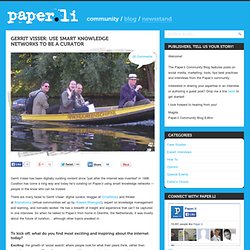
Curation has come a long way and today he’s curating on Paper.li using smart knowledge networks — people in the know who can be trusted. The Content Strategist as Digital Curator. The term “curate” is the interactive world’s new buzzword.
During content creation and governance discussions, client pitches and creative brainstorms, I’ve watched this word gain traction at almost warp speed. As a transplant from museums and libraries into interactive media, I can’t help but ask what is it about this word that deserves redefinition for the web? Article Continues Below Curation has a distinguished history in cultural institutions. 200611_HealthPolicy_1.pdf (application/pdf Object) 2008-3pp144-154.pdf (application/pdf Object)