
ERM07610.pdf (Objet application/pdf) Literacy skills for teachers. Which are the literacies we need to learn in order to prepare our students for the 21st century?

Digital literacies is “the ability to understand and use information in multiple formats from a wide range of sources when it is presented via computers Literacy has not become technological, but there has been a shift from print to digital technologies, and with this, the emergence of new families of literate practice. On the basis of this, theorists of digital literacies argue that the revolution in communication and information technologies has created new types of textual surface and hence, new literacies (Bigum & Lankshear, 1997; Durrant & Green, 2000). Mark Pegrum arrays a spectrum of literacy skills into four “literacy groups”. 1- Language literacies Check this online journal full of interesting examples on how teachers used Language literacies in the classroom According to Mark we can`t neglet traditional printed literacies. Hypertext changes the way we read and write. M. Like this: Volume 2 - Digital Culture. Beyond New Literacies: Journal Issue Looks at New Perspectives, Tensions » Spotlight.
Learning Literacies in a Digital Age. Download this document1 This paper draws on a JISC report, Thriving in the 21st century: Learning Literacies for the Digital Age, which explores examples of learning literacies provision in UK further and higher education.
The nature of work is changing, not just for the growing numbers of graduates directly employed in the ‘digital’ industries. According to the recent e-skills report ‘Technology Counts’, an estimated 77% of UK jobs involve some form of Information and Communications Technology (ICT) competence, requiring skills to be updated as technology changes. ‘Education can play a role in influencing future cultural and social practices with technology.’Opportunities for learning are also changing and by most measures becoming more numerous and openly available.
Open educational content is growing through several high profile initiatives. The texture of social life is changing, with more and more people conducting and sustaining relationships via digital media. Looking to the future. 21st Century Literacies. 21st Century Literacies: Tools for Reading the World. In Intelligence Reframed Howard Gardner contends that "literacies, skills, and disciplines ought to be pursued as tools that allow us to enhance our understanding of important questions, topics, and themes.
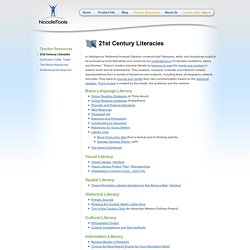
" Today's readers become literate by learning to read the words and symbols in today's world and its antecedents. They analyze, compare, evaluate and interpret multiple representations from a variety of disciplines and subjects, including texts, photographs, artwork, and data. They learn to choose and modify their own communication based on the rhetorical situation. Point of view is created by the reader, the audience and the medium. Basic Language Literacy Visual Literacy Spatial Literacy Three Information Literacy Questions to Ask About a Map: Handout Historical Literacy Cultural Literacy Information Literacy Political Literacy and News Media Literacy Scientific Literacy Mathematical Literacy.
Infolit.jpg (Image JPEG, 200x196 pixels) ELI: What Wikipedia Can Teach Us About the New Media Literacies, Jenkins : UberNoggin: Big Brains - Big Ideas. Mark and I are in San Antonio at the ELI Annual conference.

The program is super exciting with sessions on Second Life, social networking, haptic devices, and more. First up, Henry Jenkin’s talk about Wikipedia. Here are my notes from the session: **posting now due to lack of battery juice! I’ll post more complete notes later. The Evolving Definition of Literacy.