
Communication. In the realm of biology in general, communication often occurs through visual, auditory, or biochemical means.
Top 20 Communicators. Jeffrey Solomon and Charles Bronfman, authors of The Art of Giving.
Whether writing a book, giving a speech at a philanthropy forum, sitting down for a national radio or television interview, connecting with people through social media outlets or sharing their philanthropic story with investors, employees or volunteers, these Top 20 Executives, Thinkers and Experts are some of the philanthropic sector’s best communicators. There were more than 350 nominees for Top 20 Communicators in the philanthropic community, which is a little more than we expected. These leaders were selected for their philanthropic impact through the art of communication and their ability to prepare with focus, deliver with clarity and speak with power. Heurisis. Category:Communication. From Wikipedia, the free encyclopedia Subcategories This category has the following 22 subcategories, out of 22 total.
Pages in category "Communication" The following 200 pages are in this category, out of 258 total. 2009 Pathologies sociales de la communication. Category:Media theorists. Understanding Media: The Extensions of Man. McLuhan pointed to the light bulb as an example.
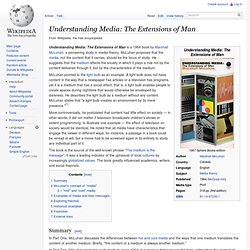
A light bulb does not have content in the way that a newspaper has articles or a television has programs, yet it is a medium that has a social effect; that is, a light bulb enables people to create spaces during nighttime that would otherwise be enveloped by darkness. He describes the light bulb as a medium without any content. U n d e r s t a n d i n g . m e d i a - good morning! Good Morning!
Welcome to U75102 'Understanding Media', an undergraduate module that was taught by Tom Tyler at Oxford Brookes University UK between 2004-05 and 2008-09. Students at Brookes who signed up for this module may initially have found the Module Overview or the weekly pages the most useful. Everyone is welcome to browse round the site, of course: you may find the pages on Marshall McLuhan, The Matrix or Videodrome the most interesting.
Category:Communication by type. Catégorie:Chercheur en communication. 3'-Sémiométrie. Semiotics - Chance and Choice. The structure of all languages have been naturally shaped by the basic form of the brain.
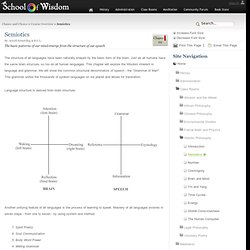
Just as all humans have the same brain structure, so too do all human languages. This chapter will explore the Wisdom inherent in language and grammar. We will show the common structural denominators of speech - the "Grammar of Man". This grammar unites the thousands of spoken languages on our planet and allows for translation. Language structure is derived from brain structure: Sémantique. La sémantique est une branche de la linguistique qui étudie les signifiés, ce dont on parle, ce que l'on veut énoncer.
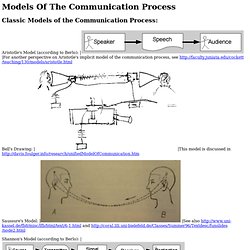
Wiki: Models Of The Communication Process. Classic Models of the Communication Process: Aristotle's Model (according to Berlo): | |For another perspective on Aristotle's implicit model of the communication process, see Bell's Drawing: | |This model is discussed in.
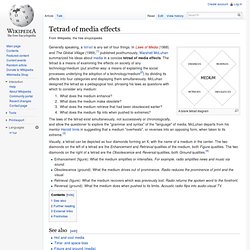
Tetrad of media effects. A blank tetrad diagram Generally speaking, a tetrad is any set of four things.
Vol 1 (2008) Open Semiotics Resource Center. 10 TED Talks That Will Change the Way You Communicate. August 1st, 2012 By: Alvina Lopez Even the most eloquent of public and private speakers could always stand to tweak their communication skills just a little bit.

After all, the ability to convey feelings and facts stands as essential to keeping the human species rolling along. Both the Internet and bookshelves sport advice a-go-go on how to get points across as clearly as possible, and the venerable open source lecture series TED does not disappoint in this regard. SciencesCom >> L’école de la communication et des médias. Les dossiers de l'observatoire. La théorie du discours ouverte à de nouvelles épistémologies.
LASCO. Sciences de l'information et de la communication. Un article de Wikipédia, l'encyclopédie libre. Pour les articles homonymes, voir SIC. Schéma simpliste de la transmission linéaire de l'information dans la communication (paradigme mécaniste) Historique des SIC[modifier | modifier le code] Le champ de connaissance a émergé après la seconde guerre, sans que l'histoire des sciences de la communication et de l'information ne se confondent entièrement[1]. L'histoire des sciences de l'information s'enracine dans l'évolution des techniques documentaires et le développement de l'informatique. Communication. Un article de Wikipédia, l'encyclopédie libre. Speech act. A speech act in linguistics and the philosophy of language is an utterance that has performative function in language and communication. According to Kent Back, "almost any speech act is really the performance of several acts at once, distinguished by different aspects of the speaker's intention: there is the act of saying something, what one does in saying it, such as requesting or promising, and how one is trying to affect one's audience.
" The contemporary use of the term goes back to J. L. Catégorie:Communication. Catégorie:Sciences de l'information et de la communication. Meme. A meme (/ˈmiːm/ meem)[1] is "an idea, behavior, or style that spreads from person to person within a culture. "[2] A meme acts as a unit for carrying cultural ideas, symbols, or practices that can be transmitted from one mind to another through writing, speech, gestures, rituals, or other imitable phenomena with a mimicked theme.
Supporters of the concept regard memes as cultural analogues to genes in that they self-replicate, mutate, and respond to selective pressures.[3] The word meme is a shortening (modeled on gene) of mimeme (from Ancient Greek μίμημα Greek pronunciation: [míːmɛːma] mīmēma, "imitated thing", from μιμεῖσθαι mimeisthai, "to imitate", from μῖμος mimos "mime")[4] and it was coined by the British evolutionary biologist Richard Dawkins in The Selfish Gene (1976)[1][5] as a concept for discussion of evolutionary principles in explaining the spread of ideas and cultural phenomena.
Old Messengers, New Media: The Legacy of Innis and McLuhan - Library and Archives Canada. Harold Innis's communications theories. Harold Adams Innis (November 5, 1894 – November 8, 1952) was a professor of political economy at the University of Toronto and the author of seminal works on Canadian economic history and on media and communication theory. Timeline Outline View. Derrick de Kerckhove. Un article de Wikipédia, l'encyclopédie libre. The Medium Is the Massage. The Medium is the Massage: An Inventory of Effects is a book co-created by media analyst Marshall McLuhan and graphic designer Quentin Fiore, and coordinated by Jerome Agel.
It was published by Bantam books in 1967 and became a bestseller with a cult following. The book itself is 160 pages in length and composed in an experimental, collage style with text superimposed on visual elements and vice versa. Some pages are printed backwards and are meant to be read in a mirror (see Mirror writing). Some are intentionally left blank.
Most contain photographs and images both modern and historic, juxtaposed in startling ways. The Big Ideas podcast: The medium is the message. The writing of the Canadian philosopher Marshall McLuhan, who would have celebrated his 100th birthday this Thursday, has entered popular jargon like that of few other modern intellectuals. Is there another line that has been quoted – and misquoted – as enthusiastically as 'the medium is the message'? McLuhan, of course, was perfectly aware of his status as the thinker du jour of the media age, the man everyone liked to quote over dinner but hadn't bothered to read – for proof, just watch Annie Hall. But what does "the medium is the message" really mean? In the first episode of our new The Big Ideas series, Benjamen Walker gets to the bottom of the slogan with the help of Canadian novelist and McLuhan-biographer Douglas Coupland, academic Lance Strate, Marshal's son Eric McLuhan, record producer John Simon, and the Guardian's media correspondent Jemima Kiss.
McLuhan - Le médium EST le message) Par Marshall McLuhan E xtrait de « Pour comprendre les médias » Sémiotique. Sur les autres projets Wikimedia : sémiotique, sur le Wiktionnaire. Center for Semiotics. Signo : Sémiotique - Théoriques sémiotiques appliquées / Semiotics - Applied Semiotic Theories. Semiotics Encyclopedia Online - Welcome. This reference website is freely usable for educational and personal use. It will provide in-depth articles written by experts in a great variety of disciplines bearing upon the ways in which organisms in general, and humans in particular, process information, discover or construct meaning, represent and share their knowledge, interact through the mediation of signs and symbols that change over time, and elaborate diverse cultures and systems of thought.
It will offer articles documenting the historical development of semiotics while emphasizing that this variegated epistemological movement is still in the making. The Semiotics Encyclopedia Online will endeavor to bring into focus important advances in the sciences, which are bound to have an impact on our understanding of the issues which have been traditionally raised by semiotics. It will also critically reexamine the basic concepts and models that form contemporary semiotic literacy. Marshall McLuhan. Un article de Wikipédia, l'encyclopédie libre. Étudiant les transformations culturelles apportées par l'imprimerie dans le monde occidental, il considère que le médium de communication a plus d'importance que son contenu, comme il l'énonce dans la formule « Le message, c'est le médium »[n 1], et tente de prévoir les bouleversements qu'entraînera la télévision.
Biographie[modifier | modifier le code] Understanding Media: The Extensions of Man. Web Sound - Marshall McLuhan. MMXI – Celebrating 100 years of McLuhan – Marshall McLuhan. Global village (term) Marshall McLuhan - The World is a Global Village (CBC TV)