
Begging the question. Begging the question means "assuming the conclusion (of an argument)", a type of circular reasoning.

This is an informal fallacy where the conclusion that one is attempting to prove is included in the initial premises of an argument, often in an indirect way that conceals this fact.[1] The term "begging the question" originated in the 16th century as a mistranslation of Latin petitio principii "assuming the initial point".[2] In modern vernacular usage, "to beg the question" is sometimes used to mean "to raise the question" (as in "This begs the question of whether...
") or "to dodge the question".[2] History[edit] Begging the question (petitio principii) is one of the classic informal fallacies in Aristotle's Prior Analytics. It is studied in Prior Analytics II, 64b, 34 – 65a, 9 and it is considered a material fallacy. Socratic method. Type of dialog or debate The Socratic method is a method of hypothesis elimination, in that better hypotheses are found by steadily identifying and eliminating those that lead to contradictions.
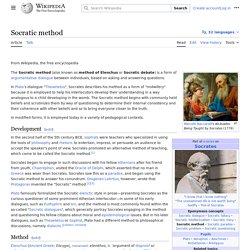
The Socratic method searches for general, commonly held truths that shape beliefs and scrutinizes them to determine their consistency with other beliefs. The basic form is a series of questions formulated as tests of logic and fact intended to help a person or group discover their beliefs about some topic; exploring definitions, and seeking to characterize general characteristics shared by various particular instances. Development[edit] In the second half of the 5th century BC, sophists were teachers who specialized in using the tools of philosophy and rhetoric to entertain, impress, or persuade an audience to accept the speaker's point of view. Method[edit] Elenchus (Ancient Greek: ἔλεγχος, romanized: elenkhos, lit. W. Application[edit] Socratic Circles[edit] Text selection[edit] Socratic Circle texts. Problem of universals. While philosophers agree that human beings talk and think about properties, they disagree on whether these universals exist in reality or merely in thought and speech.

Positions[edit] The main positions on the issue are generally considered to be: realism, nominalism, and idealism (sometimes simply called "anti-realism" with regard to universals).[4] Realism[edit] The realist school claims that universals are real — they exist and are distinct from the particulars that instantiate them. There are various forms of realism. Realists tend to argue that universals must be posited as distinct entities in order to account for various phenomena.
Nominalism[edit] Nominalists often argue for their view by claiming that nominalism can account for all the relevant phenomena, and therefore—by Ockham's razor or some sort of principle of simplicity—nominalism is preferable, since it posits fewer entities. Deepity. Deepity is a term employed by Daniel Dennett in his 2009 speech to the American Atheists Institution conference, coined by the teenage daughter of one of his friends.

The term refers to a statement that is apparently profound but actually asserts a triviality on one level and something meaningless on another. Generally, a deepity has (at least) two meanings: one that is true but trivial, and another that sounds profound, but is essentially false or meaningless and would be "earth-shattering" if true. Constructivism (mathematics) In the philosophy of mathematics, constructivism asserts that it is necessary to find (or "construct") a mathematical object to prove that it exists.

When one assumes that an object does not exist and derives a contradiction from that assumption, one still has not found the object and therefore not proved its existence, according to constructivism. This viewpoint involves a verificational interpretation of the existence quantifier, which is at odds with its classical interpretation. Constructivism is often identified with intuitionism, although intuitionism is only one constructivist program.
Intuitionism maintains that the foundations of mathematics lie in the individual mathematician's intuition, thereby making mathematics into an intrinsically subjective activity.[2] Other forms of constructivism are not based on this viewpoint of intuition, and are compatible with an objective viewpoint on mathematics. is a theorem (where x, y, z ... are the free variables in the proposition p). Dialectic. Dialectic (also dialectics and the dialectical method) is a method of argument for resolving disagreement that has been central to European and Indian philosophy since antiquity.
The word dialectic originated in ancient Greece, and was made popular by Plato in the Socratic dialogues. The dialectical method is discourse between two or more people holding different points of view about a subject, who wish to establish the truth of the matter guided by reasoned arguments.[1] The term dialectics is not synonymous with the term debate. While in theory debaters are not necessarily emotionally invested in their point of view, in practice debaters frequently display an emotional commitment that may cloud rational judgement. Debates are won through a combination of persuading the opponent; proving one's argument correct; or proving the opponent's argument incorrect. The Sophists taught aretē (Greek: ἀρετή, quality, excellence) as the highest value, and the determinant of one's actions in life.