
Marisa
100 iPad Apps Perfect for Middle School. iPad Assistive Technology. Curriculum-Based Measurement Warehouse: A World of CBM Resources... Resources for Special Education Teachers. ADHD. New ‘Dyslexie’ font helps dyslexics read better AFP/ Those in a study of the font say it improves reading accuracy.

A graphic designer from the Netherlands, Christian Boer, has developed a new font to aid his dyslexia. The font, called Dyslexie, isn’t the first of its kind, but according to Scientific American in an article published Wednesday, “it has received much fanfare from sufferers.” Boer first designing his font in 2008 while studying at the University of Twente in the Netherlands, and in 2010 a fellow student conducted an independent study on the font as part of a master s thesis project. Participants in the study said the font improved their reading accuracy and allowed them to read for longer periods of time before tiring. According to Scientific American, the font tweaks letters of the alphabet that are commonly misread, such as d and m, to make them easier to recognize. Some other fonts designed to aid dyslexic readers are Read Regular, Lexia Readable, Tiresias and Sassoon. Some Types of Learning Disabilities. Some Types of Learning Disabilities — The First Step is Understanding Some types of learning disabilities can be "treated" through proper testing and training.
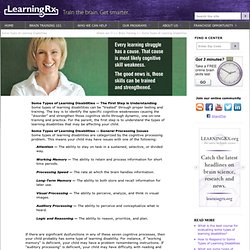
The key is to identify the specific cognitive weaknesses causing the "disorder" and strengthen those cognitive skills through dynamic, one-on-one training and practice. For the parent, the first step is to understand the types of learning disabilities that may be affecting your child. Some Types of Learning Disabilities — General Processing Issues Some types of learning disabilities are categorized by the cognitive processing problem.
This means your child may have issues with one of the following: Attention — The ability to stay on task in a sustained, selective, or divided way. Working Memory — The ability to retain and process information for short time periods. Processing Speed — The rate at which the brain handles information. Long-Term Memory — The ability to both store and recall information for later use. National Council of Teachers of English - Homepage. Ticket To Read® Comprehension - The Reading Lady. Kids Crafts, Games, Recipes & Activities For Early Childhood Education! Special Education Web Site – Parents With Children in Special Education NAPCSE. Apps in Education. Collaborative storytelling.
UDLCAST's Channel Learning Disabilities. Teachers Network for Educators - Lesson Plans, Resources, Videos About Teaching. Adrian Bruce's Educational Teaching Resources-Reading Games-Math Games-Educational Software-Motivational Posters-Line Symmetry-Readers Theater-Art Lessons-Science Lessons- CAST UDL Lesson Builder. Learning Disabilities in Children: Symptoms, Types, and Testing. What are learning disabilities?
Learning disabilities, or learning disorders, are an umbrella term for a wide variety of learning problems. A learning disability is not a problem with intelligence or motivation. Kids with learning disabilities aren’t lazy or dumb. In fact, most are just as smart as everyone else. Their brains are simply wired differently. Learning Disabilities in Children: Symptoms, Types, and Testing. Teaching Students with ADHD (Attention Deficit / Hyperactivity Disorder): Special Education Articles, Tips & Advice for ADD or ADHD Students. Tagxedo - Word Cloud with Styles. Accommodations for Students with ADHD. 30 Ideas for Teaching Children with Attention-Deficit/Hyperactivity Disorder by Leah Davies, M.Ed. By Leah Davies, M.Ed.
The following list may assist teachers who work with ADHD students. For an overview of this disorder see, "Attention-Deficit/Hyperactivity Disorder in Children. " 1. Understand the struggle a student with ADHD has and provide an ordered, safe, predictable classroom environment. 2. 3. 4. 5. 6. 7. Math, English programs, games, worksheets for grades K-8 - Dositey.com educational site. Enjoy a wide range of lessons, practice exercises, step-by-step tutorials, and printable worksheets...
Try today: Home. Siblings fo special needs children. MeeGenius! Developing Reading skills. There is always a debate about teaching reading at F.E level to students with a learning disability(i.e teach them to use the skills they already have rather than learning using phonics) If you do want to have a go at using phonics and teaching tricky words here are some links to help you: A guide from DFES Letters and Sounds guidance from Department of EducationAn introduction to synthetic phonics from dyslexics.org.uk An over view of how and when to introduce the sounds and words can be found at: Phonics Play .
DFES A contibutor to the TES website has listed all the key words in phase order TES High Frequency Words in phase order And here are a few resources for teaching phonics at the early stages. ADE Special Education. Studying with ADHD. Prezi - The Zooming Presentation Editor. Reading Comprehension & Language Arts Teaching Strategies for Kids. PaTTAN. Wrightslaw Special Education Law and Advocacy. Teaching Ideas - Free lesson ideas, plans, activities and resources for use in the primary classroom.
Educators Evaluate Learning Benefits of iPad. The Florida Center for Reading Research. Teacher Lesson Plans, Printables & Worksheets by Grade or Subject. Tweenteacher.com. National Middle School Association - Helping You Achieve Success. Homepage. GreatSchools - Public and Private School Ratings, Reviews and Parent Community. All About Adolescent Literacy.
Pearltrees tips.