
The Hobo Code: An Introduction to the Hieroglyphic Language of Early 1900s Train-Hoppers. In Brandenburg, Germany, Is Europe’s Largest Indoor Beach: The Tropical Islands Resort. The Instagram Account Sharing the World’s Most Striking Swimming Pools. August 17, 2018.

Komorebi - Leslie Nooteboom. Have a look at the project website, komorebi.studio. komorebi is sunlight filtering through leaves, creating a dance of light and shadows where filtered sunrays hit a surface.
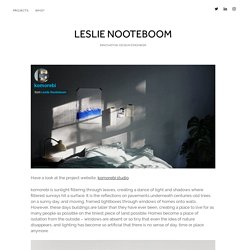
It is the reflections on pavements underneath centuries-old trees on a sunny day, and moving, framed lightboxes through windows of homes onto walls. However, these days buildings are taller than they have ever been, creating a place to live for as many people as possible on the tiniest piece of land possible. Homes become a place of isolation from the outside – windows are absent or so tiny that even the idea of nature disappears, and lighting has become so artificial that there is no sense of day, time or place anymore. komorebi lets you curate natural lighting experiences indoors. Eros Ramazzotti - Otra Como Tu. Jacquard looms: Videos demonstrating early computer programs.
Invented in 1801, Jacquard looms are really an add-on to already existent mechanical loom systems, which allowed those looms to create patterns more complex and intricate than anything that had been done before.

The difference: Punch cards. When you weave, the pattern comes from changes in thread position — which threads were exposed on the surface of the cloth and which were not. But prior to the Jacquard loom, there were only so many threads that any weaver could control at one time, so patterns were simple and blocky. Essentially, the Jacquard system vastly increased the pixels available in any weaving pattern, by automatically controlling lots and lots of threads all at once.
Ramon Llull. Se le considera uno de los creadores del catalán literario[3] y uno de los primeros en usar una lengua neolatina para expresar conocimientos filosóficos, científicos y técnicos, además de textos novelísticos.
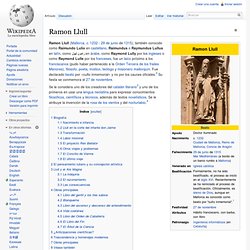
Se le atribuye la invención de la rosa de los vientos y del nocturlabio.[4] Survival books to keep on your bookshelf in case of the apocalypse. Thing in a Jar. Thing in a Jar 7 inches by 4 inches, mason jar Pictured above is the Thing in a Jar that's usually sitting in my office at work.
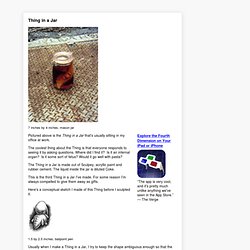
The coolest thing about the Thing is that everyone responds to seeing it by asking questions. UVB-76. UVB-76, also known as "the Buzzer", is the nickname given by radio listeners to a shortwave radio station that broadcasts on the frequency 4625 kHz.[1][2] It broadcasts a short, monotonous buzz tone , repeating at a rate of approximately 25 tones per minute, 24 hours per day.[1] Sometimes, the buzzer signal is interrupted and a voice transmission in Russian takes place.[3] The first reports were made of a station on this frequency in 1982.[4] Its origins have been traced to Russia, and although several theories with varying degrees of plausibility exist, its actual purpose has never been officially confirmed and remains a source of speculation.[5] The name[edit] Format[edit]

WMAC Masters - Ninja Challenge (Part 2) Surfer Almost Swallowed by Whale. The Best/Worst of Jean Claude Van Damme. Tank Graveyards - Buscar con Google. The Hacker Manifesto. By +++The Mentor+++ Written January 8, 1986 Another one got caught today, it's all over the papers.
"Teenager Arrested in Computer Crime Scandal", "Hacker Arrested after Bank Tampering"... Damn kids. Meme. Icono de un Meme Un meme (o mem) es, en las teorías sobre la difusión cultural, la unidad teórica de información cultural[1] transmisible de un individuo a otro, o de una mente a otra, o de una generación a la siguiente.
Es un neologismo acuñado por Richard Dawkins en El gen egoísta (The Selfish Gene), por la semejanza fonética con «gene» —gen en idioma inglés— y para señalar la similitud con «memoria» y «mimesis». Why the future doesn't need us. While some critics have characterized Joy's stance as obscurantism or neo-Luddism, others share his concerns about the consequences of rapidly expanding technology.[1] Summary[edit] Joy argues that developing technologies provide a much greater danger to humanity than any technology before it has ever presented.
In particular, he focuses on genetics, nanotechnology and robotics. He argues that 20th century technologies of destruction such as the nuclear bomb were limited to large governments, due to the complexity and cost of such devices, as well as the difficulty in acquiring the required materials. Grey goo. Grey goo (also spelled gray goo) is a hypothetical end-of-the-world scenario involving molecular nanotechnology in which out-of-control self-replicating robots consume all matter on Earth while building more of themselves,[1][2] a scenario that has been called ecophagy ("eating the environment").[3] The original idea assumed machines were designed to have this capability, while popularizations have assumed that machines might somehow gain this capability by accident.
Definition[edit] The term was first used by molecular nanotechnology pioneer Eric Drexler in his book Engines of Creation (1986). In Chapter 4, Engines Of Abundance, Drexler illustrates both exponential growth and inherent limits (not gray goo) by describing nanomachines that can function only if given special raw materials:
Moravec's paradox. Moravec's paradox is the discovery by artificial intelligence and robotics researchers that, contrary to traditional assumptions, high-level reasoning requires very little computation, but low-level sensorimotor skills require enormous computational resources. The principle was articulated by Hans Moravec, Rodney Brooks, Marvin Minsky and others in the 1980s. Year 2000 problem. The (French) sign reads "3 January 1900" instead of "3 January 2000" Lucid dream. A lucid dream is any dream in which one is aware that one is dreaming.
In relation to this phenomenon, Greek philosopher Aristotle observed: "often when one is asleep, there is something in consciousness which declares that what then presents itself is but a dream".[1] One of the earliest references to personal experiences with lucid dreaming was by Marie-Jean-Léon, Marquis d'Hervey de Saint Denys.[2] Skeptics of the phenomenon suggest that it is not a state of sleep, but of brief wakefulness.[15][16] Others point out that there is no way to prove the truth of lucid dreaming other than to ask the dreamer.[17] Lucid dreaming has been researched scientifically, with participants performing pre-determined physical responses while experiencing a lucid dream.[18][19] Scientific history[edit] Socotra. División por cero. Representación gráfica de la función y = 1/x. Sea Shadow (IX-529) Sea Shadow (IX-529) was an experimental stealth ship built by Lockheed for the United States Navy to determine how a low radar profile might be achieved and to test high stability hull configurations which have been used in oceanographic ships.
Sea Shadow was built in 1984 to examine the application of stealth technology on naval vessels. She was used in secret until a public debut in 1993. In addition, the ship was designed to test the use of automation to enable the reduction of crew size. The ship was created by the Defense Advanced Research Projects Agency (DARPA), the U.S. Navy and Lockheed. Sea Shadow had a SWATH hull design. New Wave science fiction. New Wave is a term applied to science fiction produced in the 1960s and 1970s and characterized by a high degree of experimentation, both in form and in content, a "literary" or artistic sensibility, and a focus on "soft" as opposed to hard science. New Wave writers often saw themselves as part of the modernist tradition and sometimes mocked the traditions of pulp science fiction, which some of them regarded as stodgy, adolescent and poorly written.[1] Overview[edit] Name[edit] The term "New Wave" is borrowed from the French film movement known as the nouvelle vague.[4] Gary K.
Merril later popularized this fiction in the United States through her edited anthology England Swings SF: Stories of Speculative Fiction (Doubleday 1968), although an earlier anthology (Harlan Ellison's Dangerous Visions [Doubleday 1967]) has also come to be referred to as a key work of New Wave science fiction.[7] [8] Johnston Atoll. Johnston Atoll, also known as Kalama Atoll to Native Hawaiians, is an unincorporated territory of the United States currently administered by the United States Fish and Wildlife Service (USFWS) of the Department of the Interior as part of the Pacific Remote Islands Marine National Monument.
Infosphere. Fata Morgana (mirage) Fata Morgana as seen of coast of Manhattan Beach, CA on March 9, 2014. Naga fireball. Binaural beats. Binaural beats. Slow-scan television. Mechanical glow drum slow scan television monitor, A demonstration of mechanical sstv with the latest laser glow drum scanner Slow-scan television (SSTV) is a picture transmission method, used mainly by amateur radio operators, to transmit and receive static pictures via radio in monochrome or color. Since SSTV systems operate on voice frequencies, amateurs use it on shortwave (also known as HF by amateur radio operators), VHF and UHF radio. History[edit] Concept[edit] Numbers station. A numbers station is a type of shortwave radio station characterized by unusual broadcasts, reading out lists of numbers or incomprehensible morse code messages.[1] The voices are often created by speech synthesis and are transmitted in a wide variety of languages.
The Conet Project: Ordering Information. Joseph W. Kittinger and the Highest Step in the World. Balloons : National Archives and Records Administration. Project Excelsior. Mistaken Identity. 9/11 Attacks & Sept. 11 Anniversary. Tank uses thermal camouflage to transform into a cow. Birth of the global mind. Impera el caos en Egipto; el gabinete ofrece su renuncia. The Man Who Told the Internet He'd Come from the Future. The mole people. Little A'Le'Inn. Abandoned Stations. Meet the Bloop, the mysterious sound from the bottom of the Pacific Ocean. The Town Where Everyone Wears A Gas Mask. The Nine Types of Intelligence. Infinity Imagined. Malignant Narcissism & Borderline Personality Disorder. Thee Temple ov Psychick Youth. TOPY: Thee Temple ov Psychick Youth. Infinity Imagined.