
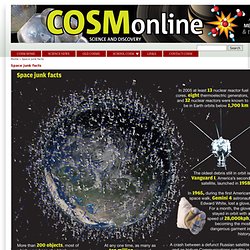
Home. Telescope House the UK No.1 for Telescopes and Binoculars since 1785. Carl Sagan. Astronomy. Astronomy. Astronomy. Astronomy. Space junk facts. Skip to Content Home » Space junk facts Space junk facts Bookmark/Search this post with: Copyright © 2014 .
Copyright 2010 Ben Gilliland Theme by Dr. We are listening. A New Explanation. Photos. Nearby supernovas may aid in understanding of star lifecycles. University Park, Pa. — According to a wealth of new data from NASA's X-ray Observatory, what scientists are calling a "supernova factory" has come to life in the Carnia Nebula, located a mere 7,500 light years from Earth.
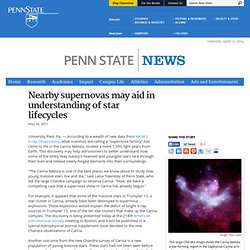
This discovery may help astronomers to better understand how some of the Milky Way Galaxy's heaviest and youngest stars race through their lives and release newly-forged elements into their surroundings. "The Carina Nebula is one of the best places we know about to study how young massive stars live and die," said Leisa Townsley of Penn State, who led the large Chandra campaign to observe Carina. ASTR 1230, Whittle [Fall 2009]. Lecture Notes.
Scientists Discover The Oldest, Largest Body Of Water In Existence. Scientists have found the biggest and oldest reservoir of water ever--so large and so old, it’s almost impossible to describe.

The water is out in space, a place we used to think of as desolate and desert dry, but it's turning out to be pretty lush. Researchers found a lake of water so large that it could provide each person on Earth an entire planet’s worth of water--20,000 times over. Yes, so much water out there in space that it could supply each one of us all the water on Earth--Niagara Falls, the Pacific Ocean, the polar ice caps, the puddle in the bottom of the canoe you forgot to flip over--20,000 times over. The water is in a cloud around a huge black hole that is in the process of sucking in matter and spraying out energy (such an active black hole is called a quasar), and the waves of energy the black hole releases make water by literally knocking hydrogen and oxygen atoms together. The new cloud of water is enough to supply 28 galaxies with water. How white holes (might) be created. Every Mission to Mars Ever.
Ten things you don’t know about black holes. Well, they’re black, and they’re like bottomless holes.

What would you call them? -Me, when a friend asked me why they’re named what they are Ah, black holes. The ultimate shiver-inducer of the cosmos, out-jawing sharks, out-ooking spiders, out-scaring… um, something scary. But we’re fascinated by ‘em, have no doubt — even if we don’t understand a whole lot about them. But then, that’s why I’m here. Space junk facts. First 'habitable' exoplanet confirmed.
Gliese 581d is the outlying planet in the Gliese 581 system, and orbits its parent star every 66.8 days.
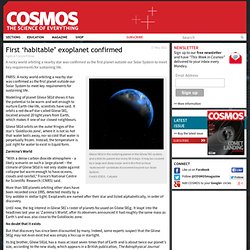
It may be covered by a large and deep ocean and is the first serious 'waterworld' candidate discovered beyond our Solar System. Credit: ESO/L. Calçada PARIS: A rocky world orbiting a nearby star was confirmed as the first planet outside our Solar System to meet key requirements for sustaining life. Modelling of planet Gliese 581d shows it has the potential to be warm and wet enough to nurture Earth-like life, scientists have said. Gliese 581d orbits on the outer fringes of the star’s ‘Goldilocks zone’, where it is not so hot that water boils away, nor so cold that water is perpetually frozen. Zarmina’s World “With a dense carbon dioxide atmosphere – a likely scenario on such a large planet – the climate of Gliese 581d is not only stable against collapse but warm enough to have oceans, clouds and rainfall,” France’s National Centre for Scientific Research (CNRS) said.
German Aerospace Center. Earth View. Radio Waves spread into space. Earth sounds space! Extrasolar Planet. ESO. EarthLOS. Astrofotografie Fotos & Bilder - Astrofotografie Bilder und Fotografien - Himmel & Universum - Natur. Definition of "azimuth" This is the direction of a celestial object, measured clockwise around the observer's horizon from north.
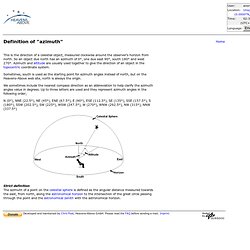
So an object due north has an azimuth of 0°, one due east 90°, south 180° and west 270°. Azimuth and altitude are usually used together to give the direction of an object in the topocentric coordinate system. Moonless Earth Could Potentially Still Support Life, Scientists Say. Scientists have long believed that, without our moon, the tilt of the Earth would shift greatly over time, from zero degrees, where the Sun remains over the equator, to 85 degrees, where the Sun shines almost directly above one of the poles.
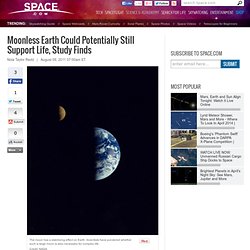
A planet's stability has an effect on the development of life. A planet see-sawing back and forth on its axis as it orbits the sun would experience wide fluctuations in climate, which then could potentially affect the evolution of complex life. However, new simulations show that, even without a moon, the tilt of Earth's axis — known as its obliquity — would vary only about 10 degrees. The influence of other planets in the solar system could have kept a moonless Earth stable. [10 Coolest New Moon Discoveries] The new research also suggests that moons are not needed for other planets in the universe to be potentially habitable.
LiftPort Space Elevator - LiftPort v2.0! 8 Wonders of the Solar System, Made Interactive. ASTR 1230, Whittle [Fall 2009]. Lecture Notes. Most Amazing Time Lapse Video of Milky Way Ever Made. Seriously.