
HTML5 vs Native: The Mobile App Debate. Introduction Mobile apps and HTML5 are two of the hottest technologies right now, and there's plenty of overlap.
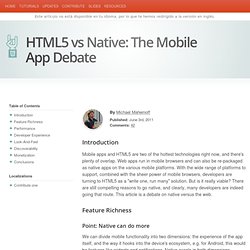
Web apps run in mobile browsers and can also be re-packaged as native apps on the various mobile platforms. With the wide range of platforms to support, combined with the sheer power of mobile browsers, developers are turning to HTML5 as a "write one, run many" solution. HTML5 vs native: advice for the pragmatic developer. HTML5 vs. Native Applications. Top Down Car Example Using Gamejs & Box2D. Bandit Racer - About. 40 Beautiful Free HTML5 & CSS3 Templates. Angular Invoice Example. HTML5 Platformer: the complete port of the XNA game to <canvas> with EaselJS - David Rousset. After a couple of hours coding with JavaScript, I’ve finally finished porting the XNA 4.0 Platformer game sample to HTML5/Canvas with the help of the EaselJS gaming framework.

This article will provide you the game and the story of some of the questions I’ve asked myself while coding it. If you’d like to know how the game works, simply read the JavaScript commented code available at the end of this article. Please note that my main goal was to better learn JavaScript by writing pure JS code (with no form of dependency to the DOM) and to write a cross-browsers working game and cross HTML5 compatible devices when possible also. Create a Game Character with HTML5 and JavaScript { William Malone } By William Malone In this series we will explore how to create a game character using HTML5 Canvas and JavaScript.
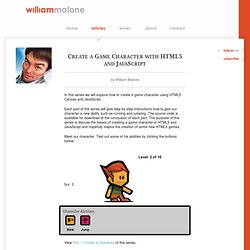
Each part of the series will give step by step instructions how to give our character a new ability such as running and jumping. The source code is available for download at the conclusion of each part. HTML5 Game Development. Turn.js - The page flip effect for HTML5. How To Make a Tile-Based Game with Cocos2D. This post is also available in: Japanese If you're new here, you may want to subscribe to my RSS feed or follow me on Twitter.
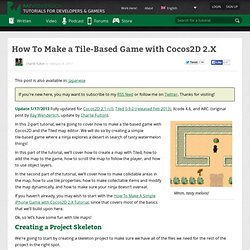
Thanks for visiting! Update 1/17/2013 Fully updated for Cocos2D 2.1 rc0, Tiled 0.9.0 (released Feb 2013), Xcode 4.6, and ARC. (original post by Ray Wenderlich, update by Charlie Fulton). Lost Garden. Not all emotions are created equal.
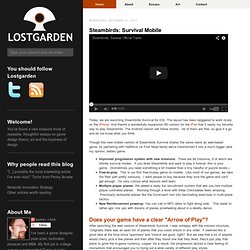
Consider: It is a distinctly different thing to feel sad while reading about a dying mother than to actually feel sad because your mother is dying. The former is a shadowy reflection that we intuitively understand is not immediately threatening. The later is raw, primary and life changing. I've yet to see existing terminology for this phenomena, so at the risk of stepping on existing toes, let's use the following labels. Mozilla/BrowserQuest.
Free video chat API. Authentication REST API calls must be authenticated using a custom HTTP header: X-TB-PARTNER-AUTH.
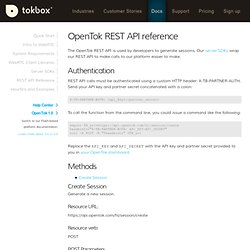
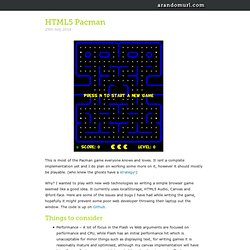
Send your API key and partner secret concatenated with a colon: X-TB-PARTNER-AUTH: <api_key>:<partner_secret> To call the function from the command line, you could issue a command like the following: HTML5 Pacman. Shim for font face This is most of the Pacman game everyone knows and loves.
Daleharvey/pacman. Tutorials. Developing Multiplayer HTML5 Games with Node.js. One day I had some friends over at my house introducing me some cool iPad games.
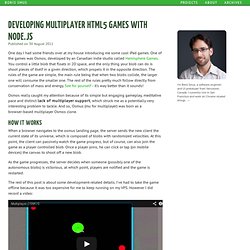
One of the games was Osmos, developed by an Canadian indie studio called Hemisphere Games. You control a little blob that floats in 2D space, and the only thing your blob can do is shoot pieces of itself in a given direction, which propels it in the opposite direction. The rules of the game are simple, the main rule being that when two blobs collide, the larger one will consume the smaller one. The rest of the rules pretty much follow directly from conservation of mass and energy. AT&T Developer Program. A few months ago at work, we decided to build a realtime multiplayer game for the web, and we chose to go with Node.js for our multiplayer server.

It was a pretty strong success, and was up running for several months without a single crash or restart of the Node.js process. We decided to write our game in Node.js because we had heard of this cool platform and had been itching to use it for a while. This turned out to be a blessing because it was very easy to get into, and many interesting Node.js libraries exist to help accomplish various task. A side benefit of using node is that javascript itself is very easy to use. Nowjs for Node - Directly call remote functions in Javascript. Arquitectura de un juego MMO en HTML5 con Node.js y MongoDB. A través de las tecnologías que se agrupan bajo el término HTML5, junto con javascript, se pueden hacer auténticas virguerías.
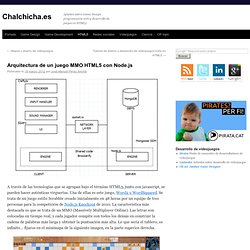
Una de ellas es este juego, Word2 o WordSquared. Se trata de un juego estilo Scrabble creado inicialmente en 48 horas por un equipo de tres personas para la competición de Node.js Knockout de 2010. La característica más destacada es que se trata de un MMO (Massively Multiplayer Online). Las letras son colocadas en tiempo real, y cada jugador compite con todos los demás en construir la cadena de palabras más larga y obtener la puntuación más alta. Lo que sería el tablero, es infinito… fijaros en el minimapa de la siguiente imagen, en la parte superior derecha. Al indagar sobre los creadores de este juego, encontré un valiosisimo artículo escrito por uno de ellos, donde explican con gran detalle como diseñaron y desarrollaron la primera versión del juego en esas 48 horas, las tecnologías que utilizaron, la planificación, etc.
Lenguaje de programación: Javascript. Goodbye Effect Games. Friends, The time has come to shut the doors on Effect Games, so we can move onto other projects. Prototyping for Game Design. HTML5 Quiz, using jQuery Mobile. Downloading Construct 2. Built with appMobi. Intel® XDK HTML5 development environment - develop, emulate, test-on-device and build apps Download Today Intel® XDK a HTML5 cross-platform solution enables developers to write web and hybrid apps once, and deploy across many app stores and form factor devices. Easy-to-use: Streamlined workflow from design to app storeDevelop faster: Integrated design, test, and build toolsDeploy simply: Across more app stores, and form factors Intel XDK is available as a free download for Windows* 7 & 8 , Apple OS X*, and Ubuntu* Linux* Build cross-platform apps easily Intel® XDK streamlined interface is built on Web technologies HTML, CSS, JavaScript*, and Node-Webkit back-end, runs on Windows*, OS X*, and Ubuntu Linux, without browser or Java* dependencies.
Development Tools Built-in Intuitive tools that let you design engaging HTML5 responsive apps in less time. Live Demo. “The simplicity of working with layouts and fonts on Spaceport is marvelous. Much time is spent on Starling, coding to position graphics, align them together, sizing fonts, creating the textures, worrying for the resolution on different devices, etc. All that is gone with Spaceport.” “This allows us to either make a complex game twice as fast or make two simple games in the same time we would have done a Starling game, thus monetizing more.” Case Study: HTML5 MathBoard. Introduction MathBoard on iPad, a PalaSoftware application, is a highly polished application with many subtle but natural animations and a unique realistic look and feel. The goal was to do the highest fidelity port of the iPad application to HTML5.
N2N-Apps is a Software Development company focusing on building next generation of Web and Mobile application with HTML5 technology. The company was funded in 2010 by Jeremy Chone whom, after 11 years of engineering and management experience from Netscape, Oracle, and Adobe, decided to share its expertise with businesses to build high-quality Web and Mobile applications.