
Working Examples - Examples. Home - Game Studies - SJSU Research Guides (LibGuides) at San Jose State University Library. Singapore-MIT GAMBIT Game Lab. q2lwebsite. Jesse Schell: When games invade real life. Playful Learning. Mitgutsch, K. / Schirra S. /, and Verrilli S. (2013).

Search Funded Research Grants and Contracts - Details. Globaloria.org. Digital Play. In the University of Bristol’s Education Endowment Foundation‘s recent study on Neuroscience and Education, (Howard-Jones, 2014), there is an interesting section on Learning Games.

Classroom practice and neuroscientific research The review ”considers the extent to which insights from the sciences of mind and brain influence, or are close to influencing classroom practice”, summarising “existing evidence about approaches and interventions that are based, or claim to be based, on neuroscience evidence.” The report categorises the approaches into 1) those which are likely to have a positive impact on attainment, 2) those which need further testing to determine the likely impact on attainment, and 3) those which do not seem to have a promising impact on attainment. Further research required What is known about Learning Games Popular games stimulate the brain’s reward systemThe brain’s reward response can positively influence the rate we learn. Boredom Busters: 50 Fantastic Play-and-Learn Apps, Sites, and Toys. Digital Tools Teaching Strategies Ansel & Clair's Adventure app features animations, quests, puzzles and games in scenic African locations.

School or no school, there’s a world of learning opportunities for kids. When they’re not exploring outdoors, keep kids engaged in learning throughout the summer months with these enjoyable and educational apps and websites. For kids, playing these games is a cool pastime; for parents, it’s another way to get kids to exercise their thinking muscles. MINECRAFT. MINDSNACKS. Alice in Wonderland app.ALICE IN WONDERLAND. Mission Impossib-Oil. Game-Based Learning: How to Delight and Instruct in the 21st Century (EDUCAUSE Review. © 2004 Joel Foreman, James Paul Gee, J.

C. Herz, Randy Hinrichs, Marc Prensky, and Ben Sawyer. EDUCAUSE Review, vol. 39, no. 5 (September/October 2004): 50–66. Joel Foreman Joel Foreman is an Associate Professor in the English Department at George Mason University. Not long after he completed his Ph.D. at the University of Michigan, Mike Van Lent used his interest in videogames and artificial intelligence to land a research professorship at the University of Southern California (USC). Herein lies a moral about how videogames (arguably one of the most sophisticated forms of information technology to date) are influencing higher education. We discussed the following six topics: I spoke with each of the five individually, culled their comments from several hours of recordings, and then combined the comments to simulate the continuity and interaction of a group discussion. The best browser games of 2011. The Sawbuck Gamer column, our recurring roundup of free and dirt-cheap games, is notorious for destroying readers’ productivity with the siren song of interactive procrastination.

While you’re home for the holidays, however, it can serve an even nobler purpose: helping you ignore your relatives. Below are our favorite free browser games from the year in Sawbuck. The list contains more than enough instant-gratification gaming to distract you while your right-wing uncle rants about Hawaiian birth certificates, your sister preaches the benefits of raw-locavore veganism, and everyone has the annual argument over what to do about Grandpa. Mimi Ito - Weblog. Cross posted from the Connected Learning Research Network Leveling Up project blog It’s the start of a new year and time to take stock.

Embedded Assessment at Quest to Learn. Four eleven-year olds focus their attention on a game board.

One girl rolls a set of dice. The boy across from her scribbles something on a sheet of paper, grins, and then exclaims,“The frequency of 7 is the highest, so far!” What? Since when do eleven-year olds discuss frequency while playing a game with such enthusiasm? This is a regular occurrence at Quest to Learn, a public middle school in New York City’s District Two. Embedded assessment is any assessment given to students during their learning process. To play the game, students roll a pair of dice and use the resulting sum to construct a caterpillar on a numbered game board. During game play, the teacher circulates around the room and monitors student learning.
Games for Change blog. Get ready to play—the 2014 Games for Change Award nominees are here!

Narrowed down from a field of over 140 titles, these eight finalists will compete for the winning prize across three categories: Most Innovative, Most Significant Impact, and Best Gameplay. The winning games will be announced on April 23 at the 11th Anniversary Games for Change Festival, and one will be named Game of the Year, as the game that best represents all three categories. You can register for the Games for Change Festival here. Have questions for the developers of these nominated games?
Leave them in the comments, so we can ask them in an upcoming series of interviews with the creators of these games for change. Most Innovative Nominees. Issue 1103, 2011. A Survey of First-person Shooters and their Avatars by Michael Hitchens A survey of over 550 first-person shooters, The titles are compared by year of release, platform and game setting.
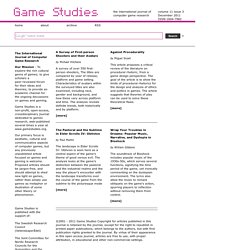
Characteristics of avatars within the surveyed titles are also examined, including race, gender and background, and how these vary across platform and time. The analysis reveals definite trends, both historically and by platform. [more] Against Procedurality by Miguel Sicart. Gamestar Mechanic. Serious Games Initiative.