
Cancelling the Beat Generation - Quillette Articles - Quillette Circle. A Surreal End for an Unforgettable Queen: Pedro Lemebel, 1952-2015. Pedro Lemebel, the Chilean writer, artist, activist, and provocateur, died last Friday morning of laryngeal cancer.
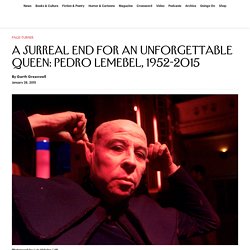
By the afternoon, newspapers in Latin America and Spain teemed with tributes. In his native Santiago, hundreds gathered for his funeral on Saturday, and celebrities and politicians competed to offer the most extravagant praise. “Pedro Lemebel is an essential figure of Chile, a great artist who leaves an enormous void in the country,” said Claudia Barattini, the minister of culture.
Children's Literature. Literary Theory. Literature in Translation. Reading. The Berlin Review of Books. By Frank Berzbach When reading certain books, I am sometimes tempted to jot down my thoughts in a blog.
Reading the almost 450 pages of Wolfgang Herrndorf’s diary, first published online and now as a hardcover, took me about two weeks. During those two weeks, I could have written about it every single day. Herrndorf’s account begins with his being diagnosed with a brain tumour in March 2010 and ends with his suicide in August 2013. I must admit that, when it comes to reading, what grips me is the prospect of identification: I rarely buy books in order to immerse myself in the study of abstract textual systems, and I am also committed to the – perhaps antiquated – belief that authors and humans really do exist. I immediately get stuck with passages where I am certain: I cannot continue reading this! Award Ceremony for ‘Tschick’ (Leipzig Book Fair 2011); Source: Wikimedia Commons (photo by Amrei-Marie, used under CC-BY SA 3.0 Creative Commons License) Reading is an active process.
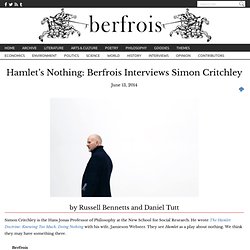
Cubicles Rise in Brave New World of Publishing. Set Your Thoughts Free - Hemingwrite. Et Spøgelse: Berfrois Interviews Simon Critchley. By Russell Bennetts and Daniel Tutt Simon Critchley is the Hans Jonas Professor of Philosophy at the New School for Social Research.
Holocaust Told in One Word, 6 Million Times. Photo JERUSALEM — There is no plot to speak of, and the characters are woefully undeveloped.
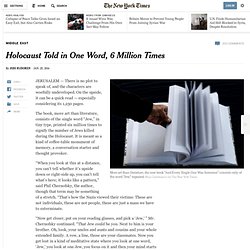
On the upside, it can be a quick read — especially considering its 1,250 pages. The book, more art than literature, consists of the single word “Jew,” in tiny type, printed six million times to signify the number of Jews killed during the Holocaust. It is meant as a kind of coffee-table monument of memory, a conversation starter and thought provoker. Writers and Rum: Why Authorship and Alcohol Have Gone Together. “Writers in this office used to drink,” a grizzled veteran of these corridors once said sternly to a couple of pup reporters, whom he had discovered taking turns trying on a good-looking cashmere jacket in another cubicle.
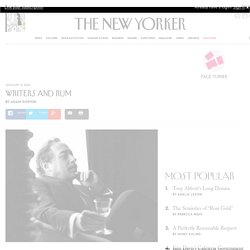
The moral, abashing if not shaming, was that in the halls where once real men had roamed, or drank in peaceable closets, now mere jacket-fanciers wandered. Certainly, it’s impossible to turn the past pages of this magazine, or the pages of American literary history, for that matter, without being reminded of how inextricable the drinking life and the writing life—or, to put it more bluntly, alcoholism and art—once were. From St. How I learned to stop worrying and love Amazon. Photo: Ralph D Fresco / Reuters I have a confession.
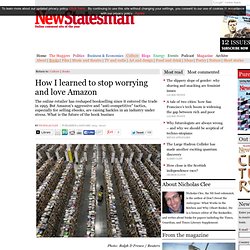
I like buying books online. From Amazon. In Praise of Failure by Pierre Bayard translated by Suzanne Menghraj. Several of the critics who appraised Pierre Bayard’s How to Talk About Books You Haven’t Read.
The origin and development of the quotation mark. The earliest book discovered in which appeared indicia which may properly be termed marks of quotation was printed in 1516 at Strasbourg, Alsace (then in Germany), by Mathias Schurer. It was “De Vitis Sophistarum” by Flavius Philostratus. The marks consisted of two commas in the left hand margin of each page outside the regular type measure. They were placed at the beginning of each line in which a quoted passage appeared, and were evidently added after the page was set up, because their alignment varies greatly.
Excerpt: 'The Book of Genesis: A Biography' by Ronald Hendel. Noah’s Offering, Francesco Castiglione, 17th C From The Comedy of the Real: Henry Miller’s Reflections on Writing. Digital and Paper Diaries Are Written for an Imagined Audience - Room for Debate. “I have tried to keep diaries before but they didn’t work out because of the necessity to be honest.”
Best Writing Music of 2012. Joan Didion on Keeping a Notebook. By Maria Popova “We are well advised to keep on nodding terms with the people we used to be, whether we find them attractive company or not.”
As a lover — and keeper — of diaries and notebooks, I find myself returning again and again to the question of what compels us — what propels us — to record our impressions of the present moment in all their fragile subjectivity. From Joan Didion’s 1968 anthology Slouching Towards Bethlehem (public library) — the same volume that gave us her timeless meditation on self-respect — comes a wonderful essay titled “On Keeping a Notebook,” in which Didion considers precisely that. Though the essay was originally written nearly half a century ago, the insights at its heart apply to much of our modern record-keeping, from blogging to Twitter to Instagram. Frank Kermode · Writing about Shakespeare has his say · LRB 9 December 1999. Fifty-odd years ago I was asked to review a book about Shakespeare by an aged professor who claimed that a career spent largely in teaching Shakespeare gave him a right to have his final say on the subject.
This notion I thought grossly self-indulgent. There seemed to be little reason to believe that at his age he could suddenly have found anything interesting to say. 23 Aphorisms by Yahia Lababidi. Penguin and Random House may merge, but the power lies elsewhere. A merger of Random House and Penguin would create a £2.5bn trade publisher – by some distance the biggest ever seen.
Authors such as E L James, Salman Rushdie, John le Carre, Pippa Middleton, and Jamie Oliver may become bedfellows. 15 Postcards from Famous Authors.
Why Does Everyone Love It But Me? An Interview with Daniel Mendelsohn. Every Book I’m Shufflin’ Ten Famed Literary Figures Based on Real-Life People. Writers are often told to write what they know, so it should come as no surprise that many of the most famous characters in literary history are based on real people. Whether drawing inspiration from their spouses, friends and family, or finally, after decades worth of work, inserting themselves into the text, authors pull nearly every word and sentence from some element of reality, and most often, that element is people. Excerpt: 'The Gentrification of the Mind' by Sarah Schulman. John Preston From Chapter Six: The Gentrification of Our Literature. A Critic's Manifesto: The Intersection of Expertise and Taste. Los Angeles Review of Books - Cogito Ergo Boom.
88 Books That Shaped America, According To Library Of Congress. On Friday, the Library of Congress released its list of the "books that shaped America. " John Sutherland on Leah Price's How to Do Things with Books in Victorian Britain. John Sutherland Paper Promises How to Do Things with Books in Victorian Britain By Leah Price (Princeton University Press 350pp £19.95)
Writing Britain: the nation and the landscape. Library Science - Essays. Ruth Franklin: How A New Clip Of Anne Frank’s Life Brings Us Closer To Her Death. ‘Revelations,’ by Elaine Pagels. Prelim Ext English Gothic Literature. Morris Lessmore and the cult of literary nostalgia. A literary engagement. Poetry. Prose. Leah Price. Edgar Allan Poe. Borges.