
Colour words in many languages. This section contains the colour words that have been indentified in various studies as the most common across most languages, although the actual colours represented by each of the colour words are not nescessarily exactly the same.
For example, in Greek and Russian there are two words for blue corresponding to light blue and dark blue, and these colours are considered and perceived as separate. In other languages there are overlaps between blue, green and grey, or red, orange and brown. Colour words in individual languages Austroasiatic languages. Languages - Event - The European Day of Languages, 26th September. Omniglot - the guide to languages, alphabets and other writing systems.
Learning Foreign Languages boosts brain power. OK so this is nothing new and I am not posting anything that people don't know already.
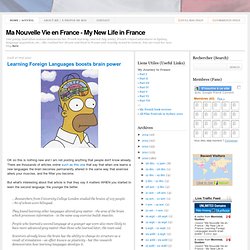
There are thousands of articles online such as this one that say that when one learns a new languages the brain becomes permanently altered in the same way that exercise alters your muscles, and the fitter you become. But what's interesting about that article is that they say it matters WHEN you started to learn the second language, the younger the better. Comparative table of languages and language profiles for the prospective learner.
How to learn any language. Lingu@net. Podcasts, radio, mp3.