
Eukaryote. Eukaryotes can reproduce both asexually through mitosis and sexually through meiosis and gamete fusion.
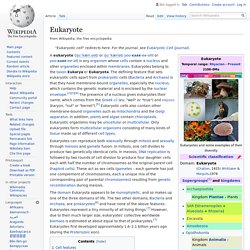
In mitosis, one cell divides to produce two genetically identical cells. In meiosis, DNA replication is followed by two rounds of cell division to produce four daughter cells each with half the number of chromosomes as the original parent cell (haploid cells). These act as sex cells (gametes – each gamete has just one complement of chromosomes, each a unique mix of the corresponding pair of parental chromosomes) resulting from genetic recombination during meiosis. Cell features[edit] Eukaryotic cells are typically much larger than those of prokaryotes. Internal membrane[edit] Detail of the endomembrane system and its components A 3D rendering of an animal cell cut in half. The nucleus is surrounded by a double membrane (commonly referred to as a nuclear membrane or nuclear envelope), with pores that allow material to move in and out. Vesicles may be specialized for various purposes.
Opisthokont. Flagella[edit] One common characteristic of opisthokonts is that flagellate cells, such as most animal sperm and chytrid spores, propel themselves with a single posterior flagellum.
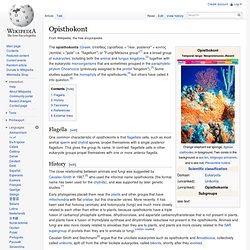
This gives the group its name. In contrast, flagellate cells in other eukaryote groups propel themselves with one or more anterior flagella. History[edit] The close relationship between animals and fungi was suggested by Cavalier-Smith in 1987,[6] who used the informal name opisthokonta (the formal name has been used for the chytrids), and was supported by later genetic studies.[7] Early phylogenies placed them near the plants and other groups that have mitochondria with flat cristae, but this character varies. Cavalier-Smith and Stechmann[8] argue that the uniciliate eukaryotes such as opisthokonts and Amoebozoa, collectively called unikonts, split off from the other biciliate eukaryotes, called bikonts, shortly after they evolved. Taxonomy[edit] One hypothesis of eukaryote relationships References[edit] Holozoa. Holozoa is a group of organisms that includes animals and their closest single-celled relatives, but excludes fungi.[1][2][3] [4] Holozoa is also an old name for the tunicate genus Distaplia.[5] Because Holozoa is a clade including all organisms more closely related to animals than to fungi, some authors prefer it to recognizing paraphyletic groups such as Choanozoa, which mostly consists of Holozoa minus animals.[6] Perhaps the best-known holozoans, apart from animals, are the choanoflagellates, which strongly resemble the collar cells of sponges, and so were theorized to be related to sponges even in the 19th century.
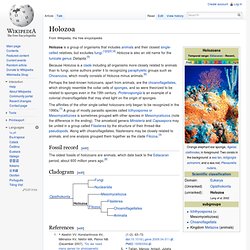
Proterospongia is an example of a colonial choanoflagellate that may shed light on the origin of sponges. The affinities of the other single-celled holozoans only began to be recognized in the 1990s.[7] A group of mostly parasitic species called Icthyosporea or Mesomycetozoea is sometimes grouped with other species in Mesomycetozoa (note the difference in the ending). Filozoa. The Filozoa are a monophyletic grouping within the Opisthokonta.
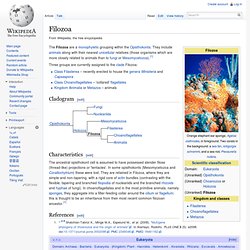
They include animals along with their nearest unicellular relatives (those organisms which are more closely related to animals than to fungi or Mesomycetozoa).[1] Three groups are currently assigned to the clade Filozoa: Cladogram[edit] Characteristics[edit] The ancestral opisthokont cell is assumed to have possessed slender filose (thread-like) projections or 'tentacles'.