
Science Experiments. Just for You from YouTube: Daily Update - Dec 26, 2012 - janetchodos - Hartlandschools.us Mail. Study reveals ancient jigsaw puzzle of past supercontinent. A new study published today in the journal Gondwana Research, has revealed the past position of the Australian, Antarctic and Indian tectonic plates, demonstrating how they formed the supercontinent Gondwana 165 million years ago.
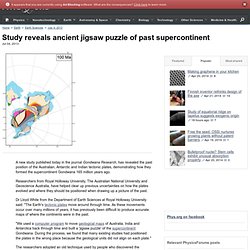
Researchers from Royal Holloway University, The Australian National University and Geoscience Australia, have helped clear up previous uncertainties on how the plates evolved and where they should be positioned when drawing up a picture of the past. Dr Lloyd White from the Department of Earth Sciences at Royal Holloway University said: "The Earth's tectonic plates move around through time. Full STEAM Ahead: DIY Ideas for Hands-On Science, Tech, Engineering, Art, and Math.
Eva makes scenes that she photographed for her book The Kinzy Chronicles Eva is a maker.
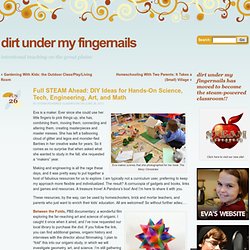
Ever since she could use her little fingers to pick things up, she has, combining them, moving them, connecting and altering them, creating masterpieces and master messes. She has left a ballooning cloud of glitter and legos and monster-fied Barbies in her creative wake for years. So it comes as no surprise that when asked what she wanted to study in the fall, she requested a “makers” year. Making and engineering is all the rage these days, and it was pretty easy to put together a host of fabulous resources for us to explore. AIMS Education Foundation.
Www.msc.ucla.edu/oceanglobe/pdf/earth_volcano.pdf. Enhancing Your STEM Curriculum. Could you dig a hole all the way to the Earth’s mantle?" Magnetism - Magnetic Field Lines. Earth's Magnetic Field Made Quick Flip-Flop. Earth's magnetic field reversed extremely rapidly soon after modern humans first arrived in Europe, completely flip-flopping in less than a thousand years.
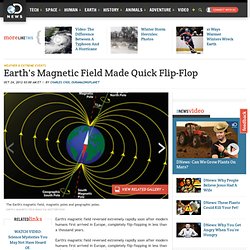
Earth's magnetic field reversed extremely rapidly soon after modern humans first arrived in Europe, completely flip-flopping in less than a thousand years, new research suggests. PHOTOS: Earth Perspectives Through the Ages These findings, detailed Oct. 15 in the journal Earth and Planetary Science Letters, could shed light on how and why magnetic field reversals happen, and how they leave Earth vulnerable to solar and space radiation, the study scientists said.
Earth's metal core acts like a giant magnet that emanates a magnetic field with two poles, north and south. These two magnetic poles very roughly match where the planet's geographic north and south poles lie, which mark the axis on which Earth spins. Home and City. Siemensscienceday.discoveryeducation.com/pdf/what_lies_beneath.pdf. The Scientific Method. Go Green Lunch Box - "Where ecology and style meet for lunch! " To read customer Testimonials, go directly to Testimonials Press As seen in bentonbetterlunches.com September 2012 As seen in eat-drink-garden.com August 2012 As seen in Metroplexbaby.com April 2012 As seen on Heal the BAY's KTLA Television Appearance Sept 2011 As see in The Daily Breeze Sept 2011As seen in San Diego Family Magazine Sept 2011 As sene in Scholastic Parent Aug/Sept 2011 As seen on www.epicurious.com, August 2011 PressAs seen in C magazine, May 2011 As seen on…….manhattanbeach.patch.com As seen on…….Babyology As seen on…….ABC Chicago in August 2010 As seen on…….
The Today Show on August 25th, 2010 Click the image below to watch the video As seen on……. www.theglobeandmail.com September 2010 click on the image below to watch the video segment As seen in……. Kiwi Magazine September 2010 As seen in……. Burke's Backyard Magazine August 2010 As seen in……. Great Lakes Life June 2010 As seen on……. FA18 extended view of Space Shuttle Endeavour's flyover Southern California. Mlebyrne's Photostream.
Live Broadcast. Curiosity Rover Report (Aug. 31, 2012) Sarah Brightman will sing in space. Follow Sarah Brightman on her journey to Russia's Star City to begin her medical assessment for spaceflight.
By Alan Boyle, Science Editor, NBC News. Curiosity Rover Report (Sept. 28, 2012) Mars Streambed. Aerial Photographs of Volcanic Iceland by Andre Ermolaev. At first glance these photos by Andre Ermolaev look like twisting abstract paintings, but in reality are aerial photos of rivers flowing through Iceland’s endless beds of volcanic ash.
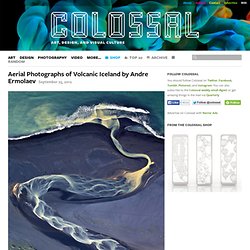
Given its name and stereotypical depiction it’s somewhat surprising to learn that the small country named after ice is home to no less than 30 active volcanic systems. You’ll remember the eruption of the massive Grímsvötn volcano just last year that spewed some 120 million tons of ash in the first 48 hours and snarled air traffic for days. Youtube.googleapis.com/v/XRCIzZHpFtY. Earth's Not-So-Juicy Center.
Neil Armstrong Tribute. Murmuration. Top 5 Coolest Things about Curiosity. Where Were You When Curiosity Landed on Mars? Bush Declares Marine Preserves In Pacific. Eyes on the Solar System. Mars Science Laboratory, the Next Mars Rover. Multimedia - Video Gallery. MOSART Test Inventory. The tests available on this web site were developed by a team of researchers in the Science Education Department of the Harvard-Smithsonian Center for Astrophysics.
The content of the questions is based on published studies of science misconceptions and the NRC National Science Education Standards. Research scientists in the specific content areas evaluated draft questions for scientific accuracy and the development team iterated revisions with the scientists until all comments were resolved. Science Experiments, Videos, and Science Fair Ideas at Sciencebob.com. Instruction versus exploration in science learning. Welcome to the fourth-grade science fair, with its baking-soda volcanoes, bread mold grown in drawers, proud parents and thoughtful judges.
The teachers can't help but wonder if the young would-be scientists can tell good science from bad. In science, how is critical thinking best taught? This question may be answered by David Klahr, PhD, a psychology professor at Carnegie Mellon University, and Milena Nigam, a research associate at the University of Pittsburgh's Center for Biomedical Informatics. 2004 Indian Ocean earthquake and tsunami. The 2004 Indian Ocean earthquake was an undersea megathrust earthquake that occurred at 00:58:53 UTC on Sunday, 26 December 2004, with an epicentre off the west coast of Sumatra, Indonesia.
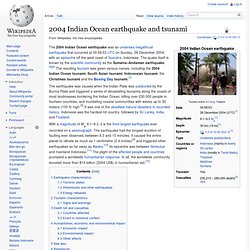
The quake itself is known by the scientific community as the Sumatra–Andaman earthquake.[5][6] The resulting tsunami was given various names, including the 2004 Indian Ocean tsunami, South Asian tsunami, Indonesian tsunami, the Christmas tsunami and the Boxing Day tsunami.[7] The earthquake was caused when the Indian Plate was subducted by the Burma Plate and triggered a series of devastating tsunamis along the coasts of most landmasses bordering the Indian Ocean, killing over 230,000 people in fourteen countries, and inundating coastal communities with waves up to 30 meters (100 ft) high.[8] It was one of the deadliest natural disasters in recorded history.
Indonesia was the hardest-hit country, followed by Sri Lanka, India, and Thailand. Earthquake characteristics. The ENERGY Song - Mr. Edmonds - Rock with "That's the Way - I Like It" music theme ! Earth Day Lessons for Teachers Using the SMART Board Interactive Whiteboard. Classroom technology just got smarter with Notebook collaborative learning software.
Teachers can easily design dynamic lesson activities using Notebook software and deliver those lessons on their SMART Board interactive whiteboards. Notebook software has a work area, easy-to-use tools, and content. The lessons provided on this site will give you a taste of the many exciting things you can do in Notebook software. You can see just how easy it is to create and deliver lessons that are interesting and interactive while reinforcing learning objectives. In order to view these lesson activities, please download the interactive viewer here.
Natural Resources (Grade 4) by Aysha Ames Learn to identify renewable versus nonrenewable resources, their origins, and how humans use them in their daily lives.
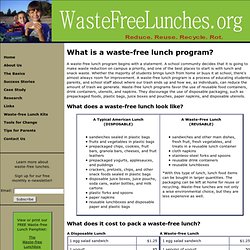
Symbiotic Relationships (Ecology) Physical science. Bottle Biology. NPR Science: Ants That Count! Look Up! The Billion-Bug Highway You Can't See by NPR. Waste-free Lunches - What is a waste-free lunch program? A waste-free lunch program begins with a statement.
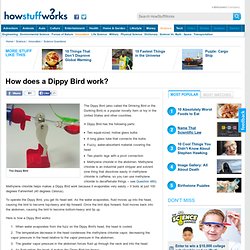
How does a Dippy Bird work?" The Dippy Bird (also called the Drinking Bird or the Dunking Bird) is a popular novelty item or toy in the United States and other countries.
Lampreys from Great Lakes destined for queen's pie. Michigan Sea Grant Great Lakes Education - Project Flow. Learningscience.org. Great Lakes Invasive Species Documentary Trailer.