
Greening the Desert. DIY - in the wild. Motor magnetico. Free Energy - How to Build Magnetic Power Generator for Home // To Our Faithful Current.com Users: Current's run has ended after eight exciting years on air and online.

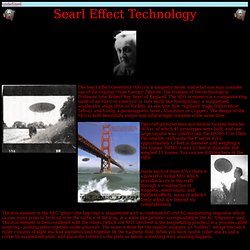
The Searl Effect Generator - Ultimate Overunity? Undefined Searl Effect Technology.
Searl Effect Generator (SEG) From PESWiki Artist animation illustrating the three rings with rollers.
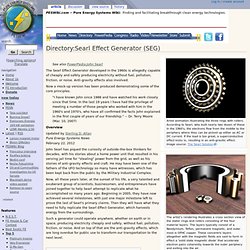
According to Searl, who built nearly two dozen of these in the 1960's, the electrons flow from the middle to the periphery where they can be picked up either as AC or DC current. If the load is too great, a superconductive effect kicks in, resulting in an anti-gravitic effect.Image source: The Searl Solution. The artist’s rendering illustrates a cross section view of the stator rings and rollers consisting of the four material layers. HHO Energy. Info International Affairs Reviews 1. Institute for Energy and Environmental Research Homepage. EcoGeek - Brains for the Earth. Home - Protecting rainforests with Cool Earth Action - Keeping carbon where it belongs.
The Copenhagen Diagnosis. Associations. Green-careers-guide. WATER SOUND IMAGES. Dolphin play bubble rings. Eco-issues. Global. Sites écologiques et pratiques. Journey Into Amazonia. Green Treasure - The Useful Plants of the Amazon Valley by Michael J.
Balick, Ph.D. Since the earliest adventurers explored the Amazon Valley, their quest has been for its treasures -- minerals, oil, animal skins, precious stones and metals, to name a few. At times, they have succeeded -- gold, emeralds, petroleum, and other raw materials so important to Western civilization have been exported from this vast region.
However, by "taming" the forest and extracting its wealth, biological diversity has become the victim. Worldchanging: Bright Green. GoodCleanTech - The Independent Guide to Ecotechnology. Divers Free Whale and Receive Rewards of Love. The Whale...If you read a recent front page story of the San Francisco Chronicle, you would have read about a female humpback whale who had become entangled in a spider web of crab traps and lines.
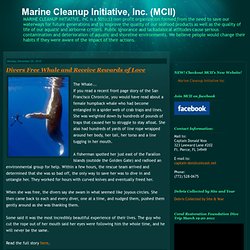
She was weighted down by hundreds of pounds of traps that caused her to struggle to stay afloat. She also had hundreds of yards of line rope wrapped around her body, her tail, her torso and a line tugging in her mouth. Marine Research Foundation - Research. In July, our crew heads to one of the most polluted areas of the world.
This place, 1,000 miles away from land, redefined Algalita’s mission and ignited a fire to study the plastic plague destroying our oceans. This is the North Pacific Gyre, home of the swirling vortex of plastic trash. Our founder Captain Charles Moore discovered the “plastic soup” in 1997. Our research team, headed by Captain Moore once again, will journey to the center of the widely known “Great Pacific Garbage Patch.” There, we’ll conduct an intensive 30-day exploration of how plastic pollution has affected the marine environment. Marine Debris Program - Marine Debris Info. The name “Pacific Garbage Patch” has led many to believe that this area is a large and continuous patch of easily visible marine debris items such as bottles and other litter —akin to a literal island of trash that should be visible with satellite or aerial photographs.
While higher concentrations of litter items can be found in this area, along with other debris such as derelict fishing nets, much of the debris is actually small pieces of floating plastic that are not immediately evident to the naked eye. The debris is continuously mixed by wind and wave action and widely dispersed both over huge surface areas and throughout the top portion of the water column. It is possible to sail through the “garbage patch” area and see very little or no debris on the water’s surface. It is also difficult to estimate the size of these “patches,” because the borders and content constantly change with ocean currents and winds. Home. Energyrevolutionreport.pdf (application/pdf Object)
Consommateur et Environnement. Globo Amazônia - Veja as últimas notícias e proteste contra queimadas e desmatamento. Energy Tower: Power for 15 Earths? Researchers have designed a product that its inventors claim could easily produce between 15 and 20 times the total electricity the world uses today.
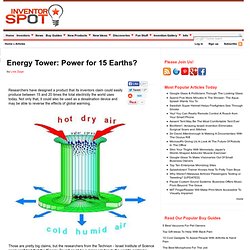
Not only that, it could also be used as a desalination device and may be able to reverse the effects of global warming. Those are pretty big claims, but the researchers from the Technion - Israel Institute of Science seem confident that the "Energy Tower" could be a major solution to the world's problems. They've been working on the concept since 1983, and together have spent more than 150 man-years researching, designing, testing, and analyzing. As project founder Professor Dan Zaslavsky explains, the Energy Tower works on the basic principle of convection: hot air rises and cold air falls. SmartPlanet - We Make You Smarter - People, Business & Technology.
Visualization Lab. AlGore.com. Energy and Environment - Green Blog. TreeHugger. Science.gov : USA.gov for Science - Government Science Portal. TRIANGULATION BLOG: Heike Weber. Instalaciones realizadas por Heike Weber, dibuja con rotulador sobre acrílico en suelo y paredes, superficies que han llegado a alcanzar los 600 m2.

En su web se pueden ver todas sus obras, que no son pocas, Weber tiene un gran recorrido artistico. Ver más dentro del post;