
Read and write windows INI files in VBSscript.
How to construct chords - Piano Clues: Free tips and lessons for playing piano, organ and electronic keyboard. You don’t need a “1000 Chords Dictionary” to be able to read and play chords.
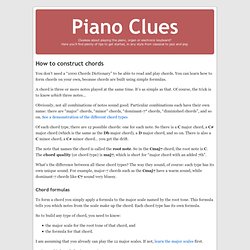
You can learn how to form chords on your own, because chords are built using simple formulas. A chord is three or more notes played at the same time. It’s as simple as that. Of course, the trick is to know which three notes… Obviously, not all combinations of notes sound good. Of each chord type, there are 12 possible chords: one for each note. The note that names the chord is called the root note. What’s the difference between all these chord types? Chord formulas To form a chord you simply apply a formula to the major scale named by the root tone. So to build any type of chord, you need to know: the major scale for the root tone of that chord, andthe formula for that chord. I am assuming that you already can play the 12 major scales. Let’s put this knowledge into practice. The formula for major chords is: 1 – 3 – 5 We know that the scale for C major is: There are also formulas that contain the symbols b and #. Latest Technology News.
Chord Calculator. Learning and Loving Music Theory. Kelvin, You actually caught a mistake on the roman numerals!
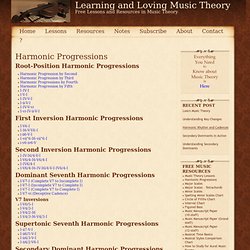
Thanks, I’ll have to fix that. The first and last chords of the progression are not 7th chords. Somehow I inadvertently typed “I7″ on the first chord of all the major keys. (Notice that I didn’t do that for the minor keys.) In the classical tradition, for the sake of stability, the first and last chords of a circle-of-fifths progression are usually triads, not 7th chords. Harmonic Sequences Part 2 In the jazz tradition all chords usually are 7ths, in which case the progression will start and end with 7th chords. Thanks again for your interest and input. ChordFind.Com - Guitar Chord Finder. Teoría - Music Theory Web. VBScript samples, PowerShell samples, discussion forums, training resources, and more. 70 Things Every Computer Geek Should Know.
The term ‘geek’, once used to label a circus freak, has morphed in meaning over the years. What was once an unusual profession transferred into a word indicating social awkwardness. As time has gone on, the word has yet again morphed to indicate a new type of individual: someone who is obsessive over one (or more) particular subjects, whether it be science, photography, electronics, computers, media, or any other field.
A geek is one who isn’t satisfied knowing only the surface facts, but instead has a visceral desire to learn everything possible about a particular subject. A techie geek is usually one who knows a little about everything, and is thus the person family and friends turn to whenever they have a question. If you’re that type of person and are looking for a few extra skills to pick up, or if you’re a newbie aiming to get a handhold on the honor that is geekhood, read on to find out what skills you need to know. How to become a real computer Geek? You may get the answer here: