
Resources for Assessment in Project-Based Learning. Transformation Central - Project-Based Learning. These teacher-developed Project-Based Learning Units are intended as an idea-generation resource, as these units may reflect alignment to outdated standards.

Please consider alignment and adjust these units to current standards prior to classroom implementation. Check out our PBL Online Workshops! Archived PBL These units have been archived and will no longer be updated. Transformation Central does not guarantee the alignment to the TEKS or state assessment. High Tech High - Project Based Learning. Seven Successful PBL Projects In March 2005 High Tech High received a $250,000 grant from the California Department of Education to disseminate project-based learning methods to teachers in non-charter public schools.
As part of the project, High Tech High teachers have documented successful projects to share with collaborating teachers from local districts and across the HTH network. The current volume presents the fruits of these labors. The aim is simple: to offer practitioners useful, easily adaptable models of real projects. Read more... This New House How does human habitation affect the environment? Learn more » Wall-to-wall project-based learning: A conversation with biology teacher Kelley Yonce.
At the mid-point of the 2008-09 academic year, according to the North Carolina Standard Course of Study, East Wake School of Integrated Technology biology teacher Kathleen (Kelley) Yonce needed to introduce her class of 20 sophomores to deoxyribonucleic acid, a.k.a.

DNA. Integrated PBL Projects: A Full-Course Meal! In the project-based learning field, we use the metaphor that projects are the "main course, not the dessert" (as coined in an article from the Buck Institute for Education).
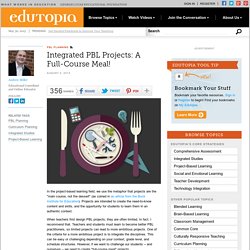
Projects are intended to create the need-to-know content and skills, and the opportunity for students to learn them in an authentic context. When teachers first design PBL projects, they are often limited. In fact, I recommend that. 20 Tips On How To Work With Students Who Have a Hard Time Collaborating. Professional Goal: Dive Into Project-based Learning - Philip Cummings. I love that my school is deeply committed to providing teachers with quality, on-going professional growth and development.

Among the many things we do each year at PDS for professional development, teachers create an individual professional development goals directly related to classroom teaching and learning. Each goal should have practical application and impact in the current year and align with broader institutional goals and philosophies. Getting into the PBL Groove. CELL at UIndy » PBL Resources. Project Based Learning Science – Lesson Plans for PBL. Putting together a PBL science plan can be enormously time consuming without excellent models.
So here are hundreds of free detailed plans for projects for elementary, middle and high school students. The plans are sorted by discipline - astronomy and space, chemistry, engineering and architecture, physics, technology, and earth, life sciences, physical sciences, and... well, "other" for no clear fit. Most of the ones I've listed provide project overviews, guiding questions, procedures and activities, work product descriptions, grading rubrics, and questions for reflection. The first PBL project I planned many years ago was the creation of a butterfly habitat in the school garden by my 3rd graders. I think the planning took more time than the project, and I didn't have a lot of resources to help guide me.
Maine East students build upon geometry lessons. The PBL Academy. CASES Online: Creating Active Student Engagement in the Sciences. What is CASES Online?
CASES Online is a collection of inquiry-based lessons to engage K-12 and undergraduate students in exploring the science behind real-world problems. Through CASES, you can transform your students into motivated investigators, self-directed and life-long learners, critical thinkers and keen problem solvers. Our cases are grounded in Problem-Based Learning (PBL), Investigative Case-Based Learning (ICBL), and related student-centered pedagogies. [more] What's new in CASES Online? Materials for over 350 cases are now posted and we are continually working to publish more.
Project-Based Learning Through a Maker's Lens. The rise of the Maker has been one of the most exciting educational trends of the past few years.

A Maker is an individual who communicates, collaborates, tinkers, fixes, breaks, rebuilds, and constructs projects for the world around him or her. A Maker, re-cast into a classroom, has a name that we all love: a learner. A Maker, just like a true learner, values the process of making as much as the product. In the classroom, the act of Making is an avenue for a teacher to unlock the learning potential of her or his students in a way that represents many of the best practices of educational pedagogy.
A Makerspace classroom has the potential to create life-long learners through exciting, real-world projects. Making holds a number of opportunities and challenges for a teacher. What Do You Want to Do? The first step in designing a PBL unit for a Maker educator is connecting specific content standards to the project. Essential Questions Making requires partners. Criteria for Effective Assessment in Project-Based Learning. One of the greatest potentials for PBL is that it calls for authentic assessment.
In a well-designed PBL project, the culminating product is presented publicly for a real audience. PBL is also standards-based pedagogy. Oftentimes when I consult and coach teachers in PBL, they ask about the assessment of standards. With the pressures of high stakes testing and traditional assessments, teachers and administrators need to make sure they accurately design projects that target the standards they need students to know and be able to do. Making Games: The Ultimate Project-Based Learning. Gamestar Mechanic Part 6 of MindShift’s Guide to Games and Learning.
As game-based learning increases in popularity, it’s easy to get pigeon-holed into one particular way of thinking about it or one way of employing it. This is true regardless of how teachers feel about gaming in the classroom, whether they’re for or against it. One common objection to game-based learning is that students will sit in front of screens being taught at. Sure, games are interactive, but on some level, don’t they still just replace the sage on the stage with the sage on the screen?
In previous posts in this series, I’ve argued that because games involve systems thinking, they contextualize learning. “Games are just simulators with an internal incentive structure (often dopamine based). However, virtual simulations of hands-on experience are not the same as tangibly engaging with the world. Assessing creativity with critical thinking. Practical PBL: The Ongoing Challenges of Assessment. In recent years, most students in my project-based AP Government classes have indicated, in both class discussions and anonymously on surveys, that they prefer project-based learning to a more traditional classroom experience.
They find PBL more fun and believe that it leads to deeper learning. However, two types of students often resist this model. Students of the first type generally do not enjoy school at all, and are looking for the path of least resistance. MakingLearningVisibleResources - home. Free Resources and Tools for "Authentic" Assessment. New York's School of the Future shares their assessment plans and rubrics, classroom projects, schedules, web links, and other resources to help you implement "authentic" assessment today. The current faculty and administrators have worked closely on a host of innovations in assessment and curriculum planning over several years. Project Based Learning Ideas, Lesson Plans, Examples, Templates. Comprehensive Assessment: A New York City Success Story. PBL and Standardized Tests? It Can Work!
It's never too late to address this subject. Yes, many of us are gearing down from (or gearing up for) the epic standardized testing season, enjoying the freedom, released from the many pressures that come with the tests. However, these tests will keep happening. Whether a yearly course assessment, a six-week benchmark exam or a state-level competency test, teachers and students are inundated with testing. Because of the way that testing permeates education culture, I often hear some "pushback" from teachers about their implementation of PBL.
Here are some tips and responses to pushback related to PBL and standardized tests. PARCC and Smarter Balanced Although some states have opted out of the PARCC or Smarter Balanced Assessments, many of our students will be taking them -- or something similar to them. Don't Wait Until After Testing Season.
The Ultimate Education Reform: Messy Learning & Problem Solving. Have you ever gone to the doctor with a rather vague problem? The kind of problem that has no obvious solution? “Doctor, my elbow hurts.” “Doctor, I have a runny nose.” “Doctor, look at this rash.” From that ambiguity, we expect our physicians to narrow down something that could have a thousand origins to the one specific cause, then make it all better with one specific treatment. We tell the mechanic: “My car is making a funny noise, can you fix it?” A quarterback asks: “What’s the best play to run, coach?” We might ask a decorator: “I need help redoing this room. We might ask friends: “What do you think is the best car for me to buy?”
Some of our ambiguous problems are mundane: “What toothpaste should I use?” From our first activity in the morning until the last thing we do before we visit dreamland each night, we are constantly engaged in a series of problems to solve — some easy, some hard. What You Need to Be an Innovative Educator. Innovation isn't a matter of will. Like most things worth creating, critical ingredients pre-exist the product. In the case of innovation in education, many of those necessary ingredients are simpler and more accessible than they might seem -- which is, of course, good news to an industry already up to its nostrils in oh my gosh for the kids we must have this for the kids yesterday for the kids admonishments. Dispelling some misunderstandings about PBL. What Project-Based Learning Is — and What It Isn’t.
Screenshot/High Tech High. How to Foster Collaboration and Team Spirit. Teaching Strategies. Project-Based Learning Professional Development Guide. Tips for Using Project-Based Learning to Teach Math Standards. Editor's Note: Andrew Miller is a consultant for the Buck Institute for Education, an organization that specializes in project-based curriculum. He also creates curriculum and instruction at Giant Campus, which seeks to create 21st century learners using PBL in an online environment. Making Projects Click. Project Based Learning. 8 Essentials for Project-Based Learning. The 8 Elements of PBL: A Model Project.
As most of you know, the uber gods of PBL are BIE. I was first introduced to the BIE PBL ‘model’ from mate Dean Groom who handed me over what I still refer to as my ‘PBL Bible’ – a ring-binder full of the BIE Freebies that help teachers plan effective projects and keep students on track as they move through the different phases of each project.
The cool thing is that you can use as much or as little as you want … PBL is a very personal process that (like all good teaching) should be tailored to the expertise and needs of the teacher and students. The Nine Steps of Project-Based Learning. Project Design Rubric.