
PolySculpt, Thomas Roussel's blog. Formations vidéos. Mysql_fetch_object. 8.80.26 mysql_fetch_object()Retourne une ligne de résultat MySQL sous la forme d'un objet [ Exemples avec mysql_fetch_object ] PHP 3, PHP 4, PHP 5 object mysql_fetch_object ( resource result ) mysql_fetch_object retourne un tableau qui contient la ligne demandée dans le résultat result et déplace le pointeur de données interne d'un cran. result La ressource de résultat qui vient d'être évaluée.
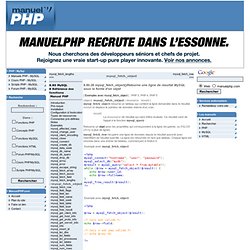
Ce résultat vient de l'appel à la fonction mysql_query . Retourne un objet avec les propriétés qui correspondent à la ligne récupérée, ou FALSE s'il n'y a plus de lignes. Programmation PHP/Exemples/Premier programme. Vos dons permettent à Wikilivres de continuer à exister !
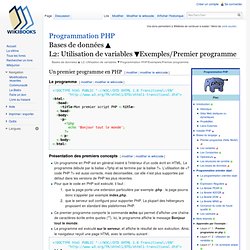
Merci de votre soutien. Un livre de Wikilivres. How to Design Programs. 50 Extremely Useful PHP Tools - Smashing Magazine. Advertisement By Jacob Gube PHP is one of the most widely used open-source server-side scripting languages that exist today.

With over 20 million indexed domains using PHP, including major websites like Facebook, Digg and WordPress, there are good reasons why many Web developers prefer it to other server-side scripting languages, such as Python and Ruby. PHP is faster (updated), and it is the most used scripting language in practice; it has detailed documentation, a huge community, numerous ready-to-use scripts and well-supported frameworks; and most importantly, it’s much easier to get started with PHP than with other scripting languages (Python, for example).
That’s why it makes perfect sense to provide the huge community of PHP developers with an overview of useful tools and resources that can make their development process easier and more effective. This post presents 50 useful PHP tools that can significantly improve your programming workflow. Debugging Tools Documentation Tools. » PHPUnit Training Course for free Programming the new world: Programming your life and the net, one day at a time. Posted in November 4th, 2010 Today is an awesome day my dear fellow programmers. Today is the day I decide to freely distribute the first couple of pages of the PHPUnit workshop I have been giving for some time now. PHP remote debugging with Xdebug and Eclipse PDT. Debugging is an invaluable part of software development.
Going instant with PHP, XML, and jQuery. Getting started with Instant Google's Instant feature, a new search enhancement that shows results as you type, has been getting a lot of buzz, and it's easy to see why.
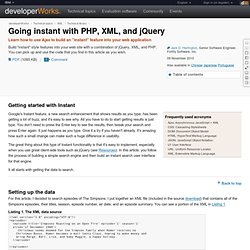
All you have to do to start getting results is just type. You don't need to press the Enter key to see the results, then tweak your search and press Enter again. It just happens as you type. PHP Creating HTML Widgets. In this third part of a series I develop another sample class, which will use the Object Value design pattern to create immutable HTML div objects in a few easy steps.

The pattern’s implementation in this case will be a bit more interesting than usual — it will use the PHP built-in type hinting feature to define a method that returns a new div object to client code, while keeping the immutability of the originating object intact. Even though at first glance it looks like an obscure and esoteric principle not worth analyzing in detail, the Value Object design pattern is a simple paradigm that permits you to generate, that is, objects whose equality is measured by the values assigned to their fields and not on a unique identity. Unlike other programming languages, PHP doesn’t package by default a lot of native value objects, with the exception of the ones that can be spawned from its built-in ArrayObject and DateTime classes.
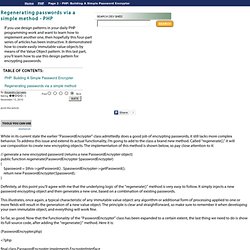
Page 2 - PHP: Building A Simple Password Encrypter. While in its current state the earlier “PasswordEncrypter” class admittedly does a good job of encrypting passwords, it still lacks more complex behavior.
Php prog. Lifehacker, tips and downloads for getting things done. Reddit.com: what's new online! TutorialBlog.org. Wolfram MathWorld: The Web's Most Extensive Mathematics Resource. Ruby. Joomla. Introduction to Algorithms, Second Edition. Table of Contents I Foundations Introduction 3 1 The Role of Algorithms in Computing 5.
The Stony Brook Algorithm Repository. This WWW page is intended to serve as a comprehensive collection of algorithm implementations for over seventy of the most fundamental problems in combinatorial algorithms.
The problem taxonomy, implementations, and supporting material are all drawn from my book The Algorithm Design Manual. Since the practical person is more often looking for a program than an algorithm, we provide pointers to solid implementations of useful algorithms, when they are available. Because of the volatility of the WWW, we provide local copies for many of the implementations. We encourage you to get them from the original sites instead of Stony Brook, because the version on the original site is more likely to be maintained. Further, there are often supporting files and documentation which we did not copy, and which may be of interest to you. How to Design Programs. Welcome. Warning: LiteratePrograms is currently undergoing a license migration to Creative Commons CC0 1.0.
All content will be erased unless its authors agree to release it under CC0. If you wish for your contributed content to be retained, please add a statement to your user page that you release all your contributions under CC0 1.0, and inform me via Special:Emailuser/Dcoetzee. You can also re-add content that you created after the migration, provided that you are the sole author. At this time all article namespace content is already migrated. Based on Donald Knuth's concept of literate programming, LiteratePrograms is a collection of code samples displayed in an easy-to-read way, collaboratively edited and debugged, and all released into the public domain under the Creative Commons CC0 1.0 waiver (see Copyrights) so that anyone can use our code and text for any purpose without restriction.