
You Become What You Pretend To Be. PARALLAX - StumbleUpon. Why Do Some People Learn Faster? &124; Wired Science&&124; Wired.com. The physicist Niels Bohr once defined an expert as “a person who has made all the mistakes that can be made in a very narrow field.”
Bohr’s quip summarizes one of the essential lessons of learning, which is that people learn how to get it right by getting it wrong again and again. Education isn’t magic. Education is the wisdom wrung from failure. A new study, forthcoming in Psychological Science, and led by Jason Moser at Michigan State University, expands on this important concept. The question at the heart of the paper is simple: Why are some people so much more effective at learning from their mistakes?
The Moser experiment is premised on the fact that there are two distinct reactions to mistakes, both of which can be reliably detected using electroenchephalography, or EEG. The second signal, which is known as error positivity (Pe), arrives anywhere between 100-500 milliseconds after the mistake and is associated with awareness.
Image: mujalifah/Flickr. 5 Psychological Experiments That Prove Humanity is Doomed. Cracked.com's new book is now on sale.

What follows is one of 22 classic articles that appear in the book, along with 18 new articles that you can't read anywhere else. Psychologists know you have to be careful when you go poking around the human mind because you're never sure what you'll find there. A number of psychological experiments over the years have yielded terrifying conclusions about the subjects. Oh, we're not talking about the occasional psychopath who turns up. No, we're talking about you. The Asch Conformity Experiment (1953) The Setup: Solomon Asch wanted to run a series of studies that would document the power of conformity, for the purpose of depressing everyone who would ever read the results. Subjects were told that they would be taking part in a vision test, along with a handful of people. The Result: Questions the subjects were asked were like the puzzle shown here: All they had to do was say which line on the right matched the one on the left.
"Wait, you're right! C. Psychology - StumbleUpon. 9 Easy Ways to Create Ideas. The Good Guy Contract. Twenty years ago, the first woman I ever loved broke my heart.

Like many break ups, the end came in stutters and sine waves rather than as an abrupt but mercifully irreversible amputation. However, for reasons I couldn't understand yet quickly began to resent, my ex-girlfriend continued to ask favors of me. And I continued to grant them. Then one morning while chanting I found myself ruminating about how inappropriate it was of her to keep asking, and the more I thought about it, the more irritated I became. My indignation continued to intensify after I'd finished chanting and began showering, finally reaching a peak as I rinsed the shampoo from my hair, causing me to make a sudden and angry determination that the next time she asked me for a favor, I'd refuse. At that exact moment, the phone rang. I knew it was her calling—and sure enough, after I'd finished showering, one of my roommates confirmed it and added that she'd asked that I call her back before I left for school.
How To Install a Power-Up Button On Your Body. For the last few months I have been habitually drawing a thin circle on the top of my left hand.
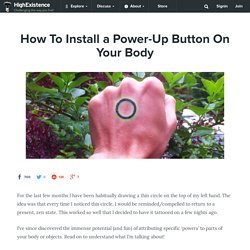
The idea was that every time I noticed this circle, I would be reminded/compelled to return to a present, zen state. This worked so well that I decided to have it tattooed on a few nights ago. I’ve since discovered the immense potential (and fun) of attributing specific ‘powers’ to parts of your body or objects. Introduction to Psychology - Download free content from MIT. The Top 10 Psychology Studies of 2010. The end of 2010 fast approaches, and I'm thrilled to have been asked by the editors of Psychology Today to write about the Top 10 psychology studies of the year.
I've focused on studies that I personally feel stand out, not only as examples of great science, but even more importantly, as examples of how the science of psychology can improve our lives. Each study has a clear "take home" message, offering the reader an insight or a simple strategy they can use to reach their goals , strengthen their relationships, make better decisions, or become happier. If you extract the wisdom from these ten studies and apply them in your own life, 2011 just might be a very good year. 1) How to Break Bad Habits If you are trying to stop smoking , swearing, or chewing your nails, you have probably tried the strategy of distracting yourself - taking your mind off whatever it is you are trying not to do - to break the habit. J. 2) How to Make Everything Seem Easier J. 3) How To Manage Your Time Better M.
J.