
Why Sleep Deprivation Eases Depression. Sleep deprivation is a quick and efficient way to treat depression.
It works 60 to 70 percent of the time—far better than existing drugs—but the mood boost usually lasts only until the patient falls asleep. As an ongoing treatment, sleep deprivation is impractical, but researchers have been studying the phenomenon in an effort to uncover the cellular mechanisms behind depression and remission. Now a team at Tufts University has pinpointed glia as the key players. The researchers previously found that astrocytes, a star-shaped type of glial cell, regulate the brain chemicals involved in sleepiness. Virtues of Cognitive Workout: New Research Reveals Neurological Underpinnings of Intelligence. How much does environment influence intelligence?
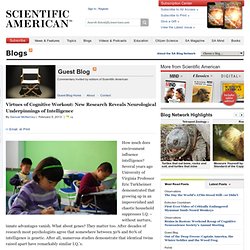
Several years ago University of Virginia Professor Eric Turkheimer demonstrated that growing up in an impoverished and chaotic household suppresses I.Q. – without nurture, innate advantages vanish. What about genes? They matter too. After decades of research most psychologists agree that somewhere between 50% and 80% of intelligence is genetic. After all, numerous studies demonstrate that identical twins raised apart have remarkably similar I.Q.’s. A 2008 paper out of the University of Michigan turned all of this on its head.
This brings me to a brand new paper recently published in the journal Neuroscience by DRDC Toronto researcher and Adjunct Assistant Professor of Psychology at the University of Toronto-Scarborough, Oshin Vartanian. To answer these questions Vartanian and his team gathered 34 participants and assigned each of them to either an experimental or control group. Emotional Smarts Tied to General IQ. Emotional smarts and general intelligence may be more closely linked than previously thought, new research suggests.
In a group of Vietnam veterans, IQ test results and emotional intelligence, or the ability to perceive, understand and deal with emotion in oneself or in others, were linked. And in brain scans, the same regions of the brain seemed to perform both emotional and cognitive tasks, the study found. The findings were published in the journal Social Cognitive & Affective Neuroscience. "Intelligence, to a large extent, does depend on basic cognitive abilities, like attention and perception and memory and language," said study coauthor Aron Barbey, a neuroscientist at the University of Illinois, in a statement.
Reminiscence bump explanations: Why we remember young adulthood better than any other age. YanLev/iStockphoto/Thinkstock.

Twentysomethings are having a moment. New Finding Calls Into Question Assumptions About Sexuality. —Paul Stokes, MD, PhD. Eye-Opener: Why Do Pupils Dilate in Response to Emotional States? The Damaging Impact of Abuse on Brain Development. Common Parasite Linked to Personality Changes. Feeling sociable or reckless?

You might have toxoplasmosis, an infection caused by the microscopic parasite Toxoplasma gondii, which the CDC estimates has infected about 22.5 percent of Americans older than 12 years old. Researchers tested participants for T. gondii infection and had them complete a personality questionnaire. They found that both men and women infected with T. gondii were more extroverted and less conscientious than the infection-free participants.
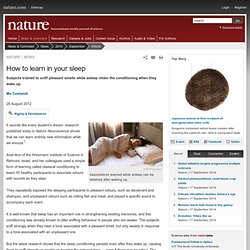
These changes are thought to result from the parasite's influence on brain chemicals, the scientists write in the May/June issue of the European Journal of Personality. “Toxoplasma manipulates the behavior of its animal host by increasing the concentration of dopamine and by changing levels of certain hormones,” says study author Jaroslav Flegr of Charles University in Prague, Czech Republic. This is Scary: Scientists find a way to erase frightening memories. How to Learn in Your Sleep. TIPS/Photoshot Associations learned while asleep can be retained after waking up.
Switch Your Brain Into Sleep Mode: On Demand. Myths About Sleep Myth One—Missing sleep is okay. Myth Two—Your financial, work or relationship problems keep you from sleeping. Myth Three—You can't influence your brain . Reality About Sleep. Memory in the Brain [Interactive] Although most people think of memory as a vault for storing information, it is more like a seamstress who stitches together logical threads into scenes that make sense.
![Memory in the Brain [Interactive]](http://cdn.pearltrees.com/s/pic/th/memory-the-brain-interactive-82305932)
In this view, a good memory is therefore not one that holds lots of data but that can deftly separate what is useful from what could distract or upset you. Getting rid of what is not necessary—forgetting—is thus an important part of memory and of thought. It is also critical to emotional wellbeing. Revisiting bad memories is hardly a formula for happiness, after all.
(For more on memory and forgetting, see Scientific American Mind’s special report on memory in January/February 2012.) To learn more about memory and the power of forgetting, see the January 2012 Scientific American Mind. Brain's Drain: Neuroscientists Discover Cranial Cleansing System. The brain can be a messy place.
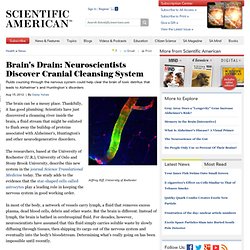
Thankfully, it has good plumbing: Scientists have just discovered a cleansing river inside the brain, a fluid stream that might be enlisted to flush away the buildup of proteins associated with Alzheimer's, Huntington's and other neurodegenerative disorders. The researchers, based at the University of Rochester (U.R.), University of Oslo and Stony Brook University, describe this new system in the journal Science Translational Medicine today. The study adds to the evidence that the star-shaped cells called astrocytes play a leading role in keeping the nervous system in good working order. In most of the body, a network of vessels carry lymph, a fluid that removes excess plasma, dead blood cells, debris and other waste. But the brain is different. In this study, researchers led by U.R. neuroscientist Maiken Nedergaard have identified a second, faster brain-cleansing system.
Is Your Mind Separate From Your Body? Premise #1: “The mind is in the body.” I teach a lot of courses and workshops on mind-body science, and Premise #1 is how I start all of them. It's a basic assumption of modern psychology, especially for those who study the brain . First map of the human brain reveals a simple, grid-like structure between neurons. What Multitasking Does To Our Brains. Easter Island drug improves learning and memory in mice of all ages. Rapamycin, a bacterial product first discovered in a soil sample from Easter Island – also known as Rapa Nui, hence the name – is an immunosuppressant drug used to prevent rejection in organ transplants that has now been found to enhance learning and memory in young and old mice alike.

Researchers at the School of Medicine at The University of Texas (UT) Health Science Center San Antonio made the discovery while looking for a way to prevent the decline in cognitive skills that comes with age. The researchers added rapamycin, which is also known as sirolimus and is marketed by Pfizer under the trade name Rapamune, to the diet of healthy mice throughout their lifespan and found the drug's effects held true for mice of all ages. “We made the young ones learn, and remember what they learned, better than what is normal,” said Veronica Galvan, Ph.D., assistant professor of physiology at the Barshop Institute for Longevity and Aging Studies, part of the UT Health Science Center. Dr. PsycNET - Display Record. Bad Memories Can Be Erased in Potential Breakthrough for Treating Depression and PTSD. People can be trained to forget specific details associated with bad memories, according to breakthrough findings that may usher the way for the development of new depression and post-traumatic stress disorder therapies.
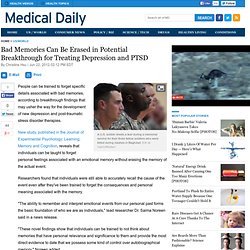
New study, published in the Journal of Experimental Psychology: Learning, Memory and Cognition, reveals that individuals can be taught to forget personal feelings associated with an emotional memory without erasing the memory of the actual event. Researchers found that individuals were still able to accurately recall the cause of the event even after they've been trained to forget the consequences and personal meaning associated with the memory.
"The ability to remember and interpret emotional events from our personal past forms the basic foundation of who we are as individuals," lead researcher Dr. Your Optimism Bias: One of the Best and Worst Tricks Your Brain Plays on You. Regular Exercise Leads to a Healthier, Smarter Brain. The Forgetting Pill Erases Painful Memories Forever. How to Train Your Brain and Boost Your Memory Like a USA Memory Champion. Hack Your Brain to Use Cravings To Your Advantage. The myth of the eight-hour sleep. Prune bad brain wiring with magnetic pulses - health - 18 February 2012. The Brain: Our Strange, Important, Subconscious Light Detectors. Studies like Foster’s prompted a number of researchers to look for those missing cells. Study Before Bed for Significantly Better Retention.
Mapping Human Consciousness. MIT discovers the location of memories: Individual neurons. Train Your Brain for Monk-Like Focus.