
New Age. Meditation and Yoga. Shanti dharm (@meditationtip) sur Twitter. Opening Horizons Well Being Company - Coaching, Massage, Yoga, Meditation, Nutrition - Catabolic and Anabolic Energy. The Two Forces That Create Your World--Every Minute of Every Day More than a hundred years ago, Albert Einstein addressed the scientific community, passionately presenting the idea that everything we see, hear, taste, touch, and smell is not matter, but energy.

Everything that "matters" is energy. On an energetic andcellular level, catabolism usually refers to a breakdown of complex molecules, while anabolism is the opposite. When you hear about a person's catabolic or anabolic energy, however, it's a broader statement about destructive and constructive forces in an entire person, who is made up not only of individual cells but also of anabolic and catabolic thoughts and beliefs. Anabolic and Catabolic energy are predominantin organizations as well as people. Remember that "group think" begins with "leader think". Anabolic leaders have the ability to motivate and inspire themselves and others to do extraordinary things. » The Amazing Power of Being Present. ‘Walk as if you are kissing the Earth with your feet.’
~Thich Nhat Hahn Post written by Leo Babauta. How can you bring calm and peace to the middle of a stress-ful, chaotic day? The answer is simple, though not always so easy to put into practice: learn to be present. No matter how out-of-control your day is, no matter how stressful your job or life becomes, the act of being present can become an oasis. Work, the internet, my own lizard brain.Social media and other digital distractions.For me it’s too many things coming at me all at once. The amazing thing: all of these problems can be solved by one technique.
How Being Present Solves Problems When you look at all of the problems above, you can see if you look closely that the problems are entirely in the mind. If you are completely present, the external forces are no longer a problem, because there is only you and that external force, in this moment, and not a million other things you need to worry about. How to Practice Being Present.
Form constant. An example of a form constant.
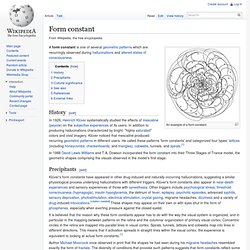
A form constant is one of several geometric patterns which are recurringly observed during hallucinations and altered states of consciousness. History[edit] In 1988 David Lewis-Williams and T.A. Dowson incorporated the form constant into their Three Stages of Trance model, the geometric shapes comprising the visuals observed in the model's first stage. Precipitants[edit] Klüver's form constants have appeared in other drug-induced and naturally-occurring hallucinations, suggesting a similar physiological process underlying hallucinations with different triggers. It is believed that the reason why these form constants appear has to do with the way the visual system is organized, and in particular in the mapping between patterns on the retina and the columnar organization of primary visual cortex.
Author Michael Moorcock once observed in print that the shapes he had seen during his migraine headaches resembled exactly the form of fractals. See also[edit] ** The Golden Ratio~Fingerprint of GOD ** Noosphere. Consciousness, group consciousness, mind. Tolle 1 by Doris Maran.