
DailyFinance - News and Advice for a Lifetime of Financial Decisions. Business & Finance. Economagic: Economic Time Series Page. The Economics of Gold-Digging. The following story is currently making the rounds on the Internet.
The events probably didn’t happen exactly as described, but for my purposes it doesn’t really matter. Supposedly, a woman posted the following personal ad on Craigslist: What am I doing wrong? Okay, I’m tired of beating around the bush. I’m a beautiful (spectacularly beautiful) 25-year-old girl. The response she got was as follows: Dear Pers-431649184:I read your posting with great interest and have thought meaningfully about your dilemma. I have to say that the respondent has some pretty sensible economics in his answer. I wouldn’t expect male economists to marry very well.
Also, completely contrary to what an economic model might predict, I can’t think of any economist who left his wife in middle age for a younger “trophy” wife. So maybe economists aren’t such heartless, conniving people after all. (Hat tip: Meng Li.)
21 Books Every Entrepreneur Should Read. What They Used To Teach You At Stanford Business School - Market Movers. Chris Wyser-Pratte, who got his MBA from Stanford in 1972 and then spent the next 23 years as an investment banker, sent me the following note last night.
I'm reprinting it here with his permission: I learned exactly seven things at Stanford Graduate School of Business getting an MBA degree in 1972. I always used them and never wavered. They were principles that enabled me to put the cookbook formulas that everyone revered in context and in perspective. I think they served my clients (and perhaps me) rather well. The 10 Best Games for Learning About the Stock Market.
Much like skydiving, playing the stock market is not an activity you want to learn through your mistakes.
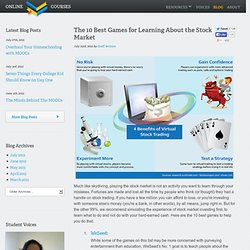
Fortunes are made and lost all the time by people who think (or thought) they had a handle on stock trading. If you have a few million you can afford to lose, or you're investing with someone else's money (you're a bank, in other words), by all means, jump right in. But for the other 99%, we recommend simulating the experience of stock market investing first, to learn what to do and not do with your hard-earned cash. Here are the 10 best games to help you do that. WeSeed:While some of the games on this list may be more concerned with purveying entertainment than education, WeSeed's No. 1 goal is to teach people about the stock market and take the fear out of investing.
Brilliant Business Books - Graphics - Portfolio.com. Business & Finance. How to start a dividend portfolio with $5,000 « Intelligent Speculator. Anytime we talk about stock picks or building a portfolio, one of the most asked questions on this blog is how to start building the portfolio itself.
It’s easier said than done of course and lends easily to procrastination. Of course, this is what makes the biggest difference in the end. Making the right picks and trades is important but getting started, to actually build the portfolio is the real critical part. That being said, we decided to write a general guide. If you follow these steps, you should be able to take that initial amount ($5000 in this case) and multiply it many times over to build yourself a solid dividend portfolio that can help you achieve your ideal lifestyle through passive income.
We used the example of starting with $5000 but this can be applied to any amount really. . #1- Open a brokerage account The first step is perhaps the more “complicated” one as you must of course open a brokerage account. . #2- Buy 2 reliable growth dividend stocks No explaining required. Rules. The Next 5 Emerging Economies That Will Change the World - Max Fisher - International. EconSources - Your one-stop portal for the best economic information on the web!