
Plagiarism. You have something in common with the smartest people in the world.

You see, everyone has ideas. We use our minds to create something original, whether it’s a poem, a drawing, a song, or a scientific paper. Some of the most important ideas are published and make it into books, journals, newspapers and trustworthy websites that become the building blocks for things we all learn. But ideas are also very personal, and we need dependable ways to keep track of the people behind the ideas we use because they deserve credit for their contribution, just as you do if someone uses your idea. Open Education Sites Offer Free Content for All. Culture Digital Tools Flickr:FontFont Open education sites exemplify how technology is democratizing education.
These sites allow both learners and teachers to create their own curriculum, whether it’s used in or out of the classroom. Here’s a comprehensive list of open education sites MindShift has covered. As always, we love to hear about sites that aren’t included in the list, so add them to the comments! MIT Open CourseWare: The Massachusetts Institute of Technology publishes nearly all of its course content on this site, from videos to lecture notes to exams, all free of charge and open to the public. La tutoría en línea, un modelo educativo para las nuevas generaciones - Tecnología. (CNN) — En la última década, 25,000 estudiantes con problemas provenientes de escuelas con pocos recursos han conseguido orientación, estímulo y asesoramiento a través mentores voluntarios.

Y nunca se han visto cara a cara ni una vez. I Could Be (Yo Podría Ser), una organización sin fines de lucro con sede en Nueva York, utiliza herramientas en línea para conectar a estudiantes con aquellos que están dispuestos a tender una mano. Éste es uno de un creciente número de grupos que se especializan en lo que denominan e-mentoring o tutoría en línea. La tecnología, por supuesto, ha existido por años. Sin embargo, el movimiento apenas empieza a encontrar sus bases mientras que los grupos empiezan a superar diversos obstáculos, tales como asegurar la privacidad y la seguridad, y establecer que haya valor en ese tipo de relaciones en línea.
Kate Schrauth, la directora ejecutiva de I Could Be, está convencida. MAESTROS Y AMIGOS 2.0. Is A College Degree An Insurance Policy? : Planet Money. Diane Bondareff/AP This week's New York Magazine profiles a couple famous venture capitalists who have been publicly arguing that college is overrated.

(Here's the article.) After spinning through the usual discussion of high tuition prices and mediocre outcomes, the story poses an interesting question: What kind of economic good is college? (Yes, there are lots of ways to think of college. Yes, I know it's not just an economic good. Here are a few (non-mutually exclusive) options: 1. The University Has No Clothes.
Teaching. A Private Universe. Supercomputing on a cell phone. Many engineering disciplines rely on supercomputers to simulate complicated physical phenomena — how cracks form in building materials, for instance, or fluids flow through irregular channels.

Now, researchers in MIT’s Department of Mechanical Engineering have developed software that can perform such simulations on an ordinary smart phone. Although the current version of the software is for demonstration purposes, the work could lead to applications that let engineers perform complicated calculations in the field, and even to better control systems for vehicles or robotic systems. The new software works in cases where the general form of a problem is known in advance, but not the particulars. PBS KIDS Lab. Encuentros - Una comunidad virtual para una comunidad real. Is Google Making Us Stupid? - Magazine. Illustration by Guy Billout "Dave, stop.
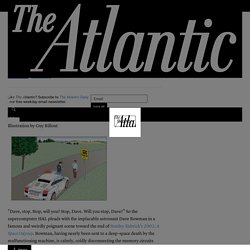
Stop, will you? Stop, Dave. Will you stop, Dave?” So the supercomputer HAL pleads with the implacable astronaut Dave Bowman in a famous and weirdly poignant scene toward the end of Stanley Kubrick’s 2001: A Space Odyssey. I can feel it, too. I think I know what’s going on. For me, as for others, the Net is becoming a universal medium, the conduit for most of the information that flows through my eyes and ears and into my mind.
I’m not the only one. Bruce Friedman, who blogs regularly about the use of computers in medicine, also has described how the Internet has altered his mental habits. Anecdotes alone don’t prove much. Ill Fares the Land. Something is profoundly wrong with the way we live today.

For thirty years we have made a virtue out of the pursuit of material self-interest: indeed, this very pursuit now constitutes whatever remains of our sense of collective purpose. We know what things cost but have no idea what they are worth. We no longer ask of a judicial ruling or a legislative act: Is it good? Is it fair? Is it just? The materialistic and selfish quality of contemporary life is not inherent in the human condition. We cannot go on living like this. And yet we seem unable to conceive of alternatives. On the left, Marxism was attractive to generations of young people if only because it offered a way to take one’s distance from the status quo.