
Schéma Heuristique, Carte Mentale, Topogramme et Mind Map. Category:Free software websites. Portal:Free software. Portal:Free software/categories. Concept map. An Electricity Concept Map, an example of a concept map A concept map or conceptual diagram is a diagram that depicts suggested relationships between concepts.[1] It is a graphical tool that designers, engineers, technical writers, and others use to organize and structure knowledge.

A concept map typically represents ideas and information as boxes or circles, which it connects with labeled arrows in a downward-branching hierarchical structure. The relationship between concepts can be articulated in linking phrases such as causes, requires, or contributes to.[2] Overview[edit] List of concept- and mind-mapping software. Concept-mapping and mind-mapping software are used to create diagrams of relationships between concepts, ideas or other pieces of information.
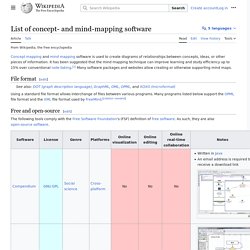
It has been suggested that the mind mapping technique can improve learning/study efficiency up to 15% over conventional note taking.[1] There are a number of software packages and websites that allow the creation of, or otherwise support mind maps. File format[edit] Using a standard file format allows interchange of files between various programs. Many of the programs listed below support the mm format used by FreeMind. The mm format is an XML text format consisting of tagged objects.
Wiki. Type of website that visitors can edit A wiki ( WIK-ee) is a hypertext publication collaboratively edited and managed by its own audience directly using a web browser.
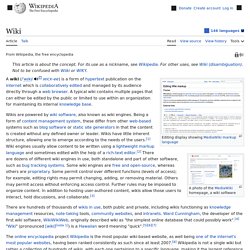
A typical wiki contains multiple pages for the subjects or scope of the project and could be either open to the public or limited to use within an organization for maintaining its internal knowledge base. Wikis are enabled by wiki software, otherwise known as wiki engines. The online encyclopedia project, Wikipedia, is the most popular wiki-based website, and is one of the most widely viewed sites in the world, having been ranked in the top twenty since 2007.[3] Wikipedia is not a single wiki but rather a collection of hundreds of wikis, with each one pertaining to a specific language.
Rhizome (philosophy) "As a model for culture, the rhizome resists the organizational structure of the root-tree system which charts causality along chronological lines and looks for the original source of 'things' and looks towards the pinnacle or conclusion of those 'things.' A rhizome, on the other hand, is characterized by 'ceaselessly established connections between semiotic chains, organizations of power, and circumstances relative to the arts, sciences, and social struggles.' Rather than narrativize history and culture, the rhizome presents history and culture as a map or wide array of attractions and influences with no specific origin or genesis, for a 'rhizome has no beginning or end; it is always in the middle, between things, interbeing, intermezzo.' The planar movement of the rhizome resists chronology and organization, instead favoring a nomadic system of growth and propagation.
Deleuze, Gilles and Félix Guattari. 1980. A Thousand Plateaus. Catégorie:Site web sur les logiciels libres. Outliner. View of very basic outline with graphics.
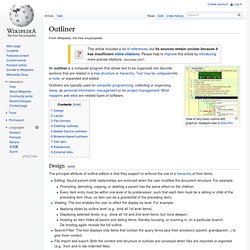
Notepad view in Ecco Pro. Outliners are typically used for computer programming, collecting or organizing ideas, as personal information management or for project management. Mind mappers and wikis are related types of software. Design[edit] The principal attribute of outline editors is that they support or enforce the use of a hierarchy of their items. Editing: Sound parent-child relationships are enforced when the user modifies the document structure. Layout[edit] There are two basic types of outliners: one-pane or intrinsic, and two-pane or extrinsic, each with its strengths and weaknesses.
A one-pane outliner is known as an intrinsic outliner because the text itself is organized into an outline format—individual sections (such as paragraphs) of text can be collapsed or expanded, while keeping others in view. A two-pane outliner separates structure from content—the structure is extrinsic to the text. Ecco Pro with EccoMV pane. File formats[edit] Mind map. A mind map about educational technology A mind map is a diagram used to visually organize information.
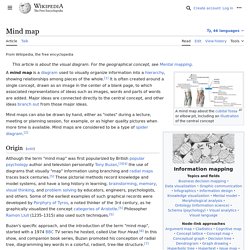
A mind map is hierarchical and shows relationships among pieces of the whole.[1] It is often created around a single concept, drawn as an image in the center of a blank page, to which associated representations of ideas such as images, words and parts of words are added. Major ideas are connected directly to the central concept, and other ideas branch out from those major ideas. Mind maps can also be drawn by hand, either as "rough notes" during a lecture, meeting or planning session, for example, or as higher quality pictures when more time is available.
Mind maps are considered to be a type of spider diagram.[2] A similar concept in the 1970s was "idea sun bursting".[3] Origins[edit] The semantic network was developed in the late 1950s as a theory to understand human learning and developed further by Allan M. Popularisation[edit] Category:Free project management software. This is a category of articles relating to project management software which can be freely used, copied, studied, modified, and redistributed by everyone that obtains a copy: free software (or “open-source software”).

Typically, this means software which is distributed with a free software license, and whose source code is available to anyone who receives a copy of the software. The following 35 pages are in this category, out of 35 total. This list may not reflect recent changes (learn more). Idea.