
SAGE Journals: Your gateway to world-class journal research. SAGE Journals: Your gateway to world-class journal research. An Integral State - Notes on Marx and Gramsci. Progress in Political Economy (PPE) The University of Sydney - Academia.edu. PhD candidate in Political Economy.

Looking at neoliberalism and the 1983-1996 Prices and Incomes Accord (between the Australian Labour Party & Australian Council of Trade Unions). Masters Research on the Global Justice Movement (Thesis title: 'From offence to defence: The Australian Global Justice Movement and the impact of 9/11'). Oceania and South-East Asia Editor of 'Interface: a journal for and about social movements': www.interfacejournal.net. Co-convenor, Sociology of Economic Life thematic group, The Australian Sociological Association. I blog at:
Labor The Greens. LABOR Taken at face value, Labor is in a lot of trouble. It was difficult to know how to approach Paul Howes’ Confessions Of A Faceless Man, his public “diary” of the 2010 election campaign.

Was it to be a tell-all insider’s account delivering anecdotes that journalistic efforts would miss? Was it to be a re-evaluation of the problems the first-term federal government got itself into, a thoughtful introspection on how the ALP went from astronomical to disastrous poll ratings in very short order? Or was it to be a meditation on the long-term trajectory of a Labor Party that, as Howes is keen to tell us on his book tour, needs to have some serious debates about “big picture” ideas. As it turns out, none of the above, and that perhaps explains some of the very critical commentary that has derided Howes for either being one of the vapid apparatchiks who caused this mess, for providing little real “insider” insight, and for generally having a really bloody short memory.
Subcontracting politics Union lineages. The Greens at the crossroads: ‘Left’ and ‘Right’ matter more than you’d think - Left FlankLeft Flank. In the last decade there has been a dramatic reconfiguration on the Left of Australian politics.
The ALP’s support has dropped to levels not witnessed since the dark years of the Great Depression. Labor has also experienced an excruciating crisis of identity in full public view. Greens' big year may sour. Left Flank . org. Left Flank @ Overland Magazine. Iraq and the Australian antiwar movement But in November 1999, a watershed moment occurred in the heart of world capitalism – on the streets of Seattle, in the United States – when Teamster unionists, environmentalists dressed as Turtles and many others joined forces to dispute that there was no alternative.

Their target was the World Trade Organisation meeting, which was negotiating a new round of free trade agreements, and their blockades of the venue and mass rallies shut it down. Elizabeth Humphrys (liz_beths) Dr_Tad (Dr_Tad)
Marxism without revolution: 1 Class. I’ve mentioned Erik Olin Wright’s Envisaging Real Utopias a couple of times, and I’ve also been reading David Harvey’s Enigma of Capital and Jerry Cohen’s if You’re an Egalitarian How Come you’re so Rich.
In different ways, all these books raise the question: what becomes of Marxism if you abandon belief in the likelihood or desirability of revolution[1]? To give the shorter JQ upfront, there are lots of valuable insights, but there’s a high risk of political paralysis. I plan alliteratively, to organise my points under three headings: Class, Capital and Crisis, and in this post I’ll talk about class. Marxism without revolution: 2 Crisis. I’m writing series of posts examining the question – what is left of Marxism, as a way to understand the world, and as a way to change it, once it is accepted that capitalism is not going to be overthrown by a working class revolution.
Last time I talked about class. This post is about crisis. Marxism without revolution: 3 Capital. I’ve been writing series of posts examining the question – what is left of Marxism, as a way to understand the world, and as a way to change it, once it is accepted that capitalism is not going to be overthrown by a working class revolution.
The first was about class and the second about crisis. Now for the final instalment: capital. Response to Quiggin, ‘Marxism without revolution’ part 1. Greek workers march on Finance Ministry, finding common cause against austerity Thanks to @liz_beths for her helpful comments and suggestions.
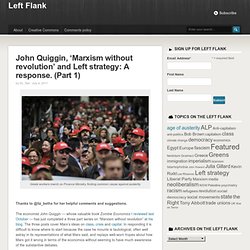
The economist John Quiggin — whose valuable book Zombie Economics I reviewed last October — has just completed a three part series on “Marxism without revolution” at his blog. The three posts cover Marx’s ideas on class, crisis and capital. In responding it is difficult to know where to start because the case he mounts is tautological, often well astray in its representations of what Marx said, and replays well-worn tropes about how Marx got it wrong in terms of the economics without seeming to have much awareness of the substantive debates. I was a bit taken aback by John’s dismissive tone at his blog and in comments at Left Flank, especially after he’d so carefully engaged with what are (in my view and his) obscure and illogical neoliberal economic theories in Zombie Economics. What Marx really said about class. Response to Quiggin, ‘Marxism without revolution’ part 2.
John Quiggin recently ran a series on “Marxism without revolution”, with posts covering Marx’s ideas on class, crisis and capital.
I began a response here. In this post I look at his claims about Marx’s theory of crisis and his approach to Left strategy. John’s attack on Marx’s crisis theory, specifically the “law of the tendency of the rate of profit to fall”, is different to his criticisms of Marx’s “value theory”. Firstly, he claims that Marx says falling profit rates make working class revolution inevitable rather than just possible and necessary. Marx did argue there were strong “laws” of capitalist development which did inevitably lead to crisis and resistance, but it is quite another thing to suggest he really thought that the outcome (socialism) was assured. Secondly, he makes an empirical claim about profit rates not falling, but it is difficult to know what he bases this on.
2012: A lesson in how to blame the victim. For the last post of 2012 we were asked to reflect on politics over the last year. In thinking on this for the last week I’ve drafted about ten first paragraphs. The writer’s block arises not from nothing to say, but from a place that wonders how many ways there are to describe how awful the Gillard government is. How many ways there are to verbalise that the political crisis of the Australian elites is playing out in increasingly cruel ways: from the demonising of asylum seekers and placing them in harms way to the smearing of Indigenous communities and the implementation of policies that stigmatise. From cutting single parents benefits to forcing people living with disabilities onto Newstart, to the rollout of the Basics Card, to the poor who are supposedly incapable of managing their government benefits in Bankstown.
All these are policies roundly condemned by non-government bodies and many international welfare agencies. Sounds awfully familiar, doesn’t it? 2012: The year that politics disoriented the Left. The political prediction business is not one you should engage in unless you’re either willing to repeatedly admit erroneous forecasts (one of Ben Eltham’s most endearing qualities) or to march on obliviously ignoring them (most of the rest of the commentariat). It’s even worse for us Marxists, as we’re notorious for having accurately foretold five out of the last two recessions. The problem is that history unfolds dialectically in the real world, and not simply through a logical derivation from some initial starting point.
Anyway, I had a go at forecasting in mid-2011, and when recently prompted to return to this by Colin Barker I was surprised at how well my scribblings had stood the test of time. For instance, I wrote: Strikingly, in this interconnected world, the organisational forms, language and methods of activism first provide inspiration and are then adapted to local circumstances. Prank calls, the media and the politics of class humiliation. A family picture of Jacintha Saldanha Of course, as Austereo CEO Rhys Holleran told reporters, nobody could have ‘reasonably foreseen’ that a prank telephone call made by two Australian radio presenters would set off a chain of events that included the apparent suicide of a nurse – Jacintha Saldanha, a mother of two teenaged children – on the other side of the world. If there is one thing you learn early in psychiatric training, it’s that we have few (if any) good predictors of an individual’s risk of killing themselves.
AUSTERITY series. 1 Explaining the age of austerity: Beyond the conjunctural, the organic crisis re-emerges - Left FlankLeft Flank. How did it come to this?
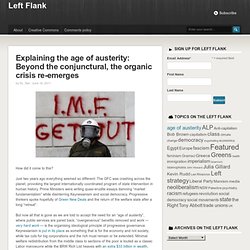
Just two years ago everything seemed so different: The GFC was crashing across the planet, provoking the largest internationally coordinated program of state intervention in human history. Prime Ministers were writing quasi-erudite essays damning “market fundamentalism” while disinterring Keynesianism and social democracy. Progressive thinkers spoke hopefully of Green New Deals and the return of the welfare state after a long “retreat”. But now all that is gone as we are told to accept the need for an “age of austerity”, where public services are pared back, “overgenerous” benefits removed and work — very hard work — is the organising ideological principle of progressive governance.
Keynesianism is put in its place as something that is for the economy and not society, while tax cuts for big corporations and the rich must remain or be extended. Organic v conjunctural A crisis occurs, sometimes lasting for decades. 2 The age of austerity: Social polarisation, fake partisanship & the Left's strategy - Left FlankLeft Flank. Austerity (noun):1. Enforced or extreme economy. From the Greek, austēros, meaning “harsh” or “severe”. The conversion of the present ALP federal government from new-era Keynesian stimulus apostles to sovereign debt doom merchants did not take place overnight, but if it happened anywhere it was in Toronto at the G20 meeting exactly a year ago.
3 Beyond the age of austerity, a new pattern of resistance and revolution emerges - Left FlankLeft Flank. In apparently “normal” times we Marxists are given a hard time, derided for our economic determinism about the crisis-prone nature of capitalism, scoffed at for suggesting that revolutionary movements could possibly occur in modern times, and accused of totalitarian impulses if we suggest that conscious revolutionaries should try to cohere their forces. Often the most strident criticisms come from those who are apparently closest to us politically, Leftists who share our anger at the injustices of existing society but adhere to social democratic principles.
RIOTS + Revolutions: in the UK. Find More Stories Riot to reform: it might be just a stone's throw away Tad Tietze The riots in the United Kingdom, mainly involving school-age and unemployed youth, have provoked a backlash that seeks to paint them narrowly as and an threat to social order. Politicians and journalists sing from the same songbook, to condemn and excoriate first and to (preferably not) ask questions later. Intended or not, the consequences of riots are not always negative - Left FlankLeft Flank. The riots in the United Kingdom, mainly involving school age and unemployed youth, have provoked a backlash that seeks to paint them narrowly as “mindless”, “criminals”, “thugs” and an “external” threat to social order. Politicians and journalists sing from the same songbook, to condemn and excoriate first and to (preferably not) ask questions later.
Search for "Egypt" Historical analogies can often be misleading, especially when a notable anniversary places them readily to hand. Mohamad Morsi is not Salvador Allende, overthrown in the seminal Chilean coup 40 years ago. But General Abdel Fatah al-Sisi is Egypt’s Augusto Pinochet — complete with military regalia and sunglasses. Search for "Greece" By KEVIN OVENDEN The struggle against the most pernicious and entrenched neo-Nazi force in Europe is at a critical moment. Search for "Arab spring" Chris Berg’s libertarian dreaming. Or, when ‘liberty’ for the few means tyranny for the many – - Left FlankLeft Flank. Do you remember 1989?
Dissecting economic mythologies - Unleashed. Find More Stories Dissecting economic mythologies. The US : Stars & swipes. Illustration: Mat Davidson.