
₪₪₪ Socionics - The New Psychology ₪₪₪ Psychology studies relevant to everyday life from PsyBlog. Happiness Quiz. The Physiology of Willpower: Linking Blood Glucose to Self-Control. Past research indicates that self-control relies on some sort of limited energy source.

This review suggests that blood glucose is one important part of the energy source of self-control. Acts of self-control deplete relatively large amounts of glucose. Self-control failures are more likely when glucose is low or cannot be mobilized effectively to the brain (i.e., when insulin is low or insensitive). Restoring glucose to a sufficient level typically improves self-control. The Substance Abuse and Mental Health Services Administration - Homepage. Link found between optimistic attitudes, longevity and health. In order to ascertain if optimistic people have longer life spans than their pessimistic counterparts, a team of researchers from the Netherlands interviewed approximately 1,000 men and women between the ages of 65 and 85 about health, self-respect, morale, optimism and contacts, and relationships.

The study, which was led by Erik Giltay, M.D., Ph.D, of Psychiatric Center GGZ Delfland, Delft, the Netherlands, included two key questions regarding optimism: "Do you often feel like life is full of promise," and "Do you still have many goals to strive for? " Answering yes to these questions revealed a sense of optimism. During the nine-year follow-up period, Dr. Giltay and his colleagues found that those participants who had reported higher levels of optimism were 55 percent less likely to die from any cause, and 23 percent were less likely to die from a heart-related illness as compared to the pessimistic group. Another study led by Dr. As Dr. Micro Expressions - Research, Theory & Lying.
Interesting Info -> Lying Index & Body Language -> Micro Expressions Is the show "Lie to Me" for real?
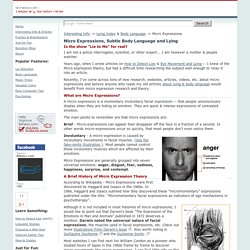
I am not a police interrogator, scientist, or other expert... I am however a mother & people watcher. Years ago, when I wrote articles on How to Detect Lies & Eye Movement and Lying -- I knew of the Micro expression theory, but had a difficult time researching the subject well enough to relay it into an article. Recently, I've come across tons of new research, websites, articles, videos, etc. about micro expressions and believe anyone who reads my old articles about lying & body language would benefit from micro expression research and theory.
How to Detect Lies - body language, reactions, speech patterns. Interesting Info -> Lying Index -> How to Detect Lies Become a Human Lie Detector (Part 1) Warning: sometimes ignorance is bliss.

After gaining this knowledge, you may be hurt when it is obvious that someone is lying to you. The following deception detection techniques are used by police, forensic psychologists, security experts and other investigators. Introduction to Detecting Lies: This knowledge is also useful for managers, employers, and for anyone to use in everyday situations where telling the truth from a lie can help prevent you from being a victim of fraud/scams and other deceptions. This is just a basic run down of physical (body language) gestures and verbal cues that may indicate someone is being untruthful. If you got here from somewhere else, be sure to check out our Lie Detection index page for more info including new research in the field of forensic psychology. Eye Movement and Lying - How to detect lies. Interesting Info -> Lying Index -> Eye Direction & Visual Accessing Cues Eye Movement and Direction & How it Can Reveal Truth or Lies This is a continuation of our previous article Detecting Lies.

Many comments by our visitors asked about how eye direction can indicate the presence of a lie. Can the direction a person's eyes reveal whether or not they are making a truthful statement? Short answer: sort of. In these shows a detective will deduce if a person is being untruthful simply because they looked to the left or right while making a statement. In reality, it would be foolish to make such a snap judgment without further investigation... but the technique does have some merit.
So, here it is... read, ponder and test it on your friends and family to see how reliable it is for yourself. Body Language and Flirting - Blifaloo. Me, Myself and My Stranger: Understanding the Neuroscience of Selfhood. Where are you right now?
Maybe you are at home, the office or a coffee shop—but such responses provide only a partial answer to the question at hand. Asked another way, what is the location of your "self" as you read this sentence? Like most people, you probably have a strong sense that your conscious self is housed within your physical body, regardless of your surroundings. What makes us attractive? What is beauty?: Viewzone - StumbleUpon. © 2014 by Dan Eden for Viewzone Do you remember being in high school or college and noticing a group of females who had their own special group?
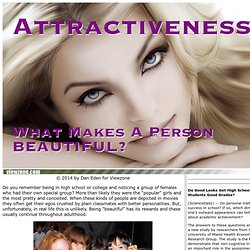
More than likely they were the "popular" girls and the most pretty and conceited. When these kinds of people are depicted in movies they often get their egos crushed by plain classmates with better personalities. But, unfortunately, in real life this is unlikely. Being "beautiful" has its rewards and these usually continue throughout adulthood. Studies show attractive people prefer to associate with others like themselves. The secret of beauty and attractiveness has been a quest of humans for as long as we have been civilized. Besides being popular, beautiful people get special attention from teachers, the legal system and employers. While we instinctively know what appeals to our own sense of beauty -- we know it when we see it -- defining what determines attractiveness is not always easy.