
7 surprising facts about sleep and dreaming. My new book on sleep and dreaming, Night School, is published today.
It has been 2 years in the making and so I am very excited to see it out there! Based on research, mass-participation experiments and the world’s largest archive of dream reports, it reveals how to… …get the best night’s sleep of your life …discover what your dreams really mean …learn information while you sleep ….banish jet-lag, nightmares and snoring To give you a flavour of the material, here are 7 surprising facts about sleep and dreaming… 1) If you want to feel sleepy when you head to bed …Banish the blues: Blue light from computer screen and smartphones keeps you awake. 2) If you want to fall asleep quickly…Use positive imagery and the paradox principle: First, imagine yourself in a very pleasant scenario. 3) If you lie in bed feeling worried …The list: If you have a lot on your mind, make a list of all of the things that you have to do the next day.
I hope you enjoy Night School! 10 things to know about sleep as the clocks go back. Image copyright Getty Images People across the UK will wake up having gained an hour's sleep on Sunday morning, as the clocks go back heralding darker evenings and shorter days.
But how much do we know about sleep and its impact on our lives, from our health and mood, to how long we'll live? 1. We're told to get our eight hours We often hear that we should all be getting eight hours' sleep a night. Studies carried out around the world, looking at how often diseases occur in different groups of people across a population, have come to the same conclusion: both short sleepers and long sleepers are more likely to have a range of diseases, and to live shorter lives. The myth of the eight-hour sleep. Image copyright Other We often worry about lying awake in the middle of the night - but it could be good for you.
A growing body of evidence from both science and history suggests that the eight-hour sleep may be unnatural. In the early 1990s, psychiatrist Thomas Wehr conducted an experiment in which a group of people were plunged into darkness for 14 hours every day for a month. Why teenagers really do need an extra hour in bed. Schools and wider society must wake up to the distinct sleep needs of adolescents "MAKING teens start school in the morning is 'cruel', brain doctor claims.
" So declared a British newspaper headline in 2007 after a talk I gave at an academic conference. One disbelieving reader responded: "This man sounds brain-dead. " Sleep quality 'improves with age' 1 March 2012Last updated at 01:03 The study involved more than 150,000 people The belief that older people tend to suffer worse sleep may be false - in fact the reverse may be true, according to US researchers.
A telephone survey of more than 150,000 adults suggested that, apart from a blip in your 40s, sleep quality gets better with age. Those in their 80s reported the best sleep, says the study in Sleep journal. A UK sleep researcher said while poor health could affect sleep, it was a "myth" that age alone was a factor. Are you a lark or an owl? Image copyright Science Photo Library Whether you prefer being up at dawn or burning the midnight oil depends on your genes, experts have found.
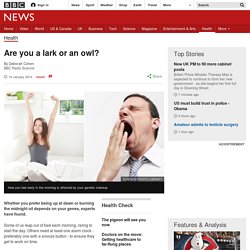
Some of us leap out of bed each morning, raring to start the day. Others need at least one alarm clock - preferably one with a snooze button - to ensure they get to work on time. And some of us happily stay up chatting until the wee small hours, while others prefer to be tucked up listening to 'Book at Bedtime' with the lights turned out. We really are divided into larks and owls. Tackling fears 'while you sleep' 22 September 2013Last updated at 19:38 ET By Caroline Parkinson Health editor, BBC News website Deep sleep is a time where we consolidate memories US researchers suggest smells could be used to calm fears - while people sleep.
People were trained to associate two images, linked to smells, with fear. During sleep they were exposed to one of those smells - and when they woke they were less frightened of the image linked to that smell. A UK expert praised the Nature Neuroscience study and said it could help treat phobias and perhaps even post-traumatic stress disorders. People with phobias are already commonly treated with "gradual exposure" therapy while they are awake, where they are exposed to the thing they are frightened of in incremental degrees. This study suggests that the theory could be extended to therapy while they are in slow-wave, or deep, sleep.
How to sleep better. Wiseman, who is Professor of the Public Understanding of Psychology at the University of Hertfordshire, had already looked into self-development during the day with his book 59 Seconds, but soon realised that no one was doing the same for the night time.

"You spend a third of your life asleep and yet we don't make the most of that, we think we just turn our brains off and so we concentrate on our waking lives," he says. "But I thought it would be nice to pay some attention to it. The experts I spoke to had a fairly good understanding of what was happening during the night, yet it hadn't really been communicated to the public.
And that seemed a real pity. " Using new research, mass-participation experiments and the world's largest archive of dreams, Wiseman explores the surprising science of sleep and dreaming in his new book Night School: Wake Up to the Power of Sleep, and reveals how to get the most out of your sleeping hours. Sleep your way to new year’s resolution success. A few years ago I tracked over 3,000 people attempting to achieve a range of new year’s resolutions, including losing weight, exercising more, stopping smoking and drinking less.
At the start of the study, 52% of participants were confident of success. One year later, only 12% had actually achieved their goal. Want to sleep like a baby? Don't shut your eyes. Don’t hate me, but I’m a really good sleeper and usually get a solid eight hours.
I rarely wake up in the night and I don’t use an alarm clock to get me up. Trust me, I know how lucky I am. We are a sleep-deprived nation — and our problems seem to be getting worse. In 2014, six in ten British adults reported getting fewer than seven hours sleep a night, a 50 per cent increase on the previous year, which is huge. Sleep engineering: Cardiff scientists working on designer rest. We spend a third of our lives sleeping. So, imagine if we could use that time to improve our memories, study, better our brain health or even tackle post-traumatic stress disorder.
Welcome to the world of sleep engineering, where tailoring your shut-eye could be a route to a better you. Cardiff University is looking at ways to make designer dozing a reality. Psychologist Prof Penny Lewis believes other scientists who find the idea far-fetched need to wake up. "The concept is about how we can manipulate our sleep, that is, intentionally apply stimuli so that we can alter our sleep in ways that benefit us," she said.
"What springs to mind for most people, I would imagine, is drugs. Prof Lewis, a self-confessed insomniac who became interested in the subject after suffering a lack of sleep while completing her PhD, said the problem was "common". Some figures suggest up to one in 10 people in the UK suffer with insomnia. Sleep 'cleans' the brain of toxins. The brain uses sleep to wash away the waste toxins built up during a hard day's thinking, researchers have shown. The US team believe the "waste removal system" is one of the fundamental reasons for sleep. Their study, in the journal Science, showed brain cells shrink during sleep to open up the gaps between neurons and allow fluid to wash the brain clean. Bedtime 'has huge impact on sport' 29 January 2015Last updated at 12:21 ET By James Gallagher Health editor, BBC News website Can Real Madrid's success be down to a later society?
Our internal body clock has such a dramatic impact on sporting ability that it could alter the chances of Olympic gold, say researchers. The team, at the University of Birmingham, showed performance times varied by 26% throughout the day. Early risers reached their athletic peak around lunchtime, while night owls were best in the evening. The researchers say it could even explain why Spanish teams have more success in European football.
The body clock controls everything from alertness to the risk of a heart attack, in a daily rhythm. Continue reading the main story Some aspects of sporting ability were thought to peak in early afternoon, but a study in the journal Current Biology suggests each competitor's sleeping habits have a powerful impact. And they did it at six different times of day between 07:00 and 22:00. How to sleep like a Premier League footballer. Sleeping longer 'helps athletes reach peak performance' 1 July 2011Last updated at 07:36 The true value of sleep is often overlooked, researchers say The value of sleep has been reinforced by yet another scientific study. Research published in the journal Sleep suggests that sleeping longer can markedly improve physical performance.
When Stanford University's male basketball team was asked to sleep for 10 hours a night for around six weeks, their shooting accuracy improved by 9%. The study at the US university found that getting enough sleep and rest was as important as training and diet for elite athletes. Cheri Mah, researcher at the Stanford Sleep Disorders Clinic and Research Laboratory, who worked with the basketball players, said that sleep was often overlooked. "Intuitively many players and coaches know that rest and sleep are important, but it is often the first to be sacrificed," she said. Continue reading the main story “Start Quote. Sleep's memory role discovered. 5 June 2014Last updated at 19:44 ET By James Gallagher Health and science reporter, BBC News The mechanism by which a good night's sleep improves learning and memory has been discovered by scientists.
The team in China and the US used advanced microscopy to witness new connections between brain cells - synapses - forming during sleep. Their study, published in the journal Science, showed even intense training could not make up for lost sleep. Experts said it was an elegant and significant study, which uncovered the mechanisms of memory. It is well known that sleep plays an important role in memory and learning. How much can an extra hour's sleep change you? 9 October 2013Last updated at 04:24 ET. Can an extra hour of sleep have radical health benefits? Just a few nights of bad sleep upsets your brain.
Image copyright Getty Images Thanks to the clocks going back, many of us managed to grab a little bit of extra shut-eye over the weekend. Alcohol-fuelled sleep 'less satisfying' Fragmented sleep 'harms memory' Poor sleep makes food more appealing. Why reducing sleep makes you hungry. Image copyright Lion Television. Fighting insomnia. Increased workloads and 24-hour access to the internet have created a world that rarely sleeps. The statistics are staggering. One 2011 survey by the Mental Health Foundation found that more than 30% of Britons suffer from insomnia or another serious sleep problem. Full Moon 'disturbs a good night's sleep' 25 July 2013Last updated at 12:26 ET By Michelle Roberts Health editor, BBC News online.
Yes, Your Sleep Schedule Is Making You Sick. 'Tired' fat cells might trigger obesity. Never underestimate the value of a good night's sleep. Not only does a lack of shut-eye leave you irritable, it has been linked to diabetes and weight gain, though no one understood why. To investigate, Matthew Brady at the University of Chicago and his colleagues tested fat cells taken from the bellies of seven adults after four nights of sleeping up to 8 and a half hours, and then again after four nights on a measly 4 and a half hours.
The team found that after sleep deprivation fat cells from the same person were on average 30 per cent less responsive to insulin – a hormone that makes muscle, liver and fat cells take up glucose after a meal. Shift workers 'risking' diabetes and obesity. 11 April 2012Last updated at 17:10 ET By James Gallagher Health and science reporter, BBC News. Late nights 'sap children's brain power' 8 July 2013Last updated at 19:45 ET By Michelle Roberts Health editor, BBC News online Late nights may have knock-on effects. Body Clock: What makes you tick? Body clock 'alters' immune system. Carry on camping - can a week under canvas reset our body clocks? Body clock 'reset button' found. Chronotherapy: The science of timing drugs to our Body Clock. Daytime wounds 'heal more quickly' How to nap like a pro. Regular naps are 'key to learning'
How to feel refreshed even after too little sleep - and why you MUST have an afternoon nap. Never wake up tired again. 'Afternoon naps' aid children's learning.