
Squid Configuration. Squid Configuration. SquidFaq/ReverseProxy. What is the Reverse Proxy (httpd-accelerator) mode?
Occasionally people have trouble understanding accelerators and proxy caches, usually resulting from mixed up interpretations of "incoming" and "outgoing" data. I think in terms of requests (i.e., an outgoing request is from the local site out to the big bad Internet). The data received in reply is incoming, of course.
Others think in the opposite sense of "a request for incoming data". An accelerator caches incoming requests for outgoing data (i.e., that which you publish to the world). Quite apart from taking the load of a site's normal web server, accelerators can also sit outside firewalls or other network bottlenecks and talk to HTTP servers inside, reducing traffic across the bottleneck and simplifying the configuration. The Squid redirector can make one accelerator act as a single front-end for multiple servers. In such a configuration, the web administrator renames all non-cachable URLs to the httpd's port (81). Common Problems.
Access Control and Access Control Operators - Squid User's Guide. Access control lists (acls) are often the most difficult part of the configuration of a Squid cache: the layout and concept is not immediately obvious to most people.
Hang on to your hat! Unless the Squid Configuration Basics chapter is still fresh in your mind, you may wish to skip back and review the access control section of that chapter before you continue. This chapter assumes that you understood the difference between an acl and an acl-operator. The primary use of the acl system is to implement simple access control: to stop other people using your cache infrastructure. (There are other uses of acls, described later in this chapter; in the meantime we are going to discuss only the access control function of acls.)
There are two elements to access control: classes and operators. Let's work through the below example line-by-line. If the admin connects to the cache from the PC, Squid does the following: Squid Configuration. Squid + SquidGuard. Voici un petit document qui décrit l’installation de Squid avec le plugin SquidGuard sur une distribution linux Debian. SQUID est un proxy WEB puissant avec de très nombreuses options. SquidGuard est un plugin qui permet de rediriger certaines pages selon des critères (mot dans l’url etc..) vers une pages choisie, ceci afin d’en interdire la consultation. Squid, principal composant de ce système, assure les fonctions de : un cache WEB commun pour optimiser la bande passante.la possibilité d’introduire une authentification utilisateurs afin d’interdire le surf à certains utilisateurs.un filtrage d’accès « basique ». PfSense Open Source Firewall Distribution - Home.
Network Monitoring Tools. Les Cottrell, SLAC.
Last Update: December 14, 2015 ESnet | ESCC | PinGER Internet monitoring | Tutorial This is a list of tools used for Network (both LAN and WAN) Monitoring tools and where to find out more about them. The audience is mainly network administrators. You are welcome to provide links to this web page. Please do not make a copy of this web page and place it at your web site since it will quickly be out of date. See here if you wish to suggest additions or changes. Introduction [Contents] We welcome corrections such as identifying broken links (especially if you can provide an alternate/update), since over the years companies are absorbed by others, disappear, split up, change their web site etc. Suggesting Additions/Corrections etc. This is a volunteer, unfunded effort. BackTrack Linux - Penetration Testing Distribution.
Quels outils pour auditer la sécurtié de son réseau. Outils d'Audit de Securité de Réseau et Scanner de Vulnerabilité. Wall. m0n0wall is a project aimed at creating a complete, embedded firewall software package that, when used together with an embedded PC, provides all the important features of commercial firewall boxes (including ease of use) at a fraction of the price (free software). m0n0wall is based on a bare-bones version of FreeBSD, along with a web server, PHP and a few other utilities.
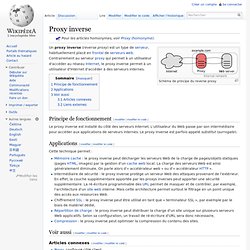
The entire system configuration is stored in one single XML text file to keep things transparent. m0n0wall is probably the first UNIX system that has its boot-time configuration done with PHP, rather than the usual shell scripts, and that has the entire system configuration stored in XML format. In m0n0wall 1.8.1, the base system has been switched to FreeBSD 8.4 for better support of recent hardware, and there have been significant improvements, new features and bug fixes in many areas. EnGarde Secure Linux. Reverse proxy. Un article de Wikipédia, l'encyclopédie libre.
Voir le sujet - Reverse proxy avec IPCop. Thonik a écrit:2°) Point de vue distribution : Debian n'est pas spécialisée pour faire du reverse-proxy.
(En même temps IpCop non plus)3°) Une des conditions est de savoir configurer et faire de la maintenance à distance. Je ne pense pas que je saurai le faire avec Debian. Vous allez finir par me faire regretter de ne pas m'en être tenu à ma première réponse. ModSecurity: Open Source Web Application Firewall. Unleash Your Router. OpenWrt. List of router or firewall distributions.
Wall - Download. LEAF — Linux Embedded Appliance Firewall. Router/Bridge Linux Firewall.