
San Diego's First Home Wind Turbine. Technology Published on January 19th, 2011 | by calfinder Driven by his desire to go green, Tim Williams recently became the first San Diego resident to install a wind turbine at his home.

The 3.4-kW Falcon turbine, a product of WePOWER, has since gone live, and will hopefully convince other homeowners to follow suit. This particular model is conducive to residential homes because it is vibration- and noise-resistant. In addition, the Falcon turbine is virtually maintenance-free and poses no threat to birds. In order to have the turbine approved, it had to be presented before the County Building Department and inspected by a third party. WePower is now a leader in the wind power industry, outfitting such big names as AT&T, Best Buy, Tata Energy, and Lockheed Martin. Each qualifies for a 30-percent federal tax credit and is backed by the California Energy Commission.
Hydrogen Combustion. The £2.2billion superlab where scientists are creating a star on Earth. By Daily Mail Reporter Updated: 20:10 GMT, 17 November 2010 It may look like any average building but behind closed doors could lie the answer to safe renewable energy of the future.
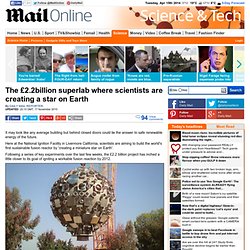
Here at the National Ignition Facility in Livermore California, scientists are aiming to build the world's first sustainable fusion reactor by 'creating a miniature star on Earth'. Neon Trees. Gold Nanoparticles Could Transform Trees Into Street Lights. Street lights are an important part of our urban infrastructure — they light our way home and make the roads safe at night.

But what if we could create natural street lights that don’t need electricity to power them? A group of scientists in Taiwan recently discovered that placing gold nanoparticles within the leaves of trees, causes them to give off a luminous reddish glow. The idea of using trees to replace street lights is an ingenious one – not only would it save on electricity costs and cut CO2 emissions, but it could also greatly reduce light pollution in major cities. Photo © mrhayata. Milky Way 'bubbles' may be black hole eruption - CTV News. Two massive and mysterious newly discovered structures in the centre of the Milky Way could be the product of a belching black hole.
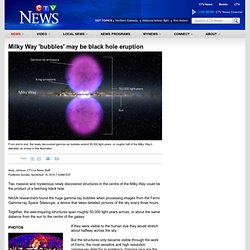
NASA researchers found the huge gamma-ray bubbles when processing images from the Fermi Gamma-ray Space Telescope, a device that takes detailed pictures of the sky every three hours. Together, the awe-inspiring structures span roughly 50,000 light years across, or about the same distance from the sun to the centre of the galaxy. If they were visible to the human eye they would stretch about halfway across the sky.
But the structures only became visible through the work of Fermi, the most sensitive and high resolution gamma-ray detector in existence. Gamma rays are the highest energy form of light. Accelerating Future » 10 Interesting Futuristic Materials. 1.
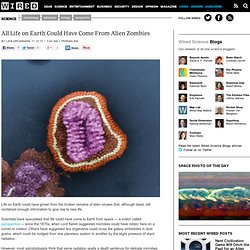
Aerogel Aerogel holds 15 entries in the Guinness Book of Records, including "best insulator", and "lowest-density solid". Sometimes called "frozen smoke", aerogel is made by the supercritical drying of liquid gels of alumina, chromia, tin oxide, or carbon. All Life on Earth Could Have Come From Alien Zombies. Life on Earth could have grown from the broken remains of alien viruses that, although dead, still contained enough information to give rise to new life.
10 Strange Things About The Universe - Top 10 Lists. Space The universe can be a very strange place.
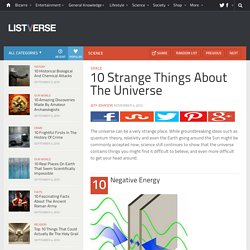
While groundbreaking ideas such as quantum theory, relativity and even the Earth going around the Sun might be commonly accepted now, science still continues to show that the universe contains things you might find it difficult to believe, and even more difficult to get your head around. Online : An antenna made from sea water. Oh Nooo!

A 404 Page! Looks like we can't find the page that you are looking for. Sorry about that. Let's see if we can make it up to you. First off, let's try searching for the content. If that doesn't work, why not try browsing from popular categories? Read Digital Edition Shop Maker Shed Trending Topics. 'Star Wars'-like Holograms Nearly a Reality. If you think FaceTime on the new iPhone is cool, you probably can't wait for the age of holo-chat.
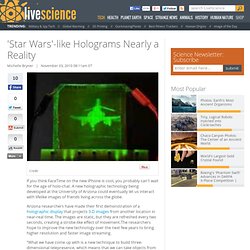
A new holographic technology being developed at the University of Arizona could eventually let us interact with lifelike images of friends living across the globe. Arctic Lake Yields Planet’s Most Continuous Record of Ancient Climate. DENVER — It took the better part of a decade, $10 million, and help from the guys who build ice roads for Canadian truckers.
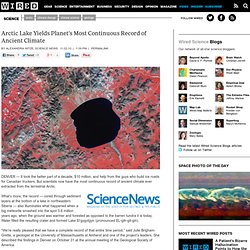
But scientists now have the most continuous record of ancient climate ever extracted from the terrestrial Arctic. Why some scientists think reality might be a hologram. What_if_solar_was_subsidized_like_fossil_fuels.jpg (JPEG Image, 550x1840 pixels) Dramatic climate change is unpredictable. The fear that global temperature can change very quickly and cause dramatic climate changes that may have a disastrous impact on many countries and populations is great around the world. But what causes climate change and is it possible to predict future climate change?