
Blink. Why not ? Computers and visual art. Robotic art. Robotic art is any artwork that employs some form of robotic or automated technology.

Head Swap for Amplified Violin and Interactive Robotic Painting Machine. Aaron - computer artist A.I. The Robot as an Artist Aaron, the first robot artist, is the brainchild of Professor Harold Cohen, the British abstract painter.

The result of 23 years of research and $150,000 Professor Cohen has pushed forward into the realm of artificial intelligence in the development of this unique computer driven robot.. Most recently Aaron created original paintings at The Computer Museum in Boston. Aaron "creates" several images in his computer memory each night. Genetics and Culture. Alpha: Computational Knowledge Engine. Image analysis. Image analysis is the extraction of meaningful information from images; mainly from digital images by means of digital image processing techniques.[1] Image analysis tasks can be as simple as reading bar coded tags or as sophisticated as identifying a person from their face.

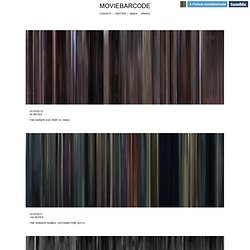
Computers are indispensable for the analysis of large amounts of data, for tasks that require complex computation, or for the extraction of quantitative information. On the other hand, the human visual cortex is an excellent image analysis apparatus, especially for extracting higher-level information, and for many applications — including medicine, security, and remote sensing — human analysts still cannot be replaced by computers. For this reason, many important image analysis tools such as edge detectors and neural networks are inspired by human visual perception models. Computer Image Analysis[edit] Techniques[edit] There are many different techniques used in automatically analysing images. References[edit] Dissecting a Trailer: The Parts of the Film That Make the Cut - Interactive Feature. Cinemetrics database. Moviebarcode. Moviebarcode contact | twitter | index | prints 2014/04/12 28 notes The Karate Kid, Part III (1989) 2014/04/11 144 notes The Hunger Games: Catching Fire (2013) 2014/04/10 35 notes.
Cinemetrics on Vimeo# CINEMETRICS — film data visualization. Adobe After Effects CS4 * Use Brainstorm to experiment and explore settings. Brainstorm creates multiple temporary variants of your composition and displays them in a grid.

You can save any number of these variants, apply one to the current composition, or redo the Brainstorm operation using only the variants that you choose as input. Brainstorm uses genetic algorithms to mutate and select property values used as input into each Brainstorm operation. You decide which variants to include as input to each generation and how much mutation (randomness) to use.
Aharon Rabinowitz provides a video tutorial on the Creative COW website that demonstrates the use of Brainstorm. View full size graphic. Kuler. Computational advancement and future. Stephen Wolfram: Computing a theory of everything. Stephen Wolfram on "Computation and the Future of Mankind" at Singularity Summit 2011.
Alpha: Making the World's Knowledge Computable. Goals.

Ray Kurzweil: The accelerating power of technology. Ray Kurzweil on "From Eliza to Watson to Passing the Turing Test" at Singularity Summit 2011. Watson. IBM Watson: Final Jeopardy! and the Future of Watson. IBM and the Jeopardy Challenge. David Ferrucci, Dan Cerutti and Ken Jennings on IBM's Watson at Singularity Summit 2011. Watson (computer) Watson is an artificially intelligent computer system capable of answering questions posed in natural language,[2] developed in IBM's DeepQA project by a research team led by principal investigator David Ferrucci.
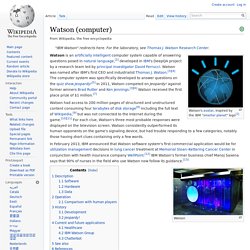
Watson was named after IBM's first CEO and industrialist Thomas J. Watson.[3][4] The computer system was specifically developed to answer questions on the quiz show Jeopardy! [5] In 2011, Watson competed on Jeopardy! Against former winners Brad Rutter and Ken Jennings.[3][6] Watson received the first place prize of $1 million.[7] Watson had access to 200 million pages of structured and unstructured content consuming four terabytes of disk storage[8] including the full text of Wikipedia,[9] but was not connected to the Internet during the game.[10][11] For each clue, Watson's three most probable responses were displayed on the television screen.
NeuroAesthetics - Science on Art. ! Introduction to NeuroAesthetics ! Ramachandran, Hirstein - The Science of Art. 40/40 Vision Lecture: Neurology and the Passion for Art. Articles and papers on neuroesthetics. Neurobeauty.pdf. Neurobeauty. VS Ramachandran: The neurons that shaped civilization. Hasson-etal_NeuroCinematics2008. Neurocinema, Neurocinematics. Is there a difference?

In The Neurocinema Collection™, we established that the term "neurocinema" doesn't really refer to movies with "Neuro" in the title or films about neurology. Instead, neuromarketers have have used the word in the following fashion: Neurocinema is a new filmmaking process that studies a viewer's sensorimotor, cognitive, and affective response to film stimuli. Researchers use technologies such as functional magnetic resonance imaging (fMRI) to measure changes in activity in parts of the brain,electroencephalography (EEG) to measure activity in specific regional spectra of the brain response, and/or sensors to measure changes in one's physiological state (heart rate, respiratory rate, galvanic skin response) to learn exactly what scenes excite or disinterest the viewer.
True horror: The spectre of neurocinema. As this year’s Oscar winners congratulate themselves, future hopefuls are experimenting with a new route to movie success.

Fastcompany.com has an interesting article about “the rise of neurocinema”. Neuromarketing firms have been applying their technical wizardry to movie trailers for a while (our own James Verrinder had his brain scanned while watching the Alice in Wonderland trailer a few months back) but now they’re talking about using brain science to refine the films themselves. According to psychologist Uri Hasson, action, horror and sci-fi films in particular rely on stimulating a certain part of the brain to provoke excitement, and scanning people’s brains allows filmmakers to measure and hone how successfully they’re doing this.
Neurocinema. Rise of Neurocinema: How Hollywood Studios Harness Your Brainwaves to Win Oscars. One thing you aren't likely to hear Sunday night from the Oscar-winning producer after accepting the trophy for Best Picture: "I'd like to thank my neuroscience partners who helped us enhance the film's script, characters, and scenes.
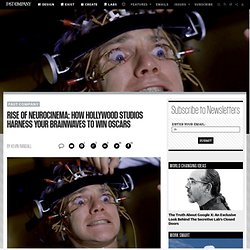
" It's not that far-fetched, though. A sizable number of neuromarketing companies already brain test movie trailers for the major studios through fMRI, EEG, galvanic skin response, eye-tracking and other biometric approaches.