
10 Incredible Architectural Wonders of The Ancient World. The science and art of designing and constructing buildings and other physical structures has been of man’s interest since his very beginning.

Architectural works have cultural rooting and symbolize the thinking of the society. When we look at the constructions of old days, we see wonders built by men with no technology. These wonders built after dedicated efforts of decades stand as a symbol of admiration and amazement. I have listed out a few of them. 10. Coral Castle, Florida, America Source Source Source Source Source Source Coral Castle was designed and built by Edward Leedskalnin, a 5 Feet tall man, weighing 100 pounds and suffering from tuberculosis. 9.
Uru people. Uros island view Los Uros island Uro man pulling boat made of reeds The Uros (Uru: Qhas Qut suñi) are a pre-Incan people who live on forty-two self-fashioned floating islands in Lake Titicaca Puno, Peru and Bolivia.

They form three main groups: Uru-Chipayas, Uru-Muratos and the Uru-Iruitos. Lost Civilizations: Atlantis: Timaeus and Critias. [ Introduction || The Dialogues || Cast of Characters ] Timaeus and Critias, two of Plato's dialogues, are the only existing written records which specifically refer to Atlantis.
The dialogues are conversations between Socrates, Hermocrates, Timeaus, and Critias. Apparently in response to a prior talk by Socrates about ideal societies, Timeaus and Critias agree to entertain Socrates with a tale that is "not a fiction but a true story. " Iron pillar of Delhi. The Floating Islands of Lake Titicaca. To visitors to Lake Titicaca, a boat trip to the floating islands, a unique tourist destination, is a must.

These islands are made and re-made from the totora reeds which provide home, sustenance and transportation for their residents. About a two hour boat ride from Puno, on the Peruvian side of the lake, the largest of about 40 islands and the main destination is the ialand of Santa María. See map showing location of Uros islands and Taquile island off Puno, Peru. Perihelion. 1.

Planet at aphelion 2. Planet at perihelion 3. Sun The perihelion is the point in the orbit of a planet, asteroid or comet where it is nearest to the sun. Gobekli Tepe: The World’s First Temple? Wari culture. Huari earthenware pot with painted design, 650-800 CE (Middle Horizon) Wari Tunic, Peru, 750-950 CE.

This tunic is made of 120 separate small pieces of cloth, each individually tie-dyed. Ceramics of the period depict high-status men wearing this style of tunic. Monoliths Wari Wari funeral bundle Pikillaqta administrative center, built by the Wari civilization in Cusco. Tiwanaku. Coordinates: 16°33′17″S 68°40′24″W / 16.55472°S 68.67333°W / -16.55472; -68.67333 Tiwanaku (Spanish: ''Tiahuanaco and Tiahuanacu'') is a Pre-Columbian archaeological site in western Bolivia, South America.
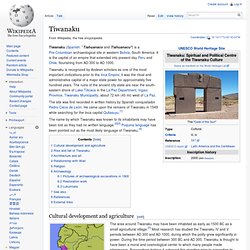
It is the capital of an empire that extended into present-day Peru and Chile, flourishing from AD 300 to AD 1000. Jul09wallpaper-8_1280.jpg (1280×960) Huascar, Inca Emperor 1527-1532. Huáscar (circa 1502-1532) was ruler of the Inca Empire for a brief time after the death of his father Huayna Capac sometime between 1525 and 1527.

When his father died, Huáscar was in command of the capital city of Cuzco and therefore most of the Inca Empire. Huáscar’s name has several different spellings, including Waskar and Waskhar. Young Huáscar soon became embroiled in a brutal civil war with his half-brother Atahualpa, who was in command of the northern city of Quito (the second largest in the Empire). More importantly, Atahualpa had the loyalty of the formidable army and its three main generals, Chalcuchima, Rumiñahui and Quisquis. Huáscar raised an army and went after Atahualpa in Quito, but he was repelled in a series of battles. As Huáscar was never seen alive by any Spanish, little is known about his personal life and personality. Web Store do Chrome - pearltrees.
History of Lake Titicaca - Lonely Planet Travel Information. When you first glimpse Lake Titicaca’s crystalline, gemlike waters, beneath the looming backdrop of the Cordillera Real in the clear Altiplano light, you’ll understand why pre-Inca people connected it with mystical events.

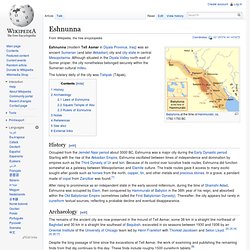
Those early inhabitants of the Altiplano believed that both the sun itself and their bearded, white god-king, Viracocha, had risen out of its mysterious depths. Eshnunna. Coordinates: 33°29′3″N 44°43′42″E / 33.48417°N 44.72833°E / 33.48417; 44.72833 Eshnunna (modern Tell Asmar in Diyala Province, Iraq) was an ancient Sumerian (and later Akkadian) city and city-state in central Mesopotamia.
Underwater Temple of Lake Titicaca. Scholars have long been intrigued by tales of ancient palaces seen by fishermen during dry spells when the lake level dropped, or of local Indians diving down and touching the roofs of stone buildings. Even early Spanish chroniclers recorded Inca stories of a great flood long ago and ruins on the lake bottom. Stories of the lost treasure were enough to draw the famous French oceanographer Jacques Cousteau to explore the lake. However, he discovered only ancient pottery. Black Mountain (Kalkajaka) National Park. Black Mountain (Kalkajaka) National Park is a 781 hectare [1]protected area in the Queensland, (Australia), 25 km south west of Cooktown.
It is managed and protected as a national park under the Nature Conservation Act 1992. The main feature of the park is the mass of granite boulders, some the size of houses. The absence of soil between the boulders and rocks create a maze of gaps and passages, which can be used to penetrate inside the mountain.[2] These rocks can become extremely hot. The area has a bad reputation as numerous people and those searching for the missing have disappeared without trace. Lake Titicaca Underwater Ruins. Sodom and Gomorrah. Updated -- 15 February 2005 (and 6 June 2005) The absolute destruction and total obliteration of two cities to the point where there is minimal evidence that they ever existed, is a singular point in the story of Genesis.
Much is made of the alleged decadence of these two cities (but in comparison to New York or Los Angeles... who knows?). All of it does seem to be a bit overwrought. Cappadocia. Cappadocia (/kæpəˈdoʊʃə/; also Capadocia; Turkish Kapadokya, from Greek: Καππαδοκία Kappadokía, from Ancient Greek: Καππαδοκία, from Old Persian: 𐎣𐎫𐎱𐎬𐎢𐎣 Katpatuka) is a historical region in Central Anatolia, largely in Nevşehir Province, in Turkey.
In the time of Herodotus, the Cappadocians were reported as occupying the whole region from Mount Taurus to the vicinity of the Euxine (Black Sea). Cappadocia, in this sense, was bounded in the south by the chain of the Taurus Mountains that separate it from Cilicia, to the east by the upper Euphrates and the Armenian Highland, to the north by Pontus, and to the west by Lycaonia and eastern Galatia.[1] The name was traditionally used in Christian sources throughout history and is still widely used as an international tourism concept to define a region of exceptional natural wonders, in particular characterized by fairy chimneys and a unique historical and cultural heritage.
Etymology[edit] Geography and climate[edit] Mt. History[edit] Chachapoya culture. Walls in Soloco - Chachapoyas. Statue of Decebalus. Ancient Alien Theory and Gobekli Tepe. Ancient Alien Theory and Gobekli Tepe by AliensWereHere.com. Ashurbanipal Library Phase 1. Lascaux. Category:Sumer. Portal:Ancient Near East. Etemenanki. Babylon. Babylon (Arabic: بابل, Bābil; Akkadian: Bābili(m);[1] Sumerian logogram: KÁ.DINGIR.RAKI;[1] Hebrew: בָּבֶל, Bāḇel;[1] Ancient Greek: Βαβυλών Babylṓn; Old Persian: 𐎲𐎠𐎲𐎡𐎽𐎢 Bābiru) was originally a Semitic Akkadian city dating from the period of the Akkadian Empire circa. 2300 BC.
Originally a minor administrative center, it only became an independent city-state in 1894 BC in the hands of a migrant Amorite dynasty not native to ancient Mesopotamia. List of Mesoamerican pyramids. This is a list of Mesoamerican pyramids or ceremonial structures. In most cases they are not true pyramids. There are hundreds of these done in many different styles throughout Mexico and Central America. Nuremberg Germany UFO Battle (1561) // December 27th, 2012 // Sightings Nuremberg Battle. Acre, Israel. Historically, it was a strategic coastal link to the Levant. In crusader times it was known as St. John d'Acre after the Knights Hospitaller of St John order who had their headquarters there. Petra. Olduvai Gorge (archaeological site, Tanzania.
Olduvai Gorge, Olduvai also spelled Olduwai, Ziggurat of Ur. Mahabalipuram. Sumerianlegacy. Category:Ancient cities. Buddhas of Bamiyan. Church of Saint George, Lalibela. Awning at the Colosseum. Olduvai Gorge. Atlantis or Someone Else? A Science Odyssey: People and Discoveries: Leakey family discovers human ancestors. Untitled. Cueva de los Tayos. The Behistun Inscription. Lost Civilizations: Atlantis: Vital Statistics. Atlantis - The Lost Continent Finally Found. Tahtzibichen Labyrinth Ancient Temple. Göbekli Tepe.
Sigiriya. Hattusa. Derinkuyu Underground City. Popol Vuh (The Mayan Bible) Turkey and India: Fathers of Civilization. Mada'in Saleh. Anunnaki. Black Mountain, Australia. List of colossal sculpture in situ. List of largest monoliths in the world. 31 Architectural Wonders of the Ancient World. Top 10 Civilizations That Mysteriously Disappeared. Lake Titicaca. Shinar.