
The Venus Project
The Venus Project proposes an alternative vision of what the future can be if we apply what we already know to achieve a sustainable new world civilization. It calls for a straightforward redesign of our culture in which the age-old inadequacies of war, poverty, hunger, debt and unnecessary human suffering are viewed not only as avoidable, but as totally unacceptable. Anything less will result in a continuation of the same catalogue of problems inherent in today's world. Today many people believe what is needed is a higher sense of ethical standards and the enactment of international laws to assure a sustainable global society.
Recommended Books. Recommended Documentaries. We are only now beginning to recognize the enormous potential and diversity of the relatively untapped resources of the world's oceans.
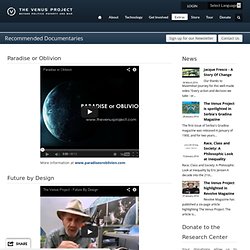
The oceans offer an almost limitless environment for food and energy production, minerals, pharmaceuticals, and much more. Colonization of the oceans is one of the last frontiers that remain on earth. If intelligently managed, the creation of ocean communities could be among the greatest achievements of the twenty-first century. This video presents visions of tomorrow's cities in the sea. Running time 15 minutes, produced 2002. The Venus Project's video, Welcome To The Future, presents an attainable vision of what our world could be if we intelligently apply science and technology with environmental and human concern--a future where war, poverty and hunger could be but a distant memory.
TVP Online Community. TVP Media.
Science. Related Media. TVP Main Website. What is The Venus Project? The Venus Project is an organization that proposes a feasible plan of action for social change, one that works towards a peaceful and sustainable global civilization.
It outlines an alternative to strive toward where human rights are no longer paper proclamations but a way of life. We operate out of a 21.5-acre Research Center located in Venus, Florida. When one considers the enormity of the challenges facing society today, we can safely conclude that the time is long overdue for us to re-examine our values and to reflect upon and evaluate some of the underlying issues and assumptions we have as a society.
This self-analysis calls into question the very nature of what it means to be human, what it means to be a member of a "civilization," and what choices we can make today to ensure a prosperous future for all the world's people. At present we are left with very few alternatives. Experience tells us that human behavior can be modified, either toward constructive or destructive activity. What is The Venus Project? Roxanne Meadows. Ms.

Roxanne Meadows attended Moore College of Art and received a B.F.A. from Maryland Institute of Art. Jacque Fresco - Social Engineer. Ask Jacque Fresco. Resource-Based Economy. The term and meaning of a Resource Based Economy was originated by Jacque Fresco.

It is a holistic socio-economic system in which all goods and services are available without the use of money, credits, barter or any other system of debt or servitude. All resources become the common heritage of all of the inhabitants, not just a select few. The premise upon which this system is based is that the Earth is abundant with plentiful resource; our practice of rationing resources through monetary methods is irrelevant and counter productive to our survival.
Modern society has access to highly advanced technology and can make available food, clothing, housing and medical care; update our educational system; and develop a limitless supply of renewable, non-contaminating energy. Energy. None of these mega-projects will ever be undertaken without a comprehensive study of the positive and negative retroactions involved.
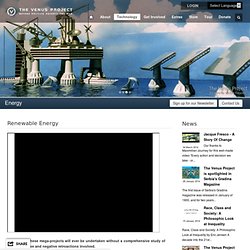
As refinements in conversion technologies increase its feasibility, geothermal energy will come to take on a more prominent role. Readily available in various geographical regions throughout the world, both on land and under the sea, this energy source alone could provide enough clean energy for the next thousand years. These underwater structures are designed to convert a portion of the flow of the Gulf Stream through turbines to generate clean electric power. These slow rotating turbines would have a centrifugal separator and deflectors to prevent harm to marine life. Transportation. Various segments of the passenger compartments on these high-speed maglev trains can be removed as the train passes through the station.
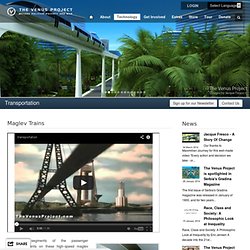
These removable sections can then take passengers to their local destinations while other compartments are lowered in their place. This method allows the main body of the train to remain in motion, thus conserving energy. In addition, the removable multi-functional compartments could be specially equipped to serve most transportation purposes. Since military aircraft will be unnecessary in the future, emphasis can be shifted to advancing medical, emergency, service, and transportation vehicles. Here is an example of VTOL (Vertical Take-off and Landing) aircraft with three synchronous turbines, which allow for exceptional maneuverability. Cities in the Sea. A global system of these structures can easily accommodate many millions of people and relieve the land based population pressures.

They can provide the inhabitants with information and serve as natural sea aquariums without artificially enclosing marine life. Space. Construction. "If technology does not liberate all people for the pursuit of higher aspirations in human achievement, then all its technical potential will be meaningless.

" Jacque Fresco The machine in the foreground is a multi-function unit. Here, it is used to lift and insert prefabricated housing components into a support structure. Although these "prefab" units will be composed of standard components, they will be of a modular design of such a wide and diverse array as to allow maximum individual expression in interior design and décor.
The construction of these industrial and research complexes in the Circular City can be carried out by robotic equipment that will receive instructions via satellite. Automated cranes travel along the buildings' length installing floors, windows, curtain walls, roofing, and other components from the ground up. Current State of Technology.
Housing. The Venus Project recommends that the present state and aims of architecture be redefined to fit the evolving needs of individuals in this new, emergent culture.

The architecture and individual dwellings of future cities will evolve on an entirely different basis from today’s houses. With the intelligent application of humane technologies, we will be able to provide and allow for a wide array of unique individual homes. Their structural elements will be flexible and coherently arranged to best serve individual preference. These pre-fabricated, modular homes, embodying a high degree of flexibility inconceivable in times past, could be built anyplace one might imagine, amidst forests, atop mountains, or on remote islands.
City Systems. It would be far easier and would require less energy to build new, efficient cities than to attempt to update and solve the problems of the old ones.

The Venus Project proposes a Research City that would use the most sophisticated available resources and construction techniques. Its geometrically elegant and efficient circular arrangement will be surrounded by, and incorporated into the city design, parks and lovely gardens. This city will be designed to operate with the minimum expenditure of energy using the cleanest technology available, which will be in harmony with nature to obtain the highest possible standard of living for everyone. This system facilitates efficient transportation for city residents, eliminating the need for automobiles.