
Vulcan (hypothetical planet) A number of reputable investigators became involved in the search for Vulcan, but no such planet was ever found, and the peculiarities in Mercury's orbit have now been explained by Albert Einstein's theory of general relativity.[1] Searches of NASA's two STEREO spacecraft data have failed to detect any vulcanoid asteroids between Mercury and the Sun that might have accounted for claimed observations of Vulcan.[2] It is doubtful that there are any vulcanoids larger than 5.7 kilometres (3.5 mi) in diameter.[2] Other than Mercury, asteroid 2007 EB26 with a semi-major axis of 0.55 AU (82,000,000 km; 51,000,000 mi) has the smallest known semi-major axis of any known object orbiting the Sun.[3] Le Verrier renewed his work and, in 1859, published a more thorough study of Mercury's motion.
Kepler mission discovers first planet orbiting two stars - Image 1 of 2. Artist's concept illustrating Kepler-16b, the first planet known to definitively orbit two stars (Image: NASA/JPL-Caltech/T.
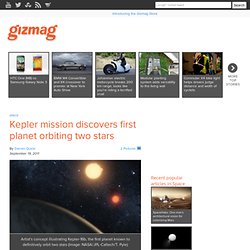
Pyle) Image Gallery (2 images) In news that conjures up visions of Luke Skywalker looking wistfully at the twin sunset of Tatooine accompanied by a stirring John Williams score, NASA's Kepler mission has detected the first planet orbiting two stars. The circumbinary planet, dubbed Kepler-16b, is some 200 light-years from Earth and, though gaseous and not thought to harbor life, its discovery broadens the opportunities for life in our galaxy according to Kepler principal investigator William Boruckias, because most of the Milky Way's stars are part of binary systems. Although scientists have theorized for decades that circumbinary planets were possible and previous research had hinted at their existence, the discovery of Kepler 16b is the first time the theory could be confirmed.
Planet. The planets were thought by Ptolemy to orbit Earth in deferent and epicycle motions.
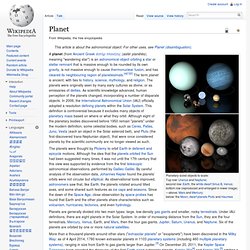
Although the idea that the planets orbited the Sun had been suggested many times, it was not until the 17th century that this view was supported by evidence from the first telescopic astronomical observations, performed by Galileo Galilei. By careful analysis of the observation data, Johannes Kepler found the planets' orbits were not circular but elliptical. As observational tools improved, astronomers saw that, like Earth, the planets rotated around tilted axes, and some shared such features as ice caps and seasons. Since the dawn of the Space Age, close observation by space probes has found that Earth and the other planets share characteristics such as volcanism, hurricanes, tectonics, and even hydrology. History. Mercury. Mercury is gravitationally locked and rotates in a way that is unique in the Solar System.
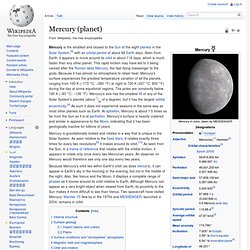
As seen relative to the fixed stars, it rotates exactly three times for every two revolutions[b] it makes around its orbit.[13] As seen from the Sun, in a frame of reference that rotates with the orbital motion, it appears to rotate only once every two Mercurian years. An observer on Mercury would therefore see only one day every two years. Because Mercury's orbit lies within Earth's orbit (as does Venus's), it can appear in Earth's sky in the morning or the evening, but not in the middle of the night.
Also, like Venus and the Moon, it displays a complete range of phases as it moves around its orbit relative to Earth. Although Mercury can appear as a very bright object when viewed from Earth, its proximity to the Sun makes it more difficult to see than Venus. Internal structure Internal structure of Mercury: 1. Mercury's density can be used to infer details of its inner structure. Surface geology. Venus. Venus is a terrestrial planet and is sometimes called Earth's "sister planet" because of their similar size, gravity, and bulk composition (Venus is both the closest planet to Earth and the planet closest in size to Earth).
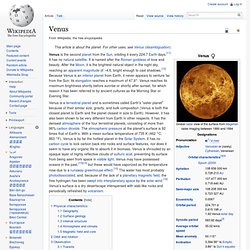
However, it has also been shown to be very different from Earth in other respects. It has the densest atmosphere of the four terrestrial planets, consisting of more than 96% carbon dioxide. The atmospheric pressure at the planet's surface is 92 times that of Earth's. With a mean surface temperature of 735 K (462 °C; 863 °F), Venus is by far the hottest planet in the Solar System. It has no carbon cycle to lock carbon back into rocks and surface features, nor does it seem to have any organic life to absorb it in biomass. Physical characteristics Venus is one of the four terrestrial planets in the Solar System, meaning that, like Earth, it is a rocky body. Geography. Earth. Earth is the third planet from the Sun.

It is the densest and fifth-largest of the eight planets in the Solar System. It is also the largest of the Solar System's four terrestrial planets. It is sometimes referred to as the world or the Blue Planet.[23] Earth formed approximately 4.54 billion years ago, and life appeared on its surface within its first billion years.[24] Earth's biosphere then significantly altered the atmospheric and other basic physical conditions, which enabled the proliferation of organisms as well as the formation of the ozone layer, which together with Earth's magnetic field blocked harmful solar radiation, and permitted formerly ocean-confined life to move safely to land.[25] The physical properties of the Earth, as well as its geological history and orbit, have allowed life to persist.
Name and etymology In general English usage, the name earth can be capitalized or spelled in lowercase interchangeably, either when used absolutely or prefixed with "the" (i.e. Heat. Mars. Animation of Mars' rotation from the vantage of an observer who moves south, then north, to hover over both poles, showing the planet's major topographic features.
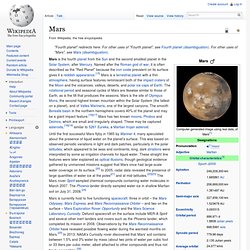
Mars is currently host to five functioning spacecraft: three in orbit – the Mars Odyssey, Mars Express, and Mars Reconnaissance Orbiter – and two on the surface – Mars Exploration Rover Opportunity and the Mars Science Laboratory Curiosity. Defunct spacecraft on the surface include MER-A Spirit and several other inert landers and rovers such as the Phoenix lander, which completed its mission in 2008.
Observations by the Mars Reconnaissance Orbiter have revealed possible flowing water during the warmest months on Mars.[25] In 2013, NASA's Curiosity rover discovered that Mars' soil contains between 1.5% and 3% water by mass (about two pints of water per cubic foot or 33 liters per cubic meter, albeit attached to other compounds and thus not freely accessible).[26] Physical characteristics. Deimos (moon) Deimos was discovered by Asaph Hall, Sr. at the United States Naval Observatory in Washington, D.C on 12 August 1877, at about 07:48 UTC (given in contemporary sources as "11 August 14:40" Washington mean time, using an astronomical convention of beginning a day at noon, so 12 hours must be added to get the actual local mean time).[9][10][11][12] Hall also discovered Phobos on 18 August 1877, at about 09:14 GMT, after deliberately searching for Martian moons.
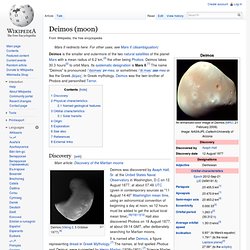
It has an escape velocity of 5.6 m/s[3] and apparent magnitude of 12.45.[4] Only two geological features on Deimos have been given names. The craters Swift and Voltaire are named after writers who speculated on the existence of two Martian moons before Phobos and Deimos were discovered.[16] Deimos's orbit is nearly circular and is close to Mars's equatorial plane. Unlike Phobos, which orbits so fast that it actually rises in the west and sets in the east, Deimos rises in the east and sets in the west.
. ^ Jump up to: a b "Apsis". Phobos (moon) Phobos (systematic designation: Mars I) is the larger and closer of the two natural satellites of Mars.
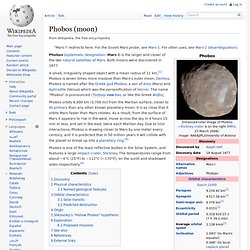
Both moons were discovered in 1877. Phobos has dimensions of 27 × 22 × 18 km,[1] and is too small to be rounded under its own gravity. Its surface area is slightly less than the land area of Delaware. Phobos does not have an atmosphere due to low mass and low gravity.[10] It is one of the least reflective bodies in the Solar System. Spectroscopically it appears to be similar to the D-type asteroids,[11] and is apparently of composition similar to carbonaceous chondrite material.[12] Phobos's density is too low to be solid rock, and it is known to have significant porosity.[13][14][15] These results led to the suggestion that Phobos might contain a substantial reservoir of ice.
Jupiter. Structure Jupiter is composed primarily of gaseous and liquid matter.
It is the largest of four gas giants as well as the largest planet in the Solar System with a diameter of 142,984 km (88,846 mi) at its equator. Callisto (moon) Callisto (bottom left), Jupiter (top right) and Europa (below and left of Jupiter's Great Red Spot) as viewed by Cassini Callisto is the outermost of the four Galilean moons of Jupiter.
It orbits at a distance of approximately 1 880 000 km (26.3 times the 71 492 km radius of Jupiter itself).[2] This is significantly larger than the orbital radius—1 070 000 km—of the next-closest Galilean satellite, Ganymede. As a result of this relatively distant orbit, Callisto does not participate in the mean-motion resonance—in which the three inner Galilean satellites are locked—and probably never has.[9] Like most other regular planetary moons, Callisto's rotation is locked to be synchronous with its orbit.[3] The length of the Callistoan day, simultaneously its orbital period, is about 16.7 days. Model of Callisto's internal structure showing a surface ice layer, a possible liquid water layer, and an ice-rock interior.
Ganymede (moon) Ganymede is composed of approximately equal amounts of silicate rock and water ice. It is a fully differentiated body with an iron-rich, liquid core. Europa (moon) Europa i/jʊˈroʊpə/[9] (Jupiter II), is the sixth-closest moon of the planet Jupiter, and the smallest of its four Galilean satellites, but still the sixth-largest moon in the Solar System. Europa was discovered in 1610 by Galileo Galilei[1] and possibly independently by Simon Marius around the same time.
Progressively better observations of Europa have occurred over the centuries by Earth-bound telescopes, and by space probe flybys starting in the 1970s. Slightly smaller than the Moon, Europa is primarily made of silicate rock and probably has an iron core. It has a tenuous atmosphere composed primarily of oxygen. Europa orbits Jupiter in just over three and a half days, with an orbital radius of about 670,900 km.
Io (moon) Io's volcanism causes many of its unique features. Its volcanic plumes and lava flows greatly change the surface and cover it in yellow, red, white, black, and green allotropes and compounds of sulfur. Many extensive lava flows, several more than 500 km (300 mi) in length, also mark the surface. The materials that this volcanism produces comprise Io's thin, patchy atmosphere and Jupiter's extensive magnetosphere. Io's volcanic ejecta produce a large plasma torus around Jupiter. Further observations have been made by Cassini–Huygens in 2000 and New Horizons in 2007, as well as from Earth-based telescopes and the Hubble Space Telescope as technology has advanced.
Saturn. Saturn's interior is probably composed of a core of iron, nickel and rock (silicon and oxygen compounds), surrounded by a deep layer of metallic hydrogen, an intermediate layer of liquid hydrogen and liquid helium and an outer gaseous layer.[15] The planet exhibits a pale yellow hue due to ammonia crystals in its upper atmosphere. Electrical current within the metallic hydrogen layer is thought to give rise to Saturn's planetary magnetic field, which is weaker than Earth's magnetic field but has a magnetic moment 580 times that of the Earth due to Saturn's larger body radius.
Moons of Saturn. Mimas (moon) Enceladus (moon) In 2005, the Cassini spacecraft started multiple close flybys of Enceladus, revealing its surface and environment in greater detail. Tethys (moon) Tethys has been approached by several space probes including Pioneer 11 (1979), Voyager 1 (1980), Voyager 2 (1981), and multiple times by Cassini since 2004. Dione (moon) Cassini enhanced-color composite of Dione, showing the darker, fractured terrain of the trailing hemisphere. Titan (moon) Iapetus (moon) Rhea (moon) Uranus. Moons of Uranus. Uranian moons are divided into three groups: thirteen inner moons, five major moons, and nine irregular moons. Miranda (moon) Ariel (moon)
Umbriel (moon) Titania (moon) Oberon (moon) Neptune. Moons of Neptune. Proteus (moon) Larissa (moon) Galatea (moon) Despina (moon) Thalassa (moon) The Nine Planets Solar System Tour. The Extrasolar Planets Encyclopaedia.