
Startseite. Goodmans Europe, Bubble Tea, Popping Bobas, Shop, Starter, Sets, Set, Topping, Bubble, Tea, Maschinen, Maschine, Shaker, Sealing, Becher, Jelly, Pulver, Zutaten, Zubehör, Ausstattung, Laden, ... Goodmans Europe, Bubble Tea, Popping Bobas, Shop, Starter, Sets, Set, Topping, Bubble, Tea, Maschinen, Maschine, Shaker, Sealing, Becher, Jelly, Pulver, Zutaten, Zubehör, Ausstattung, Laden, ... BIG ONE Bubble Tea Санкт-Петербург. Spheres – besser als nur Bubble-Tea. Spätestens mit den ukiyo-e Hokusais ist Manga zum Begriff für eine Form der Verbildlichung geworden, die von Japan ausgehend, zuerst Ende des 19.

Jahrhunderts bedeutende Künstler Europas beeinflusst hat. Sphere Bay möchte Freunde des Manga bei einer Schale Tee ein offenes Forum zum künstlerischen Austausch geben. Dafür möchten wir Mangakas zu Workshops in unser Teehaus einladen. Auch andere Veranstaltungen dazu sind in Zusammenarbeit mit der DoKomi in Vorbereitung und werden hier angekündigt. Wir freuen uns über jede Anregung, die zur Förderung dieser Kunstform in unserem Teehaus beitragen kann.
KOI Café. EasyWay Tea - Australia's Favourite Bubble Tea - EasyWay Story. A tale of Bubble Tea...

The story of the international multi-award winning franchise began in Taiwan in 1992, when “the man” discovered the potential of traditional pearl milk tea and decided to take it to another level. Unknowingly, he had created a fun brand and bubble tea concept loved by millions around the world. It has not been easy, but since landing in Sydney at the end of 2001, the market has provided us with overwhelming support to make EasyWay, the No.1 Bubble Tea brand in Australia. Now we have close to 70 stores all over Australia! EasyWay's success is because: We provide an extensive range of fun beverages and toppings like no other – from the signature pearl milk tea to the much loved iced teas.
Bubble Tea and more... Bubble Tea and more... 休閒小站連鎖加盟集團. EasyWay (outlet) EasyWay is an international tea outlet that serves hot and cold beverages with assorted flavouring.

It started out as a small store in Taiwan owned by Kuo Wun-Ho and Fu Hsin-Chin back in 1992, its success riding on the popularity of bubble tea in Taiwan. Tahô. Raw sago "pearls" A magtataho walking through a residential area in Manila.

Taho (Tagalog: [tɐˈhoʔ]) (Chinese: 豆花; Pe̍h-ōe-jī: tāu-hue) is a Philippine snack food made of fresh soft/silken tofu, arnibal (sweetener and flavoring), and sago pearl (similar to tapioca pearls).[2] This staple comfort food is a signature sweet and taho peddlers can be found all over the country. The Indonesian and Malaysian equivalent of this snack is tauhue. History[edit] Processing and preparation[edit] Most taho vendors prepare the separate ingredients before dawn. Marketing[edit] The Magtataho (taho vendor) is a common sight in the Philippine streets. Taho vendors peddle their product in a distinctive manner, calling its name in a full, rising inflection as they walk at a leisurely pace on the sidewalk or along the side of the road. Eating[edit] Taho is enjoyed either with a spoon, sipping it with a straw, or by simply slurping it straight from the cup. Varieties[edit] Falooda. Falooda (Urdu: فالودا) or Faluda is a cold and sweet beverage containing many ingredients very popular in South Asia.

Traditionally it is made by mixing rose syrup with vermicelli, psyllium (ispaghol) or basil (sabza/takmaria) seeds, jelly pieces and tapioca pearls along with either milk, water or ice cream.[1] Faloodeh, originally Paloodeh or Pālūde (Persian: پالوده) is a Persian cold dessert consisting thin vermicelli noodles made from corn starch mixed in a semi-frozen syrup made from sugar and rose water. It is often served with lime juice and sometimes ground pistachios. It is a traditional dessert in Iran and also in neighbouring Pakistan.
Paloodeh is originally from Shiraz and in Iran it is especially famous as Shirazi Faloodeh.[1] Paloodeh is one of the earliest forms of cold desserts, existing as early as 400 BCE. [citation needed] The name originally means smoothy (filtered). Taiwanese cuisine. Danzai mian (擔仔麵, dànzǎimiàn) from Dùxiǎoyuè (度小月) of Tainan Location of Taiwan Taiwanese cuisine (traditional Chinese: 台灣菜; simplified Chinese: 台湾菜; pinyin: Táiwāncài; Pe̍h-ōe-jī: Tâi-oân liāu-lí (臺灣料理)) has several variations.

In addition to the following representative dishes from the people of Hoklo (Hō-ló) ethnicity (see Taiwanese people), there are also Aboriginal, Hakka, and local derivatives of Chinese cuisines such as beef noodle soup. Taiwanese cuisine itself is often associated with influences from mid to southern provinces of Mainland China, most notably from the province of Fujian (Hokkien), but influences from all of Mainland China can easily be found. A notable Japanese influence also exists due to the period when Taiwan was under Japanese rule. Ingredients and culture[edit] In many of their dishes, the Taiwanese have shown their creativity in their selection of spices. The Taiwanese xiaochi has gained much reputation internationally. Regional specialities[edit] Taiwanese tea culture. Taiwanese tea culture includes tea arts, traditional tea ceremonies, and the social aspects of tea consumption.

While the most common teas consumed in Taiwan are oolongs (especially Taiwanese oolongs such as Iron Goddess and Alpine Oolong), Puers, black teas and green teas are also popular. Bubble tea. Bubble tea, also known as pearl milk tea or boba milk tea, is a Taiwanese tea-based drink invented in tea shops in Taichung, Taiwan, during the 1980s.[1] The term "bubble" is an Anglicized imitative form derived from the Chinese bōbà (波霸) meaning "large breasts," slang for the large, chewy tapioca balls commonly added to the drink.
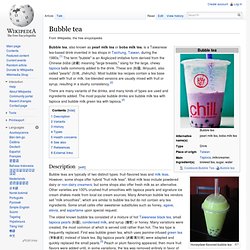
These are (粉圓, fěnyuán), also called "pearls" (珍珠, zhēnzhū). Most bubble tea recipes contain a tea base mixed with fruit or milk. Ice-blended versions are usually mixed with fruit or syrup, resulting in a slushy consistency.[2] There are many variants of the drinks, and many kinds of types are used and ingredients added. Bubble tee. Bubble tee. Bubble Tea: der Tee mit Bubbles.