
Digitalien sucht das Supermodell - vedducations Webseite! Um die Prozesse und Kompetenzen in Bezug zur Bildung und den Bedingungen der Digitalität ("digitale Bildung") zu veranschaulichen, gibt es zahlreiche Modelle, die in unterschiedlichen Zusammenhängen und mit unterschiedlichen Zielsetzungen entwickelt worden sind.

Immer wieder kommt es sowohl unter den Einsteigern als auch den Profis zur Diskussion, welches Modell in welchem Kontext sinnvoll und hilfreich ist. Welches Modell ist denn nun das Supermodell auf dem Weg nach Digitalien? Wie lässt sich die Transformation von Unterricht, Lehr- und Lernzielen, Schule und (digitaler) Bildung am Besten grafisch darstellen? In diesem Beitrag möchte ich eine Auswahl von Modellen, die ich selbst in verschiedenen Zusammenhängen von Lehreraus-, Lehrerfort- und Lehrerweiterbildung eingesetzt habe vorstellen und bewerten. Let's go! Das SAMR Modell (2006 von Ruben Puentedura entwickelt) zeigt in vier Stufen, wie digitale Medien im Unterricht den Lehr- und Lernprozess bereichern.
Zielgruppe: Stärken: Schwächen: Classroom Learning Activity Rubric (ECISD) Digital Discoveries - SAMR vs Latte. The Next Step: Amplification… Amplify… A few months ago, I wrote a blog post titled: “Enhancement-Automating-Transforming-Informating“, where I fused two models, the SARM model by Ruben Puentedura and Alan November’s Automating vs Informating model.

It made sense to me that Puentedura’s Substitution and Augmentation stage was part of November’s Automating phase and that the Modification and Redefinition belonged to the Informating phase. But, I feel that there is a third phase beyond the Transformative phase, that I am calling “Amplification”. Now, one can argue that the opportunity to “amplify is part of the “Redefinition” stage, since as it is defined by Puentedura (…to be able to create a task, that was not possible before, without technology), but I am arguing that goes further and deserves to be it’s own phase. The Free Dictionary defines the verb “amplify” as: 1. Let’s take the example of a book report, that students have been asked to produce around the world in most school systems, at many different grade levels. Qu'est-ce que le modèle SAMR ? - Prim à bord.
De quoi parle-t-on ?
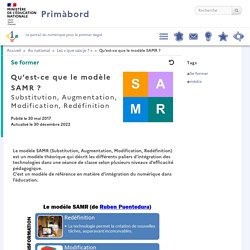
Le modèle SAMR (Substitution, Augmentation, Modification, Redéfinition) est un modèle théorique qui décrit les différents paliers d’intégration des technologies dans une séance de classe selon plusieurs niveaux d’efficacité pédagogique. C’est un modèle de référence en matière d’intégration du numérique dans l’éducation. Quel est son origine ? C’est un chercheur américain,Ruben Puentedura, enseignant à Harvard et spécialiste en éducation, qui est à l’origine de cette représentation théorique. Son modèle, exploité par de nombreux didacticiens, est utilisé pour décrire et situer le niveau d’intégration des technologies dans la pratique de classe. Quelles utilisations peut-on avoir de ce modèle ? Des exemples d’intégration : Des questions à se poser : Quels sont les scénarios et les repères pour s’assurer du développement de liens pertinents entre l’éducation et le numérique ?
Pour aller plus loin : An enthusiastic teacher! Class tasks. English jack london / call of the wild. Geography. The SAMR Ladder Through the Lens of 21st Century Skills - Getting Smart by Susan Oxnevad - EdTech, SAMR, Teaching. This summer I have been digging deeper into the SAMR model of tech integration to help educators embrace 1:1 learning and the changes it will bring about.

SAMR is a truly useful tool for helping teachers identify their current comfort zone in order to build expertise in designing efficient and effective student learning experiences. To reach higher levels on the SAMR ladder, teachers can make some planning and instructional shifts. A look at the big picture is helpful when trying to understand how to help students develop important 21st Century Skills at each level. Through the Lens of 21st Century Skills I have created an interactive graphic of the SAMR Ladder to illustrate the big picture. Final Thoughts The learning that occurs as teachers climb up the SAMR ladder is what will eventually lead to successful lesson design.