
Early Childhood. Psychosocial Development in Early Childhood. <hr><p><b>You must have javascript enabled to view this website.

Please change your browser preferences to enable javascript, and reload this page. </b></p><hr> Psychosocial Development in Early Childhood Guidepost 1: How does the self-concept develop during early childhood, and how do children advance in understanding their emotions? The self-concept undergoes major change in early childhood. Guidepost 2: How do young children develop initiative and self-esteem? According to Erikson, the developmental conflict of early childhood is initiative versus guilt. Guidepost 3: How do boys and girls become aware of the meaning of gender, and what explains differences in behavior between the sexes? Gender identity is an aspect of the developing self-concept.The main gender difference in early childhood is boys' greater aggressiveness. Guidepost 4: How do preschoolers play, and how does play contribute to and reflect development? Play has physical, cognitive, and psychosocial benefits. MALE VS. FEMALE. Brain #1.
In an attempt to better understand the differences between the brains of men and women, scientists scanned the brains of 949 young men and women in the biggest investigation of its kind thus far.

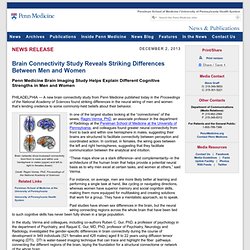
Researchers at the University of Pennsylvania found that the female brain is “hard-wired” to be better at multi-tasking, while men are better at concentrating on single, complex activities. Undated handout photo issued by National Academy of Sciences of brain networks showing significantly increased within hemispheres in males (upper) and between hemispheres in females (lower). (Caption via the Daily Mail) Women everywhere are probably nodding their heads in approval and muttering “I told you so” under their breath, but there is also some advantages found in the male brain. Using “hi-tech diffusion MRI imaging,” scientists mapped the connections between different parts of the brain and discovered that women have much better connections between the left and right sides of the brain. Dr. Brain #2. PHILADELPHIA — A new brain connectivity study from Penn Medicine published today in the Proceedings of the National Academy of Sciences found striking differences in the neural wiring of men and women that’s lending credence to some commonly-held beliefs about their behavior.
MALE. FEMALE. Hormones #1. Understanding hormones helps us decipher the relationship between type and gender.
[“Gender” is cultural while “sex” is biological.] We often associate hormones with adolescence, midlife and monthly cycles. However, the greatest influence on sex* is in the womb as the brain and body of the fetal boy or girl is developing. There are over eighty known hormones. Almost all affect personality. Testosterone Men produce ten times more testosterone than women, so even low testosterone men have more than any woman. A sense of separateness aggression and risk-taking sex drive (but not touch affection) and sexual fantasy anxiety or energy leading to poor concentration assertiveness and self-confidence visual-spatial ability and interest in moving things violent, criminal, or psychotic behavior In men, testosterone rises and falls in response to winning or losing one’s place in the social order, such as losing a game or gaining a promotion.
Humans are “naturally female.” Hormones #2. Whatever the agonizing or doubts, most mothers tenaciously persist in mothering.

In fact, despite long hours at a distance because of work and other commitments, mothers today spend just as much time with their children as their mothers did. Is this "more frenzied devotion" to children, as Ursinus University psychologist Catherine Chambliss calls it, compensation for being away — or simply the sacrifice and self-denial practiced by mothers of many species? A bird, the North American killdeer, takes big chances. It entices predators away from the nest by pretending it has a broken wing — and sometimes loses its life. To protect their young, giraffe mothers have given their lives to lions, and in Africa, elephants, sensing a threat to their babies, have attacked jeeps. What makes females so motherly? Others favor biological explanations. Rhesus monkeys lacking any experience at mothering also have been injected with the hormone. The mice lacked a gene, fosB.
MALE. FEMALE.