
Facebook's Toying With A Radical New Idea: Letting You Be Anonymous. Through Facebook's decade-long history, one thing has been consistent: You had to use your real name to do anything on the website.

But now, Mark Zuckerberg is suggesting that he's willing to loosen the reins on anonymity and let people use Facebook -- in some cases, at least -- without their real names. The Facebook founder dropped that hint in an interview with Bloomberg Businessweek for his company's 10th anniversary. "I don't know if the balance has swung too far, but I definitely think we're at the point where we don't need to keep on only doing real identity things," Zuckerberg said.
"If you're always under the pressure of real identity, I think that is somewhat of a burden. " You can't currently use a fake name on Facebook. In the interview with Bloomberg, Zuckerberg did not detail in which specific ways the real-identity rule would be pulled back. To understand how radical a shift even a little anonymity would be for Facebook, you have to look back to 2004. Who is harmed by a "Real Names" policy? - Geek Feminism Wiki.
Twitter Doesn't Give a Damn Who You Are. Why Twitter doesn’t care what your real name is. Internet Evolution: The War on Web Anonymity - SPIEGEL ONLINE - News - International. The Avenue de l'Opéra in Paris is a respectable address, surrounded by banks, boutiques and cafés.
The tenants listed on door plaques include a language school and an airline. But the name of the building's most famous tenant is not listed: Google. The global corporation values privacy -- its own privacy, at least. 5 Reasons Google+'s Name Policy Fails - Security - Privacy. Google should rethink its policy and empower users rather than restrict them.

Google should have recognized that the similarity between its Google+ name policy and the Internet usage policies favored by authoritarian regimes represents a problem. The company's recently launched social network requires that users sign up under the name by which they're referred to in real life.
But not only is this maddeningly vague definition inconsistently applied, as has been demonstrated by individuals with unusual names like Stilgherrian and Violet Blue, it is poorly thought out. Some even suggest it is evil. No, not evil on the scale of mayhem and physical harm. Google, like Facebook before it, offers a social network that doubles as a surveillance network. One identity or more? » Article » OWNI.eu, Digital Journalism.
Given the discussion about Facebook enabling other sites to use its comment infrastructure — and what that means for identity and anonymity in discussion — I thought I’d share some of what I’m saying about the question of multiple identities in my book.
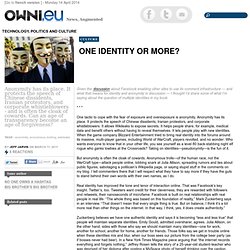
One tactic to cope with the fear of exposure and overexposure is anonymity. Anonymity has its place. It protects the speech of Chinese dissidents, Iranian protestors, and corporate whistleblowers. It allows Wikileaks to expose secrets. It helps people share, for example, medical data and benefit others without having to reveal themselves. But anonymity is often the cloak of cowards. Real identity has improved the tone and tenor of interaction online. Google+'s real name policy pisses off online activists in China - Shanghaiist. Despite being blocked, Google+ still has the power to ruffle feathers here in China as news outlets have been abuzz recently concerning Google's deletion of thousands of Google+ accounts that were not using real names.

As interesting as that may be, the real story here lies not in why "JrzyShoreGrrll1993" or "sher@mie:)" should keep their profiles, but rather in the numerous internet activists who have a much less stupid reason to use a pseudonym. Not only is there a tradition for using pen names on the internet to avoid being implicated for having certain views, many Chinese users in particular would perhaps rather be known as Walt among their American friends than Weihua.
One Chinese activist in particular wrote on his Google+: Please Google+, when you are deciding regulations, you must consider Chinese usage, especially from users in mainland China. Be sure to consider the user's actual situation. Facebook’s “Real Name” Policy Not Well Liked. Christopher "moot" Poole's Canvas Brings the Fun of 4Chan Mainstream. Like your daughter bringing home an ex-convict for dinner and saying that he's actually a "really good guy," Christopher "moot" Poole explained how the virtue of 4Chan--instantaneous collaborative creativity--could overshadow its darker, dirtier proclivities by gaining new life in a project called Canvas.

Canvas is a modernized, re-thought message board that deals mostly in images and short comments, not text posts, and feels less like a sleazy Internet saloon than 4Chan does. Poole called 4Chan a "barebones website" that, like most forums, was built on antiquated ideas using antiquated software. Unlike older message boards, Canvas will prioritize pictures, games, social networking, and other nowadays tech instead of long text posts. Supporting your freedom to choose the name you use on social networks and other online services. Google+ and pseudonymity: An open letter to @Google. As you may know, along with thousands of people around the world, my access to all of my Google services was suddenly revoked, without warning and without reason.
My original appeal to reinstate my account was rejected. I have written a letter to Google appealing this second rejection. The text of this letter appears below the jump, which may help those of you who are also appealing this decision: 4chan founder: Zuckerberg is “totally wrong” about online identity. Christopher Poole, the founder of controversial online image board 4chan, outlined his vision for Web-based community today at the South by Southwest Interactive conference — and yes, his ideas are in pretty sharp contrast to those of Facebook founder Mark Zuckerberg.

Zuckerberg has spent a lot of time talking about his stance on identity and privacy, especially recently, as Facebook has taken more criticism for its various privacy policies. (To get the flavor of his remarks, check out VentureBeat’s post about Zuckerberg’s privacy stance from last May, as well as David Kirkpatrick’s book The Facebook Effect.) South Korea to abandon “real name” internet policy. Google revises Google+ real name management policy. Over the weekend, Google annoyed numerous one-time Google+ users by blowing away their accounts because they'd broken Google's name restrictions.
That went over well. As I asked at the time, “What was Google thinking!?” Bradley Horowitz - Google+ - Last night, +Robert Scoble shared some information based on… Google Plus’s “Real Name” policy is abusive; Facebook is not a “Real Name” success story. Google+ Punts on Kafkaesque Name Policy. One of my favorite moments in Franz Kafka’s The Trial is shortly after the protagonist Josef K is placed under arrest for an unnamed offense.

The men notifying him of his arrest don’t cuff him or take him to jail. They just tell him proceedings are underway and that he’ll learn everything in due course. The only thing K can think to do is present the men his identity papers, but all he can find to show them is his bicycle license: “If this is a farce, he was going to play along.” Google Plus Deleting Accounts En Masse: No Clear Answers. A striking number of Google+ accounts have been deleted in the last 24 hours as the new social network struggles with its community standards policy around real names - alienating and frightening the people it aims to serve. Removed but restored through influence is Limor Fried - AKA Lady Ada / Adafruit Industries: She was recently featured on the cover of WIRED Magazine.
Google suspended Limor Fried “Ladyada” Google+ profile, no show-and-tell tonight… Her account has just now been mysteriously restored, though only after a groundswell of complaints. Suffice it to say, the rest of the deleted accounts will not have such well-placed advantages. Many have now been purged and not restored. The message I received this morning from the source in my previous Google+ article summarized it, Google+ refuse un anonymat pourtant salutaire. Des réflexions sont en cours afin de permettre à chacun de ne pas être tracé dans ses moindres actes sur le Net à des fins publicitaires. Comme le note cet article, "le gouvernement a donné un préavis à Google, Microsoft, Apple et consorts, afin qu'ils donnent un moyen aux consommateurs d'empêcher les annonceurs de suivre leurs actions sur le web".