
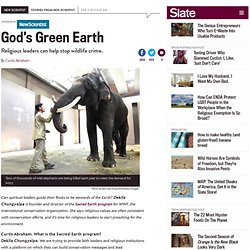
WWF Sacred Earth program: Religious leaders should preach for the environment. Photo by Kim Jae-Hwan/AFP/Getty Images Can spiritual leaders guide their flocks to be stewards of the Earth?
Dekila Chungyalpa is founder and director of the Sacred Earth program for WWF, the international conservation organization. She says religious values are often consistent with conservation efforts, and it’s time for religious leaders to start preaching for the environment. Curtis Abraham: What is the Sacred Earth program? Dekila Chungyalpa: We are trying to provide faith leaders and religious institutions with a platform on which they can build conservation messages and lead environmental change.
Nicholas Stern: 'Looking back, I underestimated the risks.' Microbes in the sky. Some clouds are also important for bacterial transport to new environments. The violent air currents inside storm clouds can speed up the mixing of different atmospheric layers and can lift bacteria above boundary layers, helping them to travel distances of up to several thousand kilometres. Dr Tina Šantl Temkiv We may think of clouds as simply water vapour in the sky, but scientists from Aarhus University in Denmark have revealed the rich diversity of microbial life and chemical compounds that exist in these temporary habitats above our heads.
The research, which appeared in the open access journal PLOS ONE , used hailstones recovered after a storm in May 2009 as its focus. As well as several species of bacteria usually associated with plants, the hailstones were found to carry nearly 3000 different compounds typically located in soil. Hailstones: A Window into the Microbial and Chemical Inventory of a Storm Cloud. Storm clouds frequently form in the summer period in temperate climate zones.

Should domestic cats be eradicated? Scientists harness firefly technology to make LEDs more efficient. To skip a flat rock across the surface of a pond, it needs to be thrown at an angle shallow enough to bounce back into the air, otherwise, it is headed straight to the bottom.

When light travels from a denser, higher refractive index medium to a less dense one, it similarly will be reflected if the the angle relative to vertical is greater than a critical angle. This phenomenon, known as total internal reflection, imposes significant restriction on the efficiency with which LEDs can transmit light into the air. How the marine snail will help build better batteries, solar cells, and drill bits. Flooding preparedness needs to include infection prevention and control strategies. Flooding can cause clinical and economic damage to a healthcare facility, but reopening a facility after extensive flooding requires infection prevention and control preparedness plans to ensure a safe environment for patients and healthcare workers.

In a study published in the February issue of Infection Control and Hospital Epidemiology, the journal of the Society for Healthcare Epidemiology of America, clinical investigators report key findings and recommendations related to the closure and re-opening of hospitals impacted by black-water floods. The guidance builds on lessons learned from Thailand and the United States. Extinction of millions of species 'greatly exaggerated' Hot days threaten corn crop yields. U.

LEEDS (UK) — Fertilizers and improved irrigation have increased corn production, but soaring temperatures could soon offset those recent gains. Increasingly hot summer weather could cause a fall in crop yields over the next two decades unless farming techniques are improved more quickly, scientists have found. Viruses infect tiny ocean creatures, too. CORNELL (US) — Scientists have found evidence that previously unknown viruses infect marine crustaceans called copepods, which are key to ocean carbon cycling.

While predation by fish and other aquatic creatures accounts for the majority of copepod deaths, up to 35 percent of the zooplankton’s mortalities are unknown. Harmful algae, environmental stressors, parasites, and diseases are likely all involved in copepod mortalities. Soot is heating up the planet, experts warn. U.

LEEDS (UK) — Soot’s role in global warming may be underestimated, but a major effort in reduction could potentially gain us a few decades of relief. The direct warming effect of black carbon, the term used by scientists to describe soot, could be about twice the previous estimates, according to a study published in the Journal of Geophysical Research Atmospheres. Black carbon is believed to have a warming effect of about 1.1 Watts per square meter (W/m2), approximately two thirds the warming effect of carbon dioxide—the largest man-made contributor to global warming—and greater than that of methane.
The figures indicate there may be a greater potential to curb warming by reducing soot emissions than previously thought. Professor Piers Forster from the School of Earth and Environment at the University of Leeds, who co-led the study, says: “There are exciting opportunities to cool climate by cutting soot emissions, but it is not straightforward. ‘Sea of exotics’ isolates native plants. U.

TORONTO (CAN) — Given time, invading plants will most likely eliminate native species growing in the wild, new research shows. Can Amazon trees survive global warming? UCL (UK) — Tree species in the Amazon are likely to survive climate warming in the coming century, having already weathered temperatures higher than any worst case scenario forecast for the year 2100.

A study published in the latest edition of Ecology and Evolution reveals the surprising age of some Amazonian tree species—more than 8 million years. Having survived warm periods in the past, the tree species will likely survive future warming, provided there are no other major environmental changes. Although extreme droughts and forest fires will impact Amazonia as temperatures rise, the trees will likely endure the direct impact of higher temperatures. As well as reducing greenhouse gas emissions to minimize the risk of drought and fire, conservation policy should remain focused on preventing deforestation for agriculture and mining, researchers say. “The past cannot be compared directly with the future. Source: UCL.