Medieval Scandinavian History - Vikings in the Middle Ages. Though notorious for their fearsome Viking raids, Scandinavians were also farmers and craftsmen.
Find out more about this complex society that began in Norway, Sweden and Denmark and spread to Iceland, Greenland, Russia, much of Europe and even the Americas. Medieval Atlas: Maps of ScandinaviaAn index of maps depicting Scandinavia, in whole or in part. History of Denmark. The history of Denmark dates back about 12,000 years, to the end of the last ice age, with the earliest evidence of human inhabitation.
The Danes were first documented in written sources around 500 AD, including in the writings of Jordanes and Procopius. With the Christianization of the Danes c. 960 AD, it is clear that there existed a kingship in Scandinavia which controlled roughly the current Danish territory. Queen Margrethe II can trace her lineage back to the Viking kings Gorm the Old and Harald Bluetooth from this time, making the Monarchy of Denmark the oldest in Europe.[1] Denmark's history has particularly been influenced by its geographical location between the North and Baltic seas.
This meant that it was between Sweden and Germany and thus at the center of the mutual struggle for control of the Baltic Sea (dominium maris baltici). VIKINGS. The term Viking though used to denote ship-borne explorers, traders and warriors, is actually a verb describing the acts of the Danes who originated in Denmark and raided the coasts of the British Isles, France and other parts of Europe from the late 8th century to the 11th century.
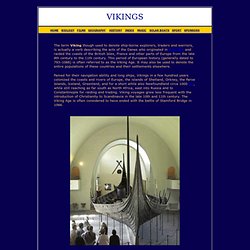
This period of European history (generally dated to 793–1066) is often referred to as the Viking Age. It may also be used to denote the entire populations of these countries and their settlements elsewhere.