
The Objectivity Problem. A Surge on One Channel, a Tight Race on Another. Senator ’s surge in the polls was so strong he was competitive in Mr.
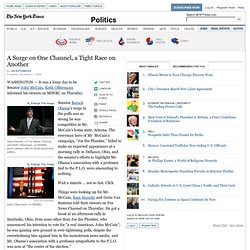
McCain’s home state, Arizona. The everyman hero of Mr. McCain’s campaign, “Joe the Plumber,” failed to make an expected appearance at a morning rally in Defiance, Ohio, and the senator’s efforts to highlight Mr. Obama’s association with a professor tied to the P.L.O. were amounting to nothing. Wait a minute ... not so fast. Things were looking up for Mr. On any given night, there are two distinctly, even extremely, different views of the presidential campaign offered on two of the three big cable news networks, Fox News Channel and MSNBC, a dual reality that is reflected on the Internet as well. On one, polls that are “tightening” are emphasized over those that are not, and the rest of the news media is portrayed as papering over questions about Mr.
On the other, polls that show tightening are largely ignored, and the race is cast as one between an angry and erratic Mr. “It was ridiculous,” said Mr. Time Editor: Objective Journalism a 'Fantasy'; Justifies Greening of Iwo Jima Photo. Time magazine Managing Editor Richard Stengel continued to defend the magazine's doctoring of the iconic Iwo Jima flag-raising photo in a speech April 21 - calling it a "point of view.
" But perhaps one of the most appalling revelations to come out of Stengel's defense of the photo is his idea of the role of objectivity in running a legitimate news magazine. During his speech at the University of Mississippi in Oxford, Miss., part of the third annual Stuart J. Bullion Lecture , Stengel defied the traditional notion that journalists should be unbiased. "I didn't go to journalism school," Stengel said. "But this notion that journalism is objective, or must be objective is something that has always bothered me - because the notion about objectivity is in some ways a fantasy. Stengel supported his claim by stating the role of journalists is not to ask questions, but answer them.
"Yes, absolutely," Stengel said, reacting to a question if he thought some might be offended by the cover. Existential Objectivity: Freeing Journalists to be Ethical - Journal of Mass Media Ethics - Volume 10. 《Journal of Hangzhou Normal University(Social Sciences Edition)》2008年05期. Rethinking Objective Journalism. July 8, 2003 | Like this article?
Join our email list: Stay up to date with the latest headlines via email. In his Mar. 6 press conference, in which he laid out his reasons for the coming war, President Bush mentioned al Qaeda or the attacks of Sept. 11 fourteen times in fifty-two minutes. No one challenged him on it, despite the fact that the CIA had questioned the Iraq-al Qaeda connection, and that there has never been solid evidence marshaled to support the idea that Iraq was involved in the attacks of 9/11.
When Bush proposed his $726 billion tax cut in January, his sales pitch on the plan's centerpiece -- undoing the "double-taxation" on dividend earnings -- was that "It's unfair to tax money twice. " Rethinking Objective Journalism. Principles of Journalism. The first three years of the Project’s work involved listening and talking with journalists and others around the country about what defines the work.

What emerged out of those conversations are the following nine core principles of journalism: 1. Journalism’s first obligation is to the truth Democracy depends on citizens having reliable, accurate facts put in a meaningful context. Journalism does not pursue truth in an absolute or philosophical sense, but it can–and must–pursue it in a practical sense. 2. While news organizations answer to many constituencies, including advertisers and shareholders, the journalists in those organizations must maintain allegiance to citizens and the larger public interest above any other if they are to provide the news without fear or favor. 3.
Journalists rely on a professional discipline for verifying information. Rethinking Journalism Ethics, Objectivity in the Age of Social Media. In response to the rapidly changing media environment, many schools and academic programs are offering novel approaches to journalism education.
This seismic change creates tensions within programs, especially when it comes to how to teach ethics for this increasingly mixed media. In an earlier column, I put forward some principles for teaching ethics amid this media revolution. But these principles do not address some specific problems. Whither objectivity? Today, students don’t just learn how to report straight news on deadline. Schools of journalism have always taught, to some extent, what is called “opinion journalism,” such as learning to write an editorial that supports a candidate for political office. The Myth of Objectivity in Journalism. By This page has been accessed since 29 May 1996.
The oft-stated and highly desired goal of modern journalism is objectivity, the detached and unprejudiced gathering and dissemination of news and information. Such objectivity can allow people to arrive at decisions about the world and events occurring in it without the journalist's subjective views influencing the acceptance or rejection of information. Few whose aim is a populace making decisions based on facts rather than prejudice or superstition would argue with such a goal. Public Journalism and the Problem of Objectivity.
Objectivity in Journalism. DAVID BROOKS There is some dispute about whether objectivity can really exist.
How do we know the truth? Well, I’m not a relativist on the subject. I think there is truth out there and that objectivity is like virtue; it's the thing you always fall short of, but the thing you always strive toward. And by the way, I think that opinion journalists have to be objective just as much as straight reporters. Opinion journalists, too, have to be able to see reality wholly and truly. Objectivity (journalism)
Journalistic objectivity is a significant principle of journalistic professionalism.
Journalistic objectivity can refer to fairness, disinterestedness, factuality, and nonpartisanship, but most often encompasses all of these qualities. Definitions[edit] Sociologist Michael Schudson argues that "the belief in objectivity is a faith in 'facts,' a distrust in 'values,' and a commitment to their segregation.