
Rabbit Killer
Tutor and father
Thoughts within thoughts make us human. Liz Else, associate editor (Image: Ivo Berg (Crazy-Ivory)/Flickr/Getty) Cogito ergo sum - I think, therefore I am - was coined by René Descartes in 1637. He was struggling to find a solid philosophical basis for how we know about reality and truth. This is also turns out to be of the most famous examples of recursion, the process of embedding ideas within ideas that humans seem to do so effortlessly.
So effortlessly and so skilfully, in fact, that it's beginning to look like the one true dividing line between animals and humans that may hold up to close scrutiny. UNetbootin - Homepage and Downloads. René Guénon. René Guénon (November 15, 1886 – January 7, 1951), also known as Shaykh 'Abd al-Wahid Yahya, was a French author and intellectual who remains an influential figure in the domain of metaphysics, having written on topics ranging from metaphysics, "sacred science"[1] and traditional studies[2] to symbolism and initiation.
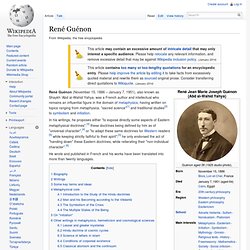
In his writings, he proposes either "to expose directly some aspects of Eastern metaphysical doctrines",[3] these doctrines being defined by him as of "universal character",[4] or "to adapt these same doctrines for Western readers [5] while keeping strictly faithful to their spirit";[3] he only endorsed the act of "handing down" these Eastern doctrines, while reiterating their "non-individual character".[6] He wrote and published in French and his works have been translated into more than twenty languages.
Biography[edit] René Guénon was born in Blois, a city in central France approximately 100 miles (~ 160 km) from Paris. Leonard Cohen - Everybody Knows. Mysterious Answers to Mysterious Questions. A sequence on how to see through the disguises of answers or beliefs or statements, that don't answer or say or mean anything.
Mysterious Answers to Mysterious Questions is probably the most important core sequence in Less Wrong. Posts in the sequence are distributed from 28 Jul 07 to 11 Sep 07. Uncleftish Beholding. Uncleftish Beholding (1989) is a short text written by Poul Anderson. It is written using almost exclusively words of Germanic origin, and was intended to illustrate what the English language might look like if it had not received its considerable number of loanwords from other languages, particularly Latin, Greek and French. The text is about basic atomic theory and relies on a number of word coinings, many of which have analogues in modern German, an important scientific language in its own right. The title "uncleftish beholding" calques "atomic theory".
The text begins: Linguistic relativity. The principle of linguistic relativity holds that the structure of a language affects the ways in which its respective speakers conceptualize their world, i.e. their world view, or otherwise influences their cognitive processes.
Popularly known as the Sapir–Whorf hypothesis, or Whorfianism, the principle is often defined to include two versions: Strong version: that language determines thought and that linguistic categories limit and determine cognitive categoriesWeak version: that linguistic categories and usage influence thought and certain kinds of non-linguistic behaviour. The term "Sapir–Whorf hypothesis" is a misnomer, because Edward Sapir and Benjamin Lee Whorf never co-authored anything, and never stated their ideas in terms of a hypothesis.
E-Prime. Some scholars advocate using E-Prime as a device to clarify thinking and strengthen writing.[1] For example, the sentence "the film was good" could not be expressed under the rules of E-Prime, and the speaker might instead say "I liked the film" or "the film made me laugh".
The E-Prime versions communicate the speaker's experience rather than judgment, making it harder for the writer or reader to confuse opinion with fact. History[edit] D. David Bourland, Jr., who had studied under Alfred Korzybski, came to the idea of E-Prime as an addition to Korzybski's general semantics in late 1940s.[2] Bourland published the concept in a 1965 essay entitled A Linguistic Note: Writing in E-Prime (originally published in the General Semantics Bulletin). The essay quickly generated controversy within the general semantics field, partly because practitioners of general semantics sometimes saw Bourland as attacking the verb 'to be' as such, and not just certain usages.
Help.