
IPCC Working Group I. IPCC climate report: humans 'dominant cause' of warming. 27 September 2013Last updated at 05:12 ET By Matt McGrath Environment correspondent, BBC News, Stockholm Climate change "threatens our planet, our only home", warns Thomas Stocker, IPCC co-chair.
Climate change: how hot will it get in my lifetime? - interactive. Heartland Institute. The Heartland Institute, according to the Institute's web site, is a nonprofit "think tank" that questions the reality and import of climate change, second-hand smoke health hazards, and a host of other issues that might seem to require government regulation.

A July 2011 Nature editorial points out the group's lack of credibility: "Despite criticizing climate scientists for being overconfident about their data, models and theories, the Heartland Institute proclaims a conspicuous confidence in single studies and grand interpretations....makes many bold assertions that are often questionable or misleading.... Many climate sceptics seem to review scientific data and studies not as scientists but as attorneys, magnifying doubts and treating incomplete explanations as falsehoods rather than signs of progress towards the truth. ... The Heartland Institute and its ilk are not trying to build a theory of anything. Evidence is there, so what are we waiting for? Climate change's link to disasters Not all extreme weather events can be attributed to climate change, but many now can, and researchers say the risk of some disasters is growing. 27, 2013 So what now?
IPCC report finds temperatures on track to rise by more than two degrees. Stronger evidence climate change man-made Scientists say it's clear human activities are to blame for the earth's warming in the latest report from the Intergovernmental Panel on Climate Change. 26, 2013 It is more certain than ever that human civilisation is the main cause of global warming, putting the world on track for dangerous temperature rises, the latest major UN assessment of climate change science has found.
The Intergovernmental Panel on Climate Change says it is "extremely likely" that humans are the dominant cause of observed warming since the mid-20th century, with carbon dioxide emissions the main factor. If emissions remain high, by 2100 temperatures are likely to rise by more than 2 degrees - and up to 4.8 degrees - breaching a threshold agreed by governments as limiting the worst impacts of climate change.
Advertisement Heatwaves will be more frequent and last longer, the report found. Glaciers and ice sheets will continue to shrink, and the sea level will rise more quickly. IPCC report: Latest climate change findings. That will just about do it for this evening's blog.
Daily weather is not, of course, anything but a snapshop of the the climate. Still, as noted at the start of this blog, this month will be the hottest September by a long way for Australia. Recent outlooks also point to above-average temperatures and below-average rainfall is likely over coming months for much of the country. The chart below gives a taste of the abnormal conditions of late - with about a third of Queensland reporting exceptional conditions, as did Sydney. Thanks very much for joining us, and keep an eye on our climate change coverage here and our carbon economy reports here. A Bureau of Meteorology report showing maximum temperature anomalies on Thursday. World won't cool without geoengineering, warns report - environment - 25 September 2013.
Global warming is irreversible without massive geoengineering of the atmosphere's chemistry.
This stark warning comes from the draft summary of the latest climate assessment by the Intergovernmental Panel on Climate Change. Delegates from national governments are discussing the draft this week, prior to its release on Friday morning. According to one of its lead authors, and the latest draft seen by New Scientist, the report will say: "CO2-induced warming is projected to remain approximately constant for many centuries following a complete cessation of emission. A large fraction of climate change is thus irreversible on a human timescale, except if net anthropogenic CO2 emissions were strongly negative over a sustained period.
" – The centre-right and climate change. Climate science: Why the world won't listen - opinion - 26 September 2013. Read full article Continue reading page |1|2 When it comes to climate change, facts don't speak for themselves.
Communicators need to find better ways to connect Editorial: "Gun control: We need a new conversation" Climate science: a beginner's guide - 27 September 2013. Read more: "Climate report 2013: Your guide to the big questions" The planet is definitely warming.
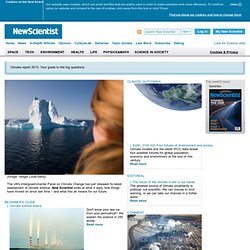
Despite a recent slowing in the pace, the atmosphere is 0.7 °C warmer than in 1950. Climate report 2013: Your guide to the big questions. Cookies on the New Scientist website close Our website uses cookies, which are small text files that are widely used in order to make websites work more effectively.
To continue using our website and consent to the use of cookies, click away from this box or click 'Close' Find out about our cookies and how to change them Log in Your login is case sensitive I have forgotten my password close My New Scientist Look for Science Jobs. IPCC report will make no difference in culture of denial - World Change Cafe. In the world we used to live in, the one in which the ideal of scientific knowledge held true, the report would give a further boost to an already valiant world effort to shift rapidly away from fossil fuels.
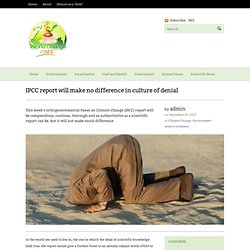
It would give hope that we could head off the catastrophes of a hot planet. But we no longer live in that world (otherwise known as the Enlightenment), the one in which we thought of ourselves as rational creatures who gather evidence, evaluate it, then act to protect our interests. 'Scientists confess'? The attack on the IPCC that went terribly wrong. When an error was found in the IPCC Assessment Report Number 4 - that mountain glaciers were likely to melt by 2035 - climate change deniers obsessed about this for several years, endlessly returning to it as proof that the IPCC was thoroughly flawed in its findings and the science could not be trusted.
Even with all the caution that the IPCC is famous for, it still managed to make a few errors in its almost 3000 page report. The caution also meant that the IPCC report in 2007 would have been loath to predict the unprecedented glacial lake outburst flood in the Himalayas that killed 6000 people in June. The ice around 20,000 large glacial lakes throughout the Himalayas is melting very fast, and when combined with monsoon rains, the ice gives way releasing billions of cubic metres of water - which happened at Kedarnath on June 16 this year.
The IPCC reports are never going to be able to warn people from these individual events, but only provide probabilities of them occurring. Climate report heralds grave fears for state of the planet. Warming trend: the rate of global warming may have been revised but there is no cause for celebration. Photo: AP. What Keeps Climate Scientists Up At Night? Right at the very time when the scientific community is more certain than ever of the causes and risks of climate change, we get a reminder that confusion and denial still hold a good chunk of the population. The latest Intergovernmental Panel on Climate Change (IPCC) report on the state of the science of global warming, to be released later this week, confirms that our planet is warming. The mean global temperature has risen by almost 1°C since pre-industrial times, with increasing temperatures over land and sea.
The evidence is also in the melting glaciers and ice sheets, and retreating sea-ice. The warming cannot be explained by natural causes alone. We already know that carbon pollution is reaching dangerous highs. So these are the findings of science; science which gives us antibiotics and aeroplanes and countless other wonders of modern life. 'Mega-mines' in Queensland's Galilee basin would guzzle water, report says. Nine planned "mega-mines" in the Galilee basin region of Queensland would drain the area of 1,354bn litres of water, equivalent to two-and-a-half times the volume of Sydney harbour, threatening the future of dozens of farming communities, a new report has found.
The study, undertaken by the anti-mining network Lock the Gate and overseen by Tom Crowthers, former general manager of water planning and allocation for the Queensland government, says the mines could cause "unacceptable impacts" on the region's groundwater and surface water resources. Crowthers said communities would be affected "forever" if all the projects were to go ahead. About « Bimblebox Nature Refuge. Galillee Report(4.2MB).pdf. Point_Of_No_Return.pdf. Climate change to have double impact - study - World Change Cafe. Earth; The Pale Blue Dot. Debunking the persistent myth that global warming stopped in 1998.