
CourseKicker. Here’s something you already know: we have an inequality problem in this country.
But while pundits and politicians can argue about the root causes, we also already know the one tried and true way to positively impact inequality across the board. Education is the great equalizer. If we improve how we educate all of our kids, we can change the trajectory of entire communities. We are now in a knowledge economy here in the United States. Penn State Lehigh Valley Writing Project - Google Docs.
Watch What's Working: Carol Dweck Talks Growth Mindset. What about the kids that don't "get" school?

What about the kid who doesn't see the point or the purpose of sitting in a desk and doing assignments that have never motivated her in the past? Or the kid who is always assigned tasks that perpetuate the notion that he is simply "not that smart? " The good news is that these students can be reached by the right kind of mindset by adults at every school. There is a sweet spot in education, where educators provide the optimal environment, support and standards and students find the motivation and purpose to own their education and work hard for success.
This is especially important for disengaged and disadvantaged students. Brainwriting Video. Leigh Thompson shows you how to ensure that all ideas are heard It's a big source of frustration when running an idea-generation session: one or two people who dominate the conversation and shut everyone else down.
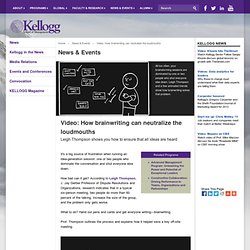
How bad can it get? According to Leigh Thompson, J. Jay Gerber Professor of Dispute Resolutions and Organizations, research indicates that in a typical six-person meeting, two people do more than 60 percent of the talking. Increase the size of the group, and the problem only gets worse. School Supply List: Mindsets Emphasizing Effort, Attitude, and Respect. Steve Wilkinson (“Wilk”) has dedicated his life to teaching – and modeling – the art of focusing on what one can control (such as mindset) as opposed to what one cannot control (such as circumstances).
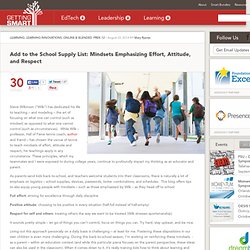
While Wilk – professor, Hall of Fame tennis coach, author and friend – has chosen the venue of tennis to teach mindsets of effort, attitude and respect, his teachings apply in any circumstance. These principles, which my teammates and I were exposed to during college years, continue to profoundly impact my thinking as an educator and parent. As parents send kids back-to-school, and teachers welcome students into their classrooms, there is naturally a lot of emphasis on logistics – school supplies, devices, passwords, locker combinations, and schedules. This blog offers tips to also equip young people with mindsets – such as those emphasized by Wilk – as they head off to school: Full effort: striving for excellence through daily discipline. How a Bigger Purpose Can Motivate Students to Learn. Jane Mount/MindShift A few years ago, psychologist David Yeager and his colleagues noticed something interesting while interviewing high school students in the San Francisco Bay Area about their hopes, dreams and life goals.

It was no surprise that students often said that making money, attaining fame or pursuing a career that they enjoyed were important to them. But many of them also spoke of additionally wanting to make a positive impact on their community or society — such as by becoming a doctor to take care of people, or a pastor who “makes a difference.” What’s more, the teens with these “pro-social” types of goals tended to rate their schoolwork as more personally meaningful. The 18 things that great principals do differently. Education Being the head of a school is about leadership, obviously.
And empowerment, that too. And vision – mustn’t forget that. How to Solve the Teaching Crisis (Or at Least How to Start) When I left my first teaching job, it took me a few years to realize why I felt a weight on my shoulders when I thought about the experience.

I felt a reluctance that I couldn't name, a hesitancy to commit myself as a teacher again. I know all too well the massive commitment that teaching requires- to make a difference, to be competent and beyond competent, requires an emotional resolution, a devotion of time and resources and integrity. 11 Ideas for Better Communication with Parents. Parents and teachers alike want to get the school year off to a good start—and keep it on a good track.
Teachers often have favorite strategies for collaborating with parents, but what do parents want? We asked 11 top parenting bloggers about the best, most effective, fun, and creative ways that teachers can collaborate with parents during the school year. Establish Communication Preferences Early “A successful school year means teachers, parents, and students need to work together as a team. The first meet and greet sets up the tone. How Teachers Can Become Fluent in Classroom Technology. During one of our last leadership team meetings this past school year, we reflected on our use of digital portfolios to house student work.

We had a lot to celebrate: We had found a digital tool to capture student learning, Evernote, a cloud-based note-taking app. No one felt much pressure to be the best at using technology. Parent feedback, although limited in the initial stages of this project, was very positive. Things were looking up going into the fall. But a variety of concerns were also shared. Although there might never be enough time, what could be an underlying concern here? A theory was that technology had not truly become embedded in the day-to-day instruction of some teachers because they had not developed fluency in using it. We had not yet achieved a sense of comfort with the digital devices we had on hand. Personally Connect With Technology Certainly, I am not advocating that educators treat school technology like their own personal property.
Starting Small. Bloom's 'Digital' Taxonomy - Printable Reference Table. 10 Characteristics Of A Highly Effective Learning Environment. 10 Characteristics Of A Highly Effective Learning Environment by Terry Heick For in-person professional development from TeachThought on how to create an effective learning environment in your classroom or school, contact us today.

Wherever we are, we’d all like to think our classrooms are “intellectually active” places. Progressive learning (like our 21st Century Model, for example) environments. Highly effective and conducive to student-centered learning. Teaching Strategies: 9 Telltale Signs of a Good Educator. Back to School: Starting the Year on the Right Foot. Storytelling in the Classroom as a Teaching Strategy.
10 Characteristics Of A Highly Effective Learning Environment. 30 Habits Of Highly Effective Teachers. Editor’s Note: We often look at the qualities and characteristics of good teaching and learning, including the recent following pieces: 26 Questions Every Student Should Be Able To Answer. 26 Questions Every Student Should Be Able To Answer by Terry Heick These questions are more about the student than you, your classroom, or education.
Middle-school transition tough for teens and parents. 26 Questions Every Student Should Be Able To Answer. The Best Advice On Engaging Parents At The Beginning Of The School Year. I have a fairly popular post titled The Best Sources Of Parent Engagement Advice For Teachers. I thought it would be useful to put together a different list focusing specially on advice to teachers on this topic related the beginning of a new school year.
Here’s a short list — each post contains links to additional resources: Writing Letters To Parents At The Start Of The Year “I Want Parents To Know This…” 7 Questions to Ask Parents at the Beginning of the Year is by Elena Aguilar. Additional suggestions are welcome. I’m adding this post to my Collection Of “The Best…” Lists On Parent Engagement. Related. Express 9.22 - Building Relationships That Transform Futures. Our Work Defines Our Legacy. 10 Timely Tips for the First Days of School. 10 Timely Tips for the First Days of School By Harry K. & Rosemary Wong closeAuthor: Harry K. & Rosemary Wong Name: Harry K. & Rosemary WongSite: About: See Authors Posts (7) From the archives… Extracted from the original article.
How well you begin school with an organized, consistent, and well managed classroom will determine your success and your students’ success for the rest of the school year. BEGINNING NEEDS OF STUDENTS. Comment on this article... This entry was posted on Friday, August 1st, 2014 and is filed under *ISSUES, August 2014, Harry Wong, Newsdesk. How a Shoe Can Teach Responsibility.
Internet Catalogue. How 21st Century Learning Fits Into The Common Core. Polv3_3.pdf. Crowdsourcing as a Class with Blogger. Paper Circuitry Illuminates ‘Writing as Making’ 7 Essential Principles of Innovative Learning. Big Ideas Culture Teaching Strategies. How To Help Your Students Embrace Failure through Game-based Learning. Appendix B, What's an Exemplar? - CORElaborate. Chris Gustafson A couple of years into work with the Common Core State Standards, there’s still confusion around the purpose of Appendix B: Text exemplars and Sample Performance Tasks.