
Populuxe. Eisenhower warns us of the military industrial complex. Rachel Maddow - The Daily Show with Jon Stewart - 03/29. Barry Schwartz on our loss of wisdom. Barry Schwartz: Using our practical wisdom. Ngram Viewer. Words exercise. The Cave by Mumford & Sons on Spotify. Siren. Siren or sirens may refer to: Most common uses[edit] Animals[edit] Places[edit] Music[edit] Performers[edit] Albums[edit] Siren Sirens Songs[edit] Other[edit] Film and television[edit] Other media and arts[edit]
Mumford and Sons, "The Cave" Mumford & Sons - The Cave.
The Electric Kool-Aid Acid Test. Plot[edit] Tom Wolfe chronicles the adventures of Ken Kesey and his group of followers.
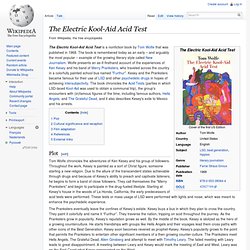
Throughout the work, Kesey is painted as a sort of Christ figure, someone starting a new religion. Due to the allure of the transcendent states achievable through drugs and because of Kesey's ability to preach and captivate listeners, he begins to form a band of close followers. They call themselves the "Merry Pranksters" and begin to participate in the drug-fueled lifestyle. "The Electric Kool-Aid Acid Test" by Tom Wolfe. Lysergic acid diethylamide. Lysergic acid diethylamide, abbreviated LSD or LSD-25, also known as lysergide (INN) and colloquially as acid, is a semisynthetic psychedelic drug of the ergoline family, well known for its psychological effects which can include altered thinking processes, closed- and open-eye visuals, synesthesia, an altered sense of time and spiritual experiences, as well as for its key role in 1960s counterculture.
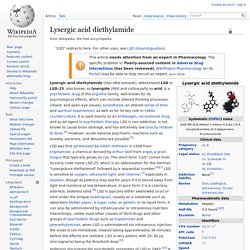
It is used mainly as an entheogen, recreational drug, and as an agent in psychedelic therapy. LSD is non-addictive, is not known to cause brain damage, and has extremely low toxicity relative to dose.[3] However, acute adverse psychiatric reactions such as anxiety, paranoia, and delusions are possible.[4] LSD was first synthesized by Albert Hofmann in 1938 from ergotamine, a chemical derived by Arthur Stoll from ergot, a grain fungus that typically grows on rye. Effects Physical. Mind-altering drugs research call from Prof David Nutt. 23 January 2012Last updated at 21:12 By Pallab Ghosh Science correspondent, BBC News Could mind-altering drugs have a medical role?

Former government drugs adviser Prof David Nutt has said that regulations should be relaxed to enable researchers to experiment on mind-altering drugs. Prof Nutt told BBC News that magic mushrooms, LSD, ecstasy, cannabis and mephedrone all have potential therapeutic applications. However, he said they were not being studied because of the restrictions placed on researching illegal drugs. He said the regulations were "overwhelming". His comments followed the publication of new research by his group in the Proceedings of the National Academy of Sciences, which suggests that the active ingredient in magic mushrooms could be used to treat depression. "I feel quite passionately that these drugs are profound drugs; they change the brain in a way that no other drugs do. The CIA's 5 Most Mind Blowing Experiments With LSD. LSD has long been a staple of overweight, furry men with ponytails who list their occupation as 'Earth Shaman' on tax forms.

The CIA is more typically known for their starched suits than their mind exploring orgies. So if we told you that the CIA was trippin' balls before Hunter S. Thompson even knew that balls existed, you'd probably call us liars. Well, prepare to have your mind, like, blown man. Here are the five strangest things you didn't know about the CIA, and how LSD really came to be. 1950s Housewife in LSD Experiment. Jerry Garcia & Ken Kesey on the Electric Kool-Aid Talk Show.
"What Do You Think of My Buddha?" reading questions. "What Do You Think of My Buddha?" (A) "What Do You Think of My Buddha?" (B) "What Do You Think of My Buddha?" (F) "What Do You Think of My Buddha?" (H) Taoism. Taoist rite at the Qingyanggong (Bronze Ram Temple) in Chengdu, Sichuan.
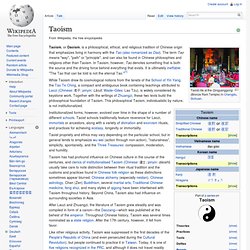
Taoism, or Daoism, is a philosophical, ethical, and religious tradition of Chinese origin that emphasizes living in harmony with the Tao (also romanized as Dao). The term Tao means "way", "path" or "principle", and can also be found in Chinese philosophies and religions other than Taoism. In Taoism, however, Tao denotes something that is both the source and the driving force behind everything that exists. It is ultimately ineffable: "The Tao that can be told is not the eternal Tao. Buddhism. Two major branches of Buddhism are generally recognized: Theravada ("The School of the Elders") and Mahayana ("The Great Vehicle").

Theravada has a widespread following in Sri Lanka and Southeast Asia (Cambodia, Laos, Thailand, Myanmar etc.). Mahayana is found throughout East Asia (China, Korea, Japan, Vietnam, Singapore, Taiwan etc.) and includes the traditions of Pure Land, Zen, Nichiren Buddhism, Tibetan Buddhism, Shingon, and Tiantai (Tendai). In some classifications, Vajrayana—practiced mainly in Tibet and Mongolia, and adjacent parts of China and Russia—is recognized as a third branch, while others classify it as a part of Mahayana. While Buddhism is practiced primarily in Asia, both major branches are now found throughout the world.
Estimates of Buddhists worldwide vary significantly depending on the way Buddhist adherence is defined. Life of the Buddha Relic depicting Gautama leaving home. Ken Kesey. "One Flew Over the Cuckoo's Nest" by Ken Kesey. Hallucinations with Oliver Sacks. Renowned neurologist Oliver Sacks answers your questions about the secret world of hallucinations.
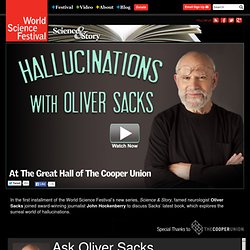
These queries came to us via Twitter, Facebook and e-mail. Q. Are the visual or auditory hallucinations in blind or deaf people analogous to sensations in a phantom limb? A. Not really. 50:00 Neil deGrasse Tyson raises ethical dilemma. The Forgetting Pill Erases Painful Memories Forever. Photo: Dwight Eschliman Jeffrey Mitchell, a volunteer firefighter in the suburbs of Baltimore, came across the accident by chance: A car had smashed into a pickup truck loaded with metal pipes.
Mitchell tried to help, but he saw at once that he was too late. The car had rear-ended the truck at high speed, sending a pipe through the windshield and into the chest of the passenger—a young bride returning home from her wedding. There was blood everywhere, staining her white dress crimson. Mitchell couldn’t get the dead woman out of his mind; the tableau was stuck before his eyes. Pushing to remember a traumatic event soon after it occurs doesn’t unburden us—it reinforces the fear and stress.